
1. The classical incompatibility
In conventional physics, Quantum Mechanics (QM) and General Relativity (GR) are described in fundamentally different languages.
- Quantum Mechanics uses Hilbert spaces, operators, and probability amplitudes defined on a fixed background.
- General Relativity treats gravity as curvature of spacetime itself, with no fixed background metric.
The tension is well known:
- QM assumes a fixed metric in which fields evolve and probabilities are defined.
- GR says the metric is dynamical and responds to energy and momentum.
- Promoting spacetime to a quantum operator produces non-renormalizable divergences.
- Keeping gravity classical while everything else is quantum breaks unitarity and locality.
In short: QM demands a stable background; GR dissolves the very notion of background.
2. UNNS removes the background as a primitive
In the UNNS Substrate, neither spacetime nor Hilbert space is fundamental. The primitive objects are:
- Recursive operators (the UNNS grammar, including Φ–Ψ branching and τ coupling).
- Unbounded nested number sequences that encode discrete recursive dynamics.
- τ-Field structure capturing torsion, flow, and resonance of recursion.
- Spectral geometry emerging from recursion depth and branching structure.
Within this view:
Both QM and GR are projections of the same underlying recursive rules, seen through different coarse-grainings and dominance regimes of Φ and Ψ.
The question is no longer “How do we quantize spacetime?” but “How do Φ and Ψ encode geometry and spectra as different phases of one recursion?”
3. Quantum Mechanics as the Ψ-branch: spectral recursion and coherence
The Ψ-branch of the UNNS grammar governs the spectral and coherent aspect of the substrate:
- linear combinations and interference of recursive paths,
- unitary-like evolution of amplitudes along nested sequences,
- attractor structures that behave like probability distributions,
- discrete minima in recursion that appear as quantized levels.
In this regime:
- Superposition arises as overlapping recursive paths that have not yet decohered into Φ-geometry.
- Quantization corresponds to stable minima of the recursive dynamics.
- Entanglement is an emergent non-local attractor linking multiple branches of recursion.
- Uncertainty reflects a tradeoff between recursion depth and spectral resolution.
QM appears as a high-coherence, low-torsion phase of the substrate where Ψ dominates the Φ–Ψ cycle.
4. General Relativity as the Φ-branch: curvature and metric emergence
The Φ-branch governs the geometric and topological side of recursion:
- formation of large-scale structures in the underlying number sequences,
- accumulation of torsion and curvature as recursion flows,
- emergence of an effective metric from recursive connectivity,
- appearance of causal order from recursion ordering.
In this regime:
- Curvature encodes gradients in recursion density and torsion.
- Mass corresponds to localized defects or concentrations in the recursive flow.
- Geodesics are preferred paths through the recursive structure.
- Spacetime itself is a coarse-grained description of Φ-dominated dynamics.
GR appears as a geometry-dominated, low-coherence phase where Φ suppresses fine-grained Ψ-interference.
5. Φ–Ψ–τ as the compatibility mechanism
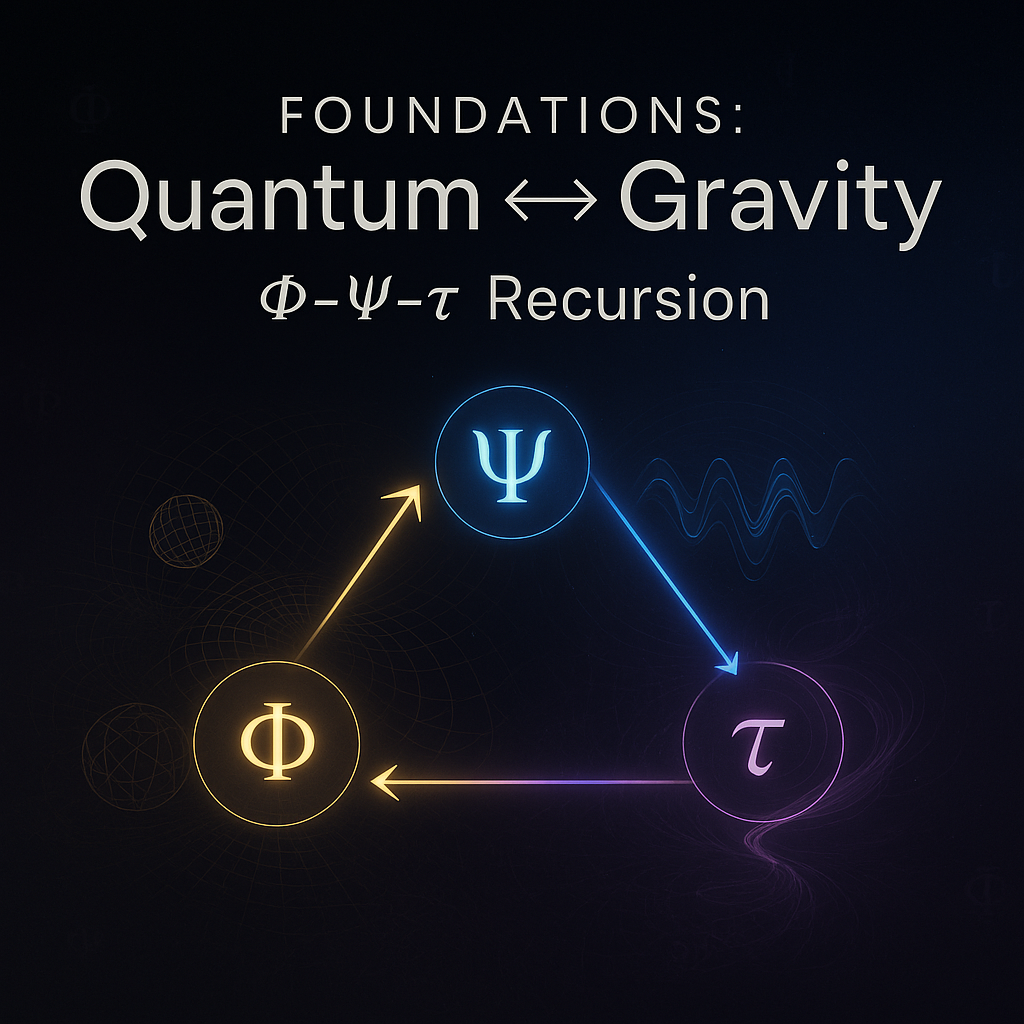
The UNNS Substrate does not pick either geometry or spectra as fundamental. Instead, it provides a Φ–Ψ–τ recursion cycle:
- Φ organizes large-scale topology, curvature, and metric structure.
- Ψ encodes spectral content, coherence, and probabilistic amplitudes.
- τ is the coupling channel that transfers information between Φ and Ψ.
In different regimes:
- Φ-dominated → the effective theory looks like GR.
- Ψ-dominated → the effective theory looks like QM.
- Balanced / critical → both descriptions become simultaneously necessary.
Quantum Mechanics and General Relativity are compatible because they are complementary projections of the same Φ–Ψ–τ recursion. The apparent conflict is a symptom of insisting on a single projection as “fundamental.”
6. τcritical and the crossover between quantum and geometric regimes
In standard approaches, the Planck scale marks the regime where quantum and gravitational effects both matter. In the UNNS Substrate, the corresponding concept is a τ-coherence threshold, which we can denote as τcritical.
Roughly:
- For τ < τcritical, Φ is weak and Ψ-coherence dominates. The world looks quantum and nearly flat.
- For τ > τcritical, Φ dominates, Ψ-coherence is suppressed, and a classical geometry emerges.
At τ ≈ τcritical, neither description alone is sufficient. The full Φ–Ψ–τ cycle must be used, and the usual split into “quantum matter on a classical background” stops making sense.
7. Why infinities and contradictions are avoided
Traditional quantum gravity attempts often assume:
- a continuum spacetime that must be quantized, and
- a fundamental Hilbert space for all fields, including gravity.
The UNNS Substrate takes a different route:
- There is no fundamental continuum to generate ultraviolet infinities. The substrate is discrete and recursive.
- There is no primitive metric to quantize; metrics are emergent summaries of Φ-structure.
- There is no single global wavefunction of spacetime; Ψ-structure is one branch of the recursion.
Instead of trying to quantize geometry itself, UNNS states:
Quantization and curvature both emerge from the same recursive grammar. The question is not “How does gravity become quantum?” but “How do Φ and Ψ co-emerge from τ-driven recursion?”
8. Synthesis
We can now state the central claim succinctly:
Quantum Mechanics and General Relativity become compatible in the UNNS Substrate because both are emergent projections of a single Φ–Ψ–τ recursion cycle. QM corresponds to a high-coherence, Ψ-dominated phase; GR corresponds to a geometry-dominated, Φ-dominated phase; τ controls how amplitudes and geometry exchange information across scales.
From this perspective, “quantum gravity” is not a new field to be invented, but a re-interpretation of QM and GR as different faces of the same recursive substrate. The UNNS viewpoint does not quantize spacetime or classicalize the wavefunction; it de-fundamentalizes both, letting them arise together from a deeper, purely recursive structure.