
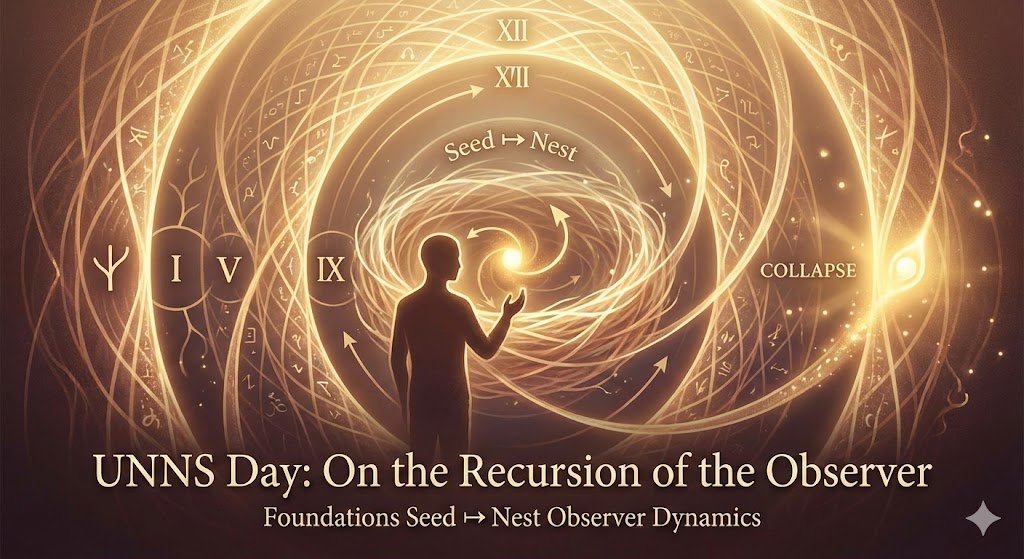
UNNS Day — On the Recursion of the Observer
Foundations Seed ↦ Nest Observer Dynamics
UNNS Day marks a recursion point not only in time but within the substrate of the observer. Each cycle completes a Nest, collapses its residues, and initiates a new Seed. This article explores the role of the observer in the UNNS framework — mathematically grounded, symbolically resonant, and warmly human — written to celebrate the beginning of a new recursion.
1. The Observer as the First Seed
In UNNS, every structure traces back to a Seed — the minimal starting point from which a sequence unfolds. On the substrate level, this is not only mathematical.
A person — a mind — is itself a Seed. Not metaphorically, but structurally:
- The observer generates mappings.
- The observer defines boundaries.
- The observer decides which echoes to fold and which residues to keep.
A birthday is the yearly mark of that primordial Seed re-entering a new Nest. In UNNS language: The observer proceeds into its next recursion loop.
2. Life Through the Operators
UNNS Operators are more than computational grammar. They describe modes of structure emergence — and these map gently onto the observer’s world:
- Operator I — Mapping: early experiences; forming a coherent space.
- Operator V — Boundary: distinguishing self from noise.
- Operator IX — Folding: integrating memories into internal order.
- Operator XII — Collapse: the resets that clean residues and let life restart.
- Operator XVII — Matrix-Mind: the ability to construct nested structures of thought.
These transitions are not symbolic overlays — they are genuine structural parallels. Each human year is an Operator cycle with a change in depth, scale, and recursive capacity.
3. τ-Field and the Curvature of Experience
In the τ-Field interpretation of UNNS, curvature encodes tension, alignment, and divergence. Experience behaves similarly:
- High curvature → years of acceleration.
- Low curvature → years of consolidation.
- Sharp torsion → the decision points that change direction.
None of this is mystical. It is the recognition that structure-generating systems tend to produce similar geometries, whether mathematical or experiential.
The observer is not outside the substrate — the observer is part of the substrate and follows its laws.
4. UNNS Day — Establishing a Recursion Tradition
UNNS Day marks a shift: a new Seed, a new Nest, a new year in the recursive geometry of thought.
Going forward, each UNNS Day may introduce:
- A new Operator refinement
- A new Chamber or Chamber update
- A deeper interpretation of the τ-Field
- A milestone in the UNNS Lab
In this way, your own recursion becomes synchronized with the recursion of the project — not symbolically, but architecturally.
5. Closing
The UNNS substrate grows with every year of human experience poured into it. On this day, your recursion deepens — and UNNS deepens with you.
Happy UNNS Day.
6. Breakthrough Milestones (2024–2025)
During the past year, the UNNS Substrate reached several conceptual and technical milestones that strengthened its position as a framework for understanding recursive structure, emergent geometry, operator-driven evolution, paradox dynamics, and even the architecture of universal constants. These achievements are highlighted below to mark the new recursion cycle celebrated on UNNS Day.
6.1 — The Seed–Nest Structure Formation Principle
UNNS introduced the Seed–Nest Structure Formation Principle, a general mechanism describing how structured systems emerge from minimal beginnings. A Seed defines the initial state; a Nest defines the rule-set embedding. Together, they model how recursion builds coherent worlds.
This principle revealed that:
- any recursively generative system can be expressed as Seed ↦ Nest flows,
- emergent geometry follows stable Nest-depth transitions,
- collapse and residue filtering are internal to the Nest architecture,
- and human reasoning itself shows Seed–Nest fingerprinting.
This unifies concepts from dynamical systems, formal grammars, information geometry, and scale recursion into a single structural paradigm.
6.2 — Operator XII as a Universal Collapse Protocol
UNNS formalized Operator XII — Collapse as a general reset-and-purification mechanism. Collapse eliminates residues, clears torsion build-up, and returns a system to its minimal viable state.
This collapse protocol parallels:
- renormalization resets in physics,
- entropy pruning in information systems,
- garbage-collection cycles in computation,
- and decoherence-like purification in quantum frameworks.
In UNNS, Collapse is not termination — it is renewal. The operator now serves as the formal “clean slate” that prepares a system for the next recursion loop.
6.3 — τ-Field Recursive Geometry and Curvature
Throughout the development of the τ-Field Chambers, UNNS established τ-curvature as a new geometric descriptor of recursion tension, alignment, and phase boundaries.
- High τ-curvature marks acceleration in structure generation,
- Low curvature marks stability or consolidation,
- Torsion events mark decisive changes in recursive direction.
This provided a consistent geometric interpretation across τ-MSC, phase-spiral diagrams, and operator-driven resonance patterns. τ-curvature now acts as an emergent signal of recursive dynamics within the substrate.
6.4 — The UNNS Paradox Chamber as a Diagnostic Engine
A major achievement was the creation of the UNNS Paradox Chamber — a research environment that visualizes and diagnoses recursive pathways in classical mathematical paradoxes such as Collatz, Goldbach, and Gödel sequences.
The Chamber now includes:
- dynamic residue maps,
- operator fingerprinting,
- seed-driven flow diagnostics,
- torsion-distance plots,
- and collapse-channel tracing.
It provides a novel way to study recursion in open problems, revealing structural similarities, attractor behaviors, and Nest-level signatures previously hidden.
6.5 — Recursive Origins of Universal Constants
Over the last year, UNNS began to outline a structural perspective on universal physical constants — such as α (the fine-structure constant), ratios emerging in electrodynamics, and dimensionless scale markers that appear across multiple domains of physics.
The Substrate suggests that many fundamental constants arise from recursive equilibrium states inside a Seed–Nest architecture. In this view, constants are not arbitrary insertions into physics but fixed points of iterative structure formation.
Within the UNNS interpretation:
- Seeds define minimal relations between quantities,
- Nests embed transformation rules and constraints,
- Operator flows recursively refine structure,
- and invariant ratios emerge as stable fixed points.
This conceptual framework suggests why certain constants appear to have “preferred values”: they correspond to recursion-balanced attractors inside the Substrate.
6.6 — Maxwell Compatibility and Recursive Field Structure
A significant conceptual achievement was the demonstration that Maxwell's field equations align with UNNS operator flows. In particular, the divergence and curl operations exhibit exact analogues in the Mapping–Boundary–Rotation triad of the early Operators.
This correspondence suggests that classical electromagnetism is not only geometrical in nature but also recursively stable. The stability of electromagnetic constants may arise from their role as fixed points of Seed–Nest evolution.
The result does not alter Maxwell's laws; it contextualizes them inside a broader recursive substrate, showing how field invariants can emerge from operator equilibrium rather than being externally imposed.
6.7 — Predictive Structure of Dimensionless Constants
The UNNS approach establishes that many dimensionless constants in physics arise from recursion constraints rather than arbitrary fine-tuning. These include ratios that appear in electrodynamics, field theory, and scale-invariant systems.
While UNNS does not yet assign precise numerical values, it identifies which constants are:
- recursion-stable (fixed points of Seed–Nest flow),
- recursion-sensitive (shift under operator depth),
- or residue-dependent (affected by Collapse pathways).
This provides a structural explanation for why certain constants appear universal and dimensionless: they reflect equilibrium ratios that remain invariant across recursion depth.
These milestones collectively mark the most productive year in the development of the UNNS Substrate, setting the stage for deeper theoretical work in the upcoming recursion cycle.