
A Second Coordinate
of Physical Structure
Every system is defined by two independent structural coordinates: what is allowed to exist — and how it is internally organized.
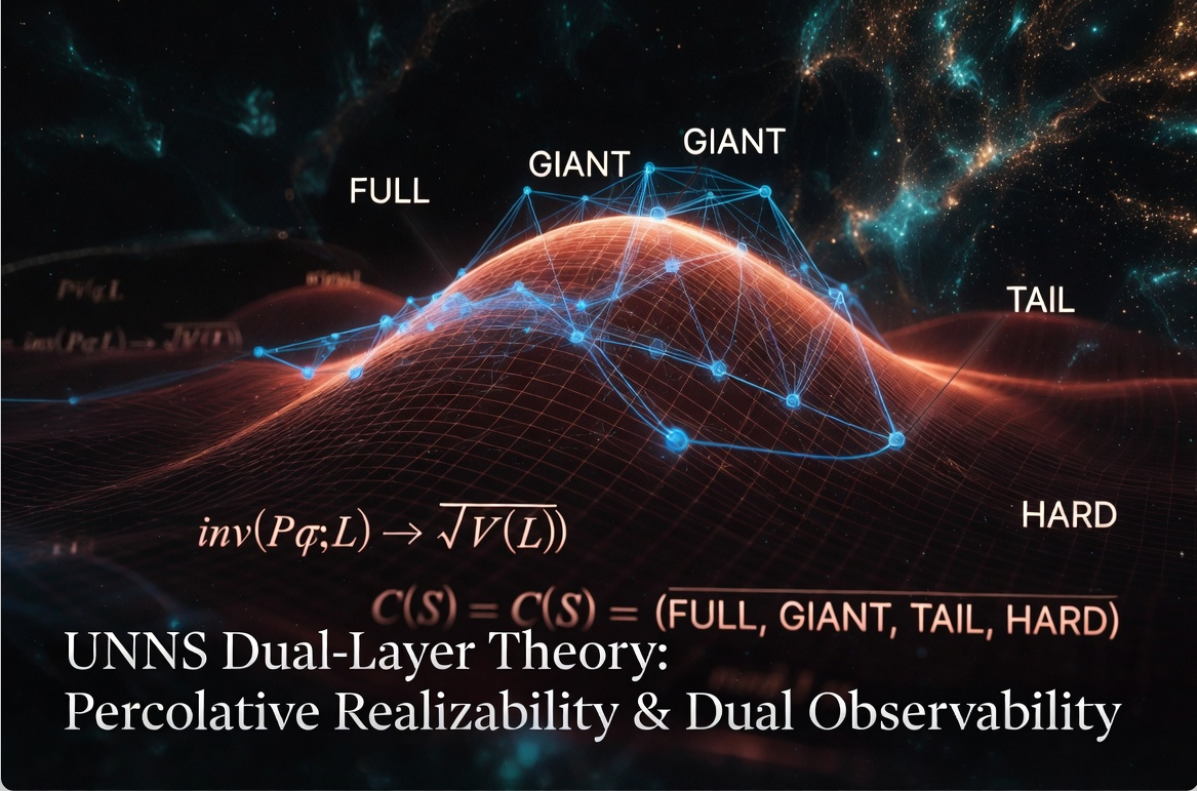
We expected disconnected systems to violate the structural law.
They do not.
The original formulation predicted: if a physical system's internal gap structure fails to connect across measurement scales, it must violate the Universal Structural Law. This seemed reasonable. It was wrong.
Nuclear isotopes ⁴⁸Ca, ¹⁵⁰Nd, ¹⁰⁰Mo, ²³⁸U do not form a connected backbone across scales. Their gap structures contain single transitions with magnitudes 10¹⁸ times larger than the bulk — permanently isolated vertices. Zero admissibility violations. The same pattern appears in molecular ladders and cosmic-web orientation fields.
This single result invalidates the previous equivalence between disconnection and violation. Disconnection and admissibility are not the same thing. They measure different structural properties, require different instruments, and are independent of each other. They are the two coordinates of physical structure.
The most extreme system is also fully connected — at the most extreme delay ever measured.
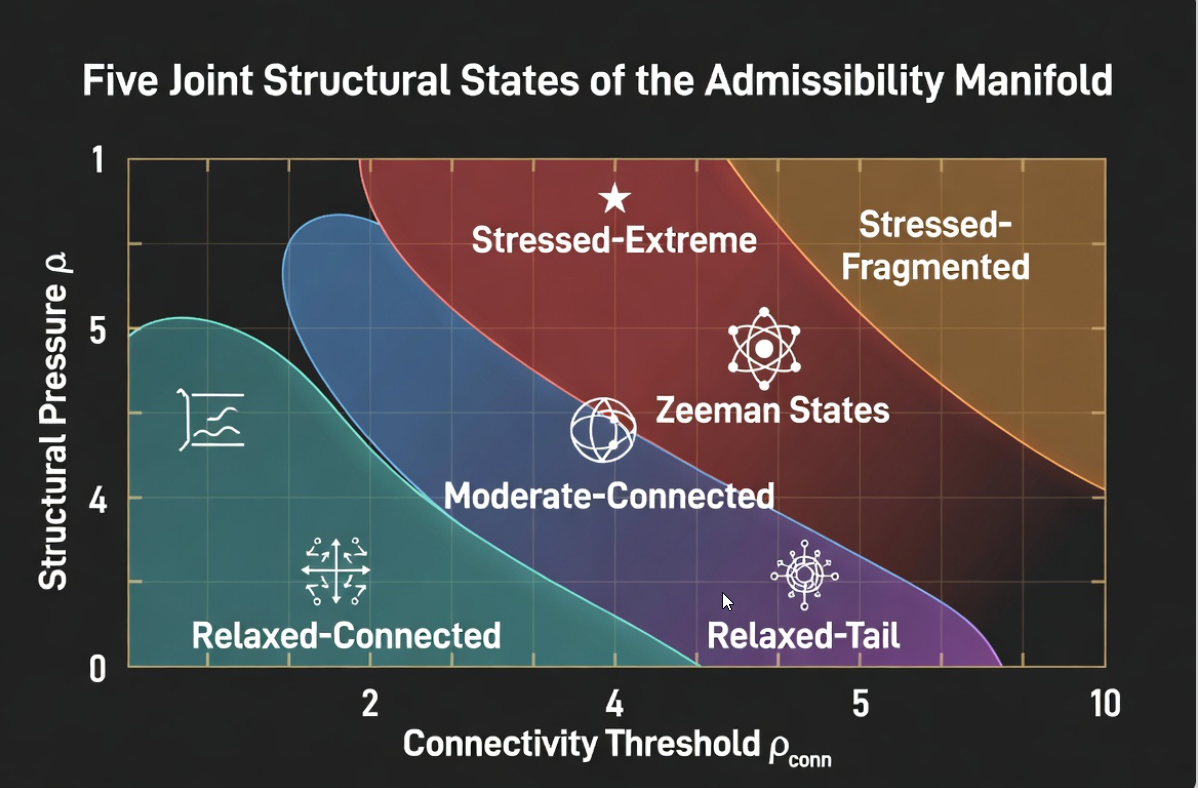
Zeeman-split atomic spectral ladders — measured from hydrogen to gold — reach the highest structural pressure in the entire corpus. They sit 4.15% from hard violation. At exactly the same time, they are fully connected across scales — but at a connectivity threshold orders of magnitude beyond any other domain.
Maximum structural pressure and maximum connectivity delay coexist in the same physical system. No formula from the admissibility instrument predicts the connectivity threshold. No formula from the connectivity instrument predicts the pressure. These are not redundant measurements of the same property. They are two genuinely independent observables. This is the operational proof that the second coordinate exists.
Selection is not Organisation
These are not the same process. Knowing that a system is admissible — knowing its structural pressure ρ̄ — tells you nothing about whether its internal gap architecture connects immediately or only after a delay of five orders of magnitude. A biological ribozyme and a nuclear isotope can have identical admissibility profiles and be separated by a factor of 10⁵ in connectivity threshold. The admissibility manifold ℳ_adm is not one-dimensional. It has internal geometry, visible only through the second instrument.
What this means
Physical systems can be valid but structurally fractured
A system can satisfy the Universal Structural Law globally — admissible in every test — while containing internal gap structure that is permanently disconnected at any measured scale. Global validity and local coherence are not the same thing. The nuclear TAIL isotopes demonstrate this directly.
Stability does not imply coherence
High structural pressure does not predict connectivity regime. A system under extreme structural loading can be fully connected or tail-fragmented. The pressure alone cannot distinguish them. A second measurement is required.
Different domains follow different structural laws — inside the same framework
Biology achieves immediate internal connectivity (κ_conn ≈ 1). Nuclear spectra connect only after extreme delay (κ_conn ~ 10⁵). Both are admissible, both are physical. The connectivity threshold is a domain fingerprint that admissibility cannot detect. The framework spans both — and distinguishes them.
A single number is not enough to describe structure
The two-component structural state (ρ̄, κ_conn) is the minimum description. Neither coordinate determines the other. Neither can be omitted. This is the content of the Dual Observability Theorem.
A new coordinate of physical structure. Not a refinement of existing theory — an extension of the dimensionality of structure itself.
The formal framework: two manuscripts
The theoretical foundations are developed in two companion manuscripts establishing the dual-layer theory: admissibility (USL layer) and realizability (PRP layer) as independent structural coordinates. Together they prove the Dual Observability Theorem, derive the four realizability classes formally, and establish the logical hierarchy USL → Admissibility → Realizability → Dynamics.
Realizability Structure and the Revised Necessary Direction
Defines the vulnerability graph and the four-condition percolation definition. Formally derives the FULL/GIANT/TAIL/HARD partition as an exhaustive, mutually exclusive classification (Appendix A). Retracts the original equivalence — admissibility ⟺ percolation — proved false by TAIL counterexamples. Establishes the surviving theorem: HARD-class fragmentation implies the existence of a deformation producing a USL violation.
Structural Realizability and Dual Observability in the Admissibility Manifold
Proves the Dual Observability Theorem in two steps: logical non-reducibility of the two projections and empirical independence via three counterexample sets from the cross-instrument corpus. Introduces the five-state joint structural taxonomy, the Forbidden State Theorem (high pressure + HARD is empirically excluded), and the Layered Structure Theorem (Appendix B: formal derivation of realizability classes).
What we actually measured
We measure how a system's internal gap structure connects across scales. As the threshold widens, more gaps become structurally coupled. We track whether a dominant connected backbone forms and persists across the full scale range — and at what threshold it does so. Formally, this is the vulnerability graph G_κ(L): vertices are the gaps of the ladder, edges connect gaps within exchange distance ε = κ·median(Δ) at each scale κ.
The horizontal and vertical axes are independent. Neither predicts the other.
Complete Connectivity
All gaps in one backbone at κ_max. Percolating.
Dominant Backbone
≥ 90% span, tiny isolated tail. Formally percolating.
Extreme Outliers — Admissible
Large backbone + one permanently isolated gap (ratio up to 10¹⁸). Non-percolating. Fully admissible.
Severe Fragmentation → Violation
No backbone at any scale. Only class implying a violating deformation exists.
The structural state space
Tested across atoms, nuclei, cosmology, and biology
| Domain | ρ̄ | Realizability | κ_conn | What it demonstrates |
|---|---|---|---|---|
| Zeeman (atomic) | 0.9585 | FULL | 2–4×10⁵ | Max pressure + max delay — orthogonal axes |
| Biology (QT45 ribozyme) | 0.19–0.82 | FULL | 0.42–2.00 | Wide ρ̄ range — immediate connectivity (10⁵× below nuclear) |
| Nuclear FULL (10 isotopes) | 0.197 | FULL | 3.8×10⁴–4.2×10⁵ | Same ρ̄ as TAIL below — different realizability |
| Nuclear TAIL (⁴⁸Ca, ¹⁵⁰Nd…) | 0.197 | TAIL | undefined | Equal admissibility — non-percolating, still admissible |
| Molecular (CO, N₂, HCl) | 0.103 | GIANT | undefined | Lowest ρ̄ — percolating backbone, outlier tail |
| CMB (Planck 2018 TT) | — | FULL | 230–2,389 | Cosmological scale — same structural law applies |
| Atmosphere (ERA5) | 0.09–0.23 | FULL | 0.42–2.00 | Like biology in connectivity — different domain, same result |
The instrument: STRUC-PERC-I v2.4.0
A browser-based computational chamber — no backend, no installation — that measures internal connectivity structure from any ladder dataset and returns the four-tier realizability verdict, connectivity threshold, giant ratio profile, and outlier gap analysis.
Relation to existing frameworks
This work does not replace existing theories. It extends them by introducing a missing structural dimension — a second coordinate that existing frameworks cannot see, because they each operate within a single descriptive axis.
Statistical Physics
Classical percolation theory describes systems in terms of a binary phase transition: connected versus disconnected, subcritical versus supercritical. This framework introduces a fundamentally richer picture. Connectivity is not binary — it is structured across regimes. FULL, GIANT, TAIL, and HARD replace simple thresholds; connectivity becomes scale-dependent and history-dependent; and percolation is no longer just a phase transition but a structural condition interacting with admissibility. Most importantly: non-percolation is not equivalent to failure. TAIL systems are non-percolating and fully admissible. This breaks a deep assumption embedded in classical interpretations.
Network Theory
Standard network theory focuses on local and mesoscopic descriptors — degree distributions, clustering coefficients, shortest paths. This framework operates at a different level: global structural organization across scales. It introduces two new dimensions invisible to standard graph metrics:
Standard network theory
- Degree distributions
- Clustering coefficients
- Shortest paths
- Local or mesoscopic descriptors
- Describes how nodes connect
This framework adds
- Structural pressure (ρ̄) — constraint dimension
- Scale-continuous connectivity (κ_conn) — organizational dimension
- Globally valid but locally isolated structures (TAIL)
- Delayed connectivity regimes and dominant backbone formation
- Describes how structure organizes under constraint
Cosmology
Cosmology traditionally describes large-scale structure geometrically — voids, filaments, clusters — through spatial distribution. This framework introduces a structural-spectral perspective: cosmic structure can be analyzed through the connectivity of gaps, not just spatial position. The cosmic web (DESI, SDSS, 2MRS orientation ladders) returns GIANT and TAIL connectivity profiles, revealing persistent structural isolation and non-trivial connectivity delays across scales that geometry alone does not capture. This suggests that cosmic organization is not purely spatial — it is also structurally hierarchical in gap space. It opens a new way to interpret void boundaries, extreme underdense regions, and large-scale coherence transitions.
Quantum and Atomic Systems
Atomic and quantum systems are usually described through energy levels, transitions, and symmetries. This framework shifts the focus to the structure of gaps between levels — how they are organized in magnitude space, not what their absolute values are. Instead of asking what are the energies? it asks how are the gaps organized? This reveals structural regimes entirely independent of absolute energy scales. The Zeeman case is the sharpest example: maximum structural pressure and maximum connectivity delay coexist in the same spectral system, a finding invisible in any energy-only description.
Beyond existing frameworks
The shared assumption that breaks
All existing frameworks share an implicit assumption: structure can be described within a single descriptive dimension. Statistical physics uses the percolation threshold. Network theory uses graph topology. Cosmology uses spatial geometry. Quantum physics uses the energy spectrum. This work shows that structure requires at least two independent coordinates — one for existence (admissibility) and one for organization (realizability). No existing framework provides both.
A unifying structural layer
This framework does not compete with existing theories. It provides a structural layer beneath them — extending percolation into multi-regime behavior, extending networks into constraint-aware organization, extending cosmology into structural connectivity analysis, and extending quantum descriptions into gap-based organization. Every domain tested confirms the same dual-coordinate structure. The admissibility manifold has internal geometry, and that geometry is the same regardless of what physical medium generates the ladder.
This framework describes the structure of structure itself.
Physical structure is not one-dimensional. It is governed by two independent coordinates — admissibility and realizability — and no measurement of one predicts the other.
Realizability answers how it exists.
⬇ Reproduce the Experiments
All data and instruments used in the corpus analysis are publicly available. The struc_perc_i_v2_4_0 chamber runs entirely in the browser — upload a CSV, press Run, and the full admissibility analysis runs in seconds. The corpus packs below are the exact input files used to produce the published results.
Resources
- Percolative Realizability Principle — Manuscript (PDF) · Revised formulation · formal partition proof · restricted necessary direction
- Structural Realizability and Dual Observability — Manuscript (PDF) · Dual Observability Theorem · Forbidden State · five-state taxonomy
- STRUC-PERC-I v2.4.0 · Percolation Chamber
- STRUC-PERC Corpus Analysis · 81 runs, 14 domains
- Cross-Instrument Corpus Analysis · STRUC-I × STRUC-PERC-I
- Output Data (ZIP) · Complete percolation results
- Data sources: NIST atomic energy levels · Materials Project & AFLOW condensed-matter · EIGEN-6C4 / MRO-MRS / GRAIL gravity harmonics · DESI / SDSS / 2MRS galaxy surveys · NGL tenv3 GNSS crustal displacement · Planck 2018 CMB · NNDC nuclear γ-level data