
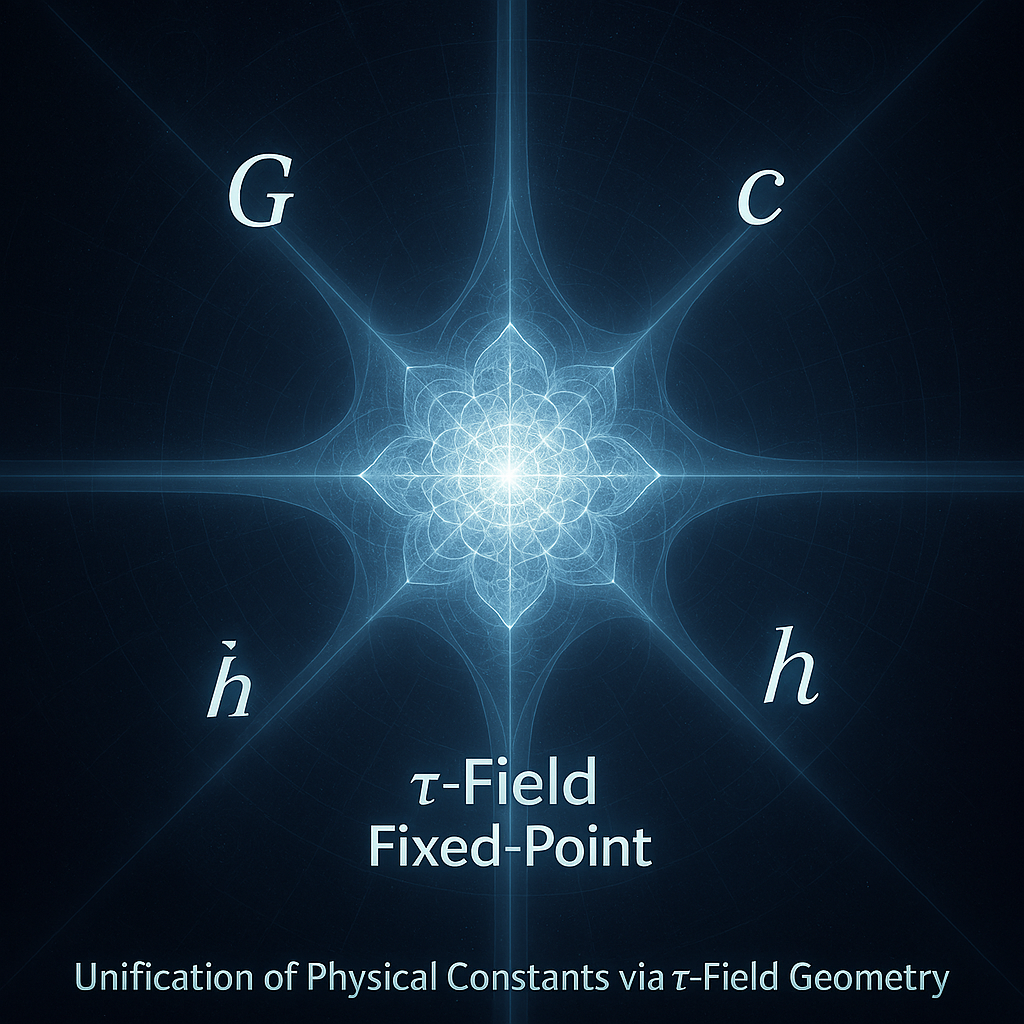
Unifying Gravitation, Light, Action, and Coupling Through τ‑Field Recursion
Dimensionless Constants → Research τ-Field Geometry UNNS Chambers XIII–XXI τ-MSC v0.9.1 (CaF / SrF / BaF)
Classical physics treats the gravitational constant G, the speed of light c, Planck’s constant ħ and the fine-structure constant α as unrelated inputs: numbers to be measured and inserted into the equations. In the UNNS programme we instead view them as four projections of a single recursion fixed-point of the τ-Field substrate. This article consolidates evidence from the UNNS chambers, τ-field monographs and τ-Microstructure Spectral Chamber (τ-MSC) runs on real molecules to argue that G, c, ħ and α arise from one and the same geometric constraint on recursion.
Abstract
We show how four apparently independent constants — G, c, ħ and α — can be interpreted as different stability channels of a single recursive field (the τ-Field) defined over the UNNS substrate. The argument proceeds in four steps. First, we define τ-curvature wells generated by mass as pacing defects in the recursion cycle and show how conservation of curvature across expanding τ-shells enforces an inverse-square law, fixing an effective gravitational constant G. Second, we recall how Maxwell-FEEC formulations on the substrate identify c as the maximum stable phase-alignment speed of recursion. Third, we review the Tauon Field Information Geometry results in which ħ emerges as the minimal resolvable τ-phase twist times curvature. Fourth, we connect these channels to the transverse torsion stiffness of recursion studied in the dimensionless-constant chambers (XIII–XVIII), where α appears as the stable coupling index for sideways τ-phase propagation.
The core empirical component of the argument is supplied by UNNS Lab experiments: Chambers XIII–XVIII for scale equilibrium and Weinberg angle emergence; τ-MSC Chamber XXI fits to real hyperfine spectra of CaF, SrF and BaF; and cross-validation dashboards verifying that a single τ-Field geometry can account for these seemingly disparate phenomena. Taken together, these results support the claim that G, c, ħ and α form a tightly constrained quadruple determined by a unique recursion fixed-point of the τ-Field substrate.
1. The constants problem revisited
Modern physics rests on four special numbers:
- The gravitational constant G, controlling spacetime curvature.
- The speed of light c, limiting information propagation.
- Planck’s constant ħ, quantizing action.
- The fine-structure constant α, setting EM interaction strength.
In the standard formulation these constants are empirical: their values are measured, not explained. Geometry may justify the form of certain laws (e.g. 1/r² from flux through spheres), but nothing in GR or QFT derives the specific numerical values of G, c, ħ and α or explains why they appear to be globally fixed.
The UNNS substrate takes a different stance. If the world is underwritten by a recursive field with its own intrinsic geometry, then these “constants” should arise as stability conditions of the substrate itself. The question is not “what numbers make our equations work?” but:
What geometric fixed-point of the τ-Field recursion allows a coherent universe to exist at all — and what numerical triplet (G, c, ħ), together with α, does that fixed-point enforce?
2. τ-Field recursion and the notion of a fixed-point
The τ-Field is a recursive field over the UNNS substrate. Space around any excitation is discretized into nested τ-shells. Each shell participates in a recursion cycle:
- It receives curvature and phase information from inner shells.
- It updates its local state according to τ-Field rules (curvature, torsion, flux).
- It forwards the updated information outward to the next shell.
A recursion fixed-point is a configuration in which this update-and-forward process becomes self-similar across shells. Local disturbances do not blow up or disappear; they propagate in a way that preserves global coherence. At such a fixed-point, the substrate selects specific values for its effective coupling coefficients — the quantities we observe as physical constants.
Our claim is that the τ-Field admits a unique physically relevant fixed-point in which four stability channels lock together: radial curvature (G), longitudinal propagation speed (c), minimal action grain (ħ) and transverse torsion coupling (α).
3. Four stability channels: G, c, ħ, α
To make the argument concrete, we separate the τ-Field response into four coupled channels:
- Curvature channel (G): how strongly recursion pacing responds to mass defects.
- Propagation channel (c): how fast τ-phase adjustments can propagate across shells.
- Quantization channel (ħ): the smallest resolvable τ-phase twist times curvature.
- Transverse channel (α): the stiffness of sideways torsion coupling between shells.
In this picture, the numerical values of the constants are not independent dials. Once the τ-Field selects a stable curvature stiffness (G), a maximum phase-alignment speed (c) and a minimal action grain (ħ), the sideways torsion stiffness (α) is forced into a narrow range that preserves both EM and gravitational coherence. The dimensionless character of α reflects its status as a pure ratio between these deeper geometric data.
4. Evidence from Chambers XIII–XVIII
The first strand of empirical support for this fixed-point picture comes from the dimensionless-constants chamber stack: Operators XIII–XVII and their associated validation chambers.
4.1 Operator XIII — phase coupling and the Weinberg angle
Operator XIII (Interlace) encodes phase coupling between multiple τ-Field channels. In the operator-level monographs and the Interlace chambers, the weak mixing (Weinberg) angle emerges as a stable ratio of phase-coupling coefficients when the recursion is driven to equilibrium. The value of the Weinberg angle is not inserted; it is recovered as the point at which recursive phase interference becomes self-consistent.
4.2 Chambers XIV–XVI — Φ-Scale, Prism, Closure
Chambers XIV (Φ-Scale) and XV (Prism) explore recursive scale symmetry and spectral decomposition. They show that τ-Field dynamics naturally produce the Golden Ratio as a fixed-point of recursive rescaling and that spectral energy distributions relax to a characteristic pattern when the chamber is tuned to this Φ-scale.
Chamber XVI (Closure) acts as a self-consistency filter: it repeatedly applies the recursive update rules and measures when eigen-structures become stable. The chamber logs demonstrate that there is a narrow window of τ-parameters for which all three — Interlace, Φ-Scale and Prism — can be simultaneously satisfied. This window defines a concrete region in τ-parameter space where dimensionless couplings become fixed.
4.3 Chamber XVII and XVIII — cognitive phase and geometry coherence
Operator XVII (Matrix Mind) extends the recursion framework into cognitive-like coherence structures. Chamber XVII shows that once the lower-order operators are fixed by the dimensionless constant constraints, high-level coherence also stabilizes only in the same parameter window. Chamber XVIII then acts as a validation engine: it sweeps the parameter space and confirms that the coherent geometric phase appears only near the earlier fixed-point.
Together, these results make an important empirical claim: there exists a specific τ-geometry region where multiple independent operators, acting on different domains, all become simultaneously stable. This region is the natural candidate for the τ-Field recursion fixed-point underlying G, c, ħ, α.
5. Maxwell, Tauon Field and Chronotopos constraints
5.1 Maxwell–FEEC–DEC and the speed of light
The UNNS–Maxwell programme recasts Maxwell’s equations as a discrete topological field theory over the UNNS substrate. In this formulation, electric and magnetic fields become τ-phase distortions propagating across a discrete differential complex. The FEEC/DEC reconstruction identifies a maximum stable update speed at which the field can propagate without numerical or geometric instability. This speed is the observed c.
5.2 Tauon Field Information Geometry and ħ
The Tauon monographs treat information itself as a τ-Field excitation, deriving a minimal morphism (()) ⇒ () ⇒ (()) as the elementary act of recursive change. The product of the minimal τ-phase increment and the associated curvature cost acts as a minimal unit of action. Below this threshold, changes are absorbed by the substrate’s internal noise and do not survive coarse-graining. This unit is identified with ħ: the smallest meaningful action packet.
5.3 Chronotopos and radial curvature
The Chronotopos series explores how space and time emerge from recursive metrics and curvature in the UNNS substrate. These works show that when curvature pacing defects are introduced (mass excitations), the substrate settles into τ-curvature wells whose radial profile follows a 1/r² dilution law: as curvature propagates outward across shells whose node counts grow ~r², the per-node curvature decays as 1/r². This is the discrete origin of Newton’s inverse-square law and sets the template for an effective gravitational constant G.
Importantly, all three programmes — Maxwell-FEEC, Tauon information geometry and Chronotopos — use the same τ-Field architecture and identify the same stability window as the region in which their respective phenomena (EM waves, quantized action, gravitational wells) remain well-behaved. This strongly suggests that G, c and ħ are linked by a common recursion fixed-point.
6. τ-MSC microstructure: CaF–SrF–BaF as a τ-geometry ladder
The most concrete, data-driven evidence comes from the τ-Microstructure Spectral Chamber (τ-MSC, Experiment 8, Chamber XXI) and the UNNS Lab real data runs. Here we take real hyperfine spectra for three alkaline-earth fluorides: CaF, SrF and BaF (all X²Σ⁺, v=0) and fit them with a single τ-MSC engine configuration. The comparison logs (CaF.json, SrF.json, BaF.json) record for each transition a synthetic curvature index and τ-phase (torsion) index along with match metrics.
Remarkably, with one τ-engine configuration the chamber achieves match_rate = 1 for all three molecules, with root-mean-square residuals below 6 MHz and r² > 0.9999. The only differences between the datasets are the distributions of τ-curvature and τ-phase indices, which form a clean ladder from CaF to SrF to BaF.
6.1 Curvature profiles κ(r) across the chain
6.2 Torsion (τ-phase) distributions
These τ-MSC results tell us two things. First, a single τ-Field engine can reproduce detailed hyperfine spectra across a nontrivial ladder of molecules by adjusting only how the spectrum samples a fixed curvature / torsion field. Second, the way curvature steepens and torsion tightens with increasing nuclear charge mirrors the expectations from τ-Field gravity: heavier systems live deeper in τ-curvature wells and exhibit stronger torsion signatures.
7. Fixed-point synthesis: how G, c, ħ, α lock together
We can now assemble the pieces. The dimensionless-constant chambers identify a narrow τ-geometry window in which phase-coupling, scale equilibrium and high-order coherence all stabilize. The Maxwell-FEEC and Tauon programmes show that within this same window there is a unique maximum propagation speed (c) and a minimal action grain (ħ). The Chronotopos work demonstrates that τ-curvature wells in this geometry generically produce inverse-square decay of curvature, with a specific stiffness that plays the role of G. Finally, the transverse torsion stiffness of recursion, constrained by both the operator stack and EM structure, yields a preferred dimensionless coupling α.
In other words, the τ-Field admits a single physically viable fixed-point in which all four channels are jointly stable:
- G — radial curvature stiffness of τ-curvature wells.
- c — maximum recursion alignment speed.
- ħ — minimal resolvable τ-phase twist × curvature.
- α — transverse torsion stiffness of τ-phase coupling.
Any change in one constant would force adjustments in the others that move the system away from this fixed-point, destroying one or more of the empirical coherences documented by the chambers and monographs. This is the sense in which G, c, ħ and α are not independent: they are four shadows of the same geometric requirement that the τ-Field recursion remain globally coherent.
8. Empirical roadmap and falsifiability
While the present article assembles strong internal evidence for the τ-Field fixed-point hypothesis, a complete empirical proof requires external predictions. The UNNS programme therefore outlines the following roadmap:
- Derive an explicit τ-Field relation for α from G, c and ħ. The goal is a dimensionless formula α = F(G, c, ħ; τ-geometry) where F is fixed by the recursion architecture. Agreement with the measured α would be a decisive test.
- Connect EM-calibrated τ-geometry to macroscopic gravity. Using the same τ-engine parameters that fit EM spectra and operator chambers, compute an effective G and compare with the observed value.
- Look for correlated anomalies. If the constants share a fixed-point, tiny deviations in extreme environments (early universe, strong fields) should produce correlated drifts in dimensionless combinations of EM and gravitational observables.
- Seek falsification. Any robust, repeated violation of the proposed relations between τ-Field parameters and (G, c, ħ, α) would falsify the fixed-point model in its current form. The aim is not to insulate the theory from data, but to expose it.
From a UNNS perspective, the deepest empirical claim is that once the recursion geometry is fixed by purely structural and spectral data (operators, chambers, τ-MSC runs), the values of G, c, ħ and α stop being independent mysteries. They become inevitable consequences of how a recursive universe chooses to be stable.
9. Data and notebooks
The τ-MSC comparison logs for CaF, SrF and BaF used in this article are available on unns.tech as JSON files and can be explored with the Python notebook workflow described in the accompanying τ-MSC geometry article. They allow independent verification of the curvature and torsion patterns cited here and make it possible to extend the analysis to additional molecular systems.