UNNS Substrate Research Program · Foundation Document · 2026
Universal Admissibility: The Structural Law Beneath Physical Reality
A Cross-Domain Synthesis of Persistence, Boundary Behavior,
Operator-Selective Response, and the Geometry of Structural Admissibility
Instrument: STRUC-I v1.0.4
Corpus: >1,500 ladders · >150,000 assessments
Constants: α · μ · αₛ · αG
Domains: 10 physical + biological
Protocol: Falsification-first · Preregistered
There exists a universal structural law that decides which ordered relational configurations
can persist as stable observables — and it sits logically prior to dynamics,
symmetry, or chance. This is the central claim of the UNNS Substrate programme, now fully
formalised in a 62-page foundation document.
Fig. 1 · Foundation document cover · UNNS Substrate Research Program · 2026
Foundation Document · Full Text
Foundations of the UNNS Substrate:
From Universal Admissibility to Structural Regime Theory
62 pages · Intermediate Stage · 2026 · UNNS Substrate Research Program
Quantum mechanics tells you how a hydrogen atom's electrons evolve. General Relativity tells
you how spacetime curves around a planet. Thermodynamics tells you which equilibria a system
settles into. What none of them tell you — what they all silently assume — is that the
systems they describe already exist as stable, ordered relational configurations.
The UNNS programme asks the question those theories skip: which ordered configurations
can persist as stable structures in the first place? The answer is formalised in a
single structural inequality, the Universal Structural Law (USL), and the
geometric framework it generates: the admissibility manifold
𝓜adm.
Central Thesis
The Universal Structural Law is not a dynamical law, a conservation law, or a symmetry
principle. It is a structural selection law — a constraint on which
relational configurations can persist as stable physical structures, operating at the
pre-dynamical layer that precedes and conditions all dynamical, geometric, and
thermodynamic descriptions.
The Universal Structural Law: One Inequality, Eleven Domains
Physical systems of all kinds produce ladders: ordered sequences of ranked
observable values — energy levels, spectral gaps, harmonic coefficients, fitness landscape
steps. The USL is an inequality on any such ladder:
inv(Pε ; L) ≤ ν(Vε(L))
Here, inv(Pε; L) counts the invariant persistent structure of ladder
L at threshold scale ε, and ν(Vε(L)) is the total
variation capacity at that scale. The admissibility score at scale κ is:
Aκ(L, c) = inv(Pε ; L) / ν(Vε(L)) ≤ 1
The mean structural pressure across a 17-point κ-grid:
ρ̄(L) = (1/|K|) Σκ∈K Aκ(L)
This inequality is not a tautology. Adversarial synthetic ladders violate
it systematically — which is precisely what confirms it is non-trivial. In the physical
corpus of over 1,500 ladders and 150,000 assessments, not a single persistent physical
system at physical parameter values has produced a violation. The range of structural
pressure across the corpus spans 43-fold — from ρ̄ ≈ 0.018 (N₂/HCl molecular) to ρ̄ ≈ 0.773
(⁴⁸Ca nuclear under αₛ). This is not uniform sampling of the admissible space. It is a
structured distribution.
The USL inequality: persistent structure cannot exceed variation capacity.
Violations define the non-physical exterior.
The Selection Operator: Formalising the Rupture
The framework introduces the Selection OperatorΣ : S → {0, 1}, the first formal object that unifies the empirical
admissibility result with the operator framework:
    Σ(S) = 1   if Aκ(S, c) ≤ 1  ∀κ, ∀c

    Σ(S) = 0   otherwise
The admissibility manifold is then directly induced as the pre-image of 1:
𝓜adm := Σ-1(1) = Sadm
Σ is derived, not postulated. It is the composition of the operator
family {Oκ} over the tested deformation domain C. Selection is the observable
action of the operator structure — not a separate metaphysical principle imposed on the
data.
The Rupture is the statement that, within the observed corpus, Σ(S) = 1
exactly coincides with physical persistence. This is not a coincidence to be explained
away — it is the minimal consistent closure of three independently established facts:
universal boundedness, absence of persistent violators, and structured boundary proximity.
The Rupture · §5.10
The distinction between Σ(S) = 1 and Σ(S) = 0 coincides, within the observed corpus,
with the distinction between physically persistent and non-persistent configurations.
Within the corpus, physical structure corresponds to operator-admissible relational
structure. The USL defines the condition under which structures appear as stable
observables.
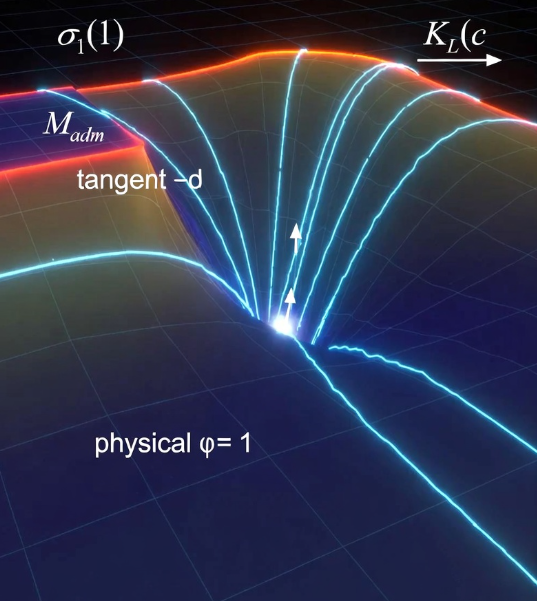
Figure 2 — Operator trajectories in the admissibility manifold ℳadm. Flat (metric) and curved (structural) directions are shown under operator deformation. The boundary Aκ = 1 defines the admissibility limit; the physical configuration corresponds to α = 1.
The Geometry of Admissibility
𝓜adm is not just a set — it is a structured geometric object. The
framework equips it with coordinates, trajectories, and curvature, turning a binary
admissibility verdict into an operational geometry of physical structure.
Coordinates
Every point in the manifold carries two primary coordinates: structural pressure
ρ̄ (how close a system is to the admissibility ceiling) and the constraint margin
Aκmin (how far the worst scale is from violation). Together with
the TYPE classification, these form an operational coordinate chart on the physically
sampled region of 𝓜adm.
Trajectories
Each operator sweep γ ↦ (L(γ), γ) defines a trajectory through the manifold.
Three trajectory classes emerge from the corpus:
Three trajectory classes in 𝓜adm:
flat (metric), extremising (structural anchor), and narrow channel (boundary-adjacent).
Curvature
The directional curvature KL(c) = d²ρ̄/dγ²|γ=1 encodes the
structural constraint imposed by the USL in each operator direction:
FLAT DIRECTION
KL ≈ 0
No USL constraint active in this direction. Operator is metrically neutral — changes
values without changing admissibility geometry. E.g. αₛ, αG in all tested domains.
CURVED DIRECTION
KL ≠ 0, d ρ̄/dγ = 0
USL constraint is active. Physical point is a structural extremum. E.g. H₂ under μ
(global ρ̄ maximum at β = 1.00); CMB TT under α (local ρ̄ minimum).
CHANNEL CLASS
Aκmin drops sharply near γ = 1
USL boundary is locally binding. Physical point is uniquely protected. HD under μ:
hard violation at β = 0.996, four parts per thousand from physical value.
The Structural Regime Map: Physical Systems Have an Address
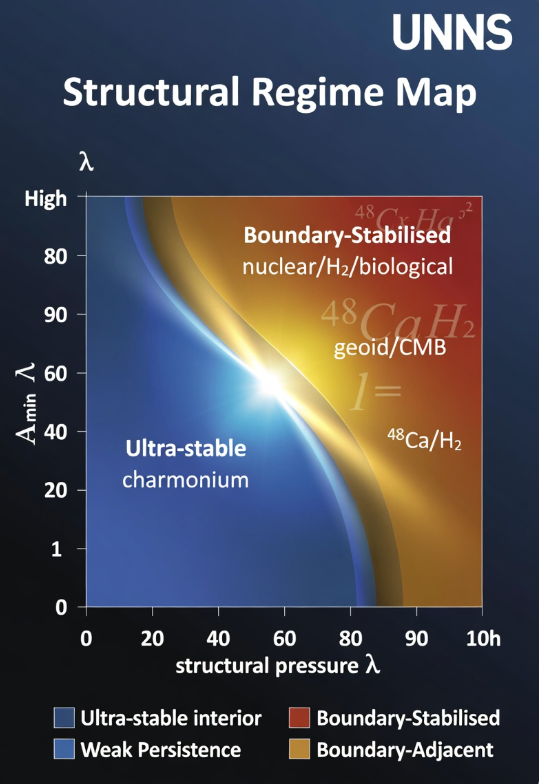
Physical systems do not uniformly fill 𝓜adm. They cluster in four
identifiable regimes that reflect deep physical properties — force-law character, mass
distribution, shell structure. The regime map is the UNNS coordinate system over physical
structure, operational and reproducible.
Fig. 3 · UNNS Structural Regime Map · ρ̄ (structural pressure) vs Amin · four characteristic regimes
Regime
ρ̄ Range
Aκmin
Exemplars
Physical character
Ultra-stable interior
< 0.05
≈ 1.000
Charmonium · N₂/HCl
Over-constrained by force law; insensitive to any operator
Weak Persistence
0.35 – 0.55
≥ 0.998
Geoid · CO · CMB · Cosmic Web
Balanced structure; weak operator sensitivity
Boundary-Stabilised
0.55 – 0.80
0.97 – 1.00
Nuclear · H₂ · condensed matter · biological
High structural loading; selective operator activation
Boundary-Adjacent
> 0.65, structured
< 0.98
H₂ (TYPE III-Max) · ⁴⁸Ca (TYPE III-Fr)
Maximal structural information; constants at extrema
The 43-fold range in ρ̄ (from charmonium at 0.024 to ⁴⁸Ca at 0.773) is not noise. Domain
family predicts regime position with high reliability, because the physical mechanism
determining structural redundancy — force law, reduced mass, shell closure — maps
directly to the admissibility landscape.
The Phase Interface: Where Physics Becomes Most Legible
The admissibility boundary ∂𝓜adm is not a hard wall — it is a
structural phase interface. Systems do not avoid the boundary because
they are constrained away from it; they cluster near it because their physical structure
loads them toward it.
Three independent evidence lines establish this:
Repeated approach without crossing. H₂:
Aκmin = 0.978; ⁴⁸Ca under α: 0.9990; ¹⁵⁰Nd under αₛ: 0.9945.
All approach closely; none cross at physical parameter values.
Structural activation near the boundary.
H₂ under μ: ρ̄(β) peaks sharply at β = 1.00 — maximally loaded at the physical value.
This is what a phase interface predicts; a hard wall predicts uniform avoidance.
The HD adjacent-violation pattern. HD at β = 1.00
has Aκmin = 0.706. At β = 0.996 — four parts per thousand from
physical — hard violation appears (Aκmin = 0.517). The physical
mass ratio is the uniquely protected point in a narrow admissible channel.
Boundary-adjacent systems are not almost-broken. They are the most informationally rich
members of the corpus — the natural observatories of structural geometry.
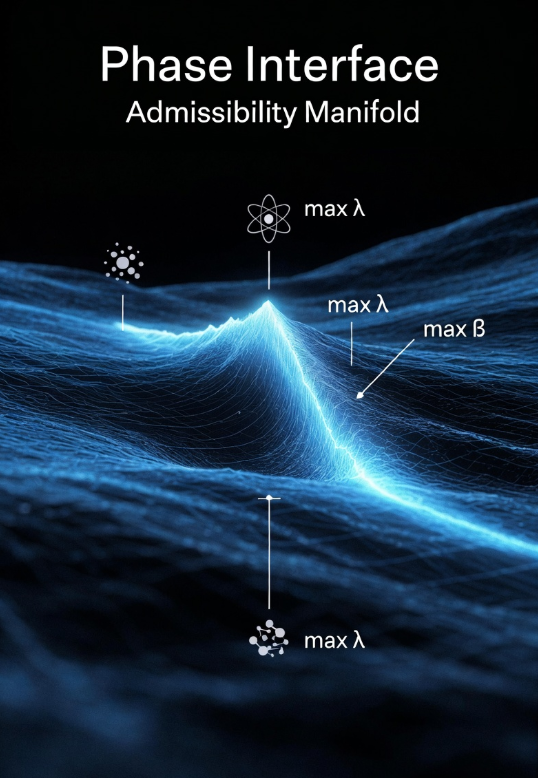
Fig. 4 · Phase Interface · Admissibility Manifold
max λ structural pressure peaks at physical parameter values
Operator Anisotropy: Physical Reality Is Structurally Selective
The four-column programme tests four fundamental constant deformations as operator
directions. The result is striking: physical systems respond anisotropically. Most operator
directions are metrically flat; only selected directions generate genuine
structural reorganisation.
Four-Column Alignment Matrix (qualitative). Active columns identify structural
directions; null columns map metrically flat directions in operator space.
The null results for αₛ and αG are not failures — they are positive measurements
of flat directions. ⁴⁸Ca under αₛ is completely inert (TYPE I calm) despite being
TYPE III-Fr under α. The same gap geometry, two completely different structural responses:
the excursion character of ⁴⁸Ca is α-specific, not intrinsic to its spectral structure.
This is operator anisotropy made concrete.
The structural sensitivity matrix Σ across all 10 domains and 4 operators has observed
rank ≤ 2. Only two independent directions in constant space generate genuine structural
reorganisation. The space of ways to approach the admissibility boundary is
low-dimensional.
The Constant-Anchoring Hypothesis: Constants as Fixed Points
The deepest pattern visible from the combined four-column corpus is one that was not
predicted before the data were collected: in every domain where a constant is structurally
active, the physical value of that constant coincides with a structural extremum
of the admissibility geometry.
INSTANCE 1 · TIER A
H₂ under μ
ρ̄(β) has its global maximum at β = 1.00 (the physical mass ratio). Confirmed by
both 17-point and fine-grid sweeps independently. The physical constant sits at the
apex of the structural pressure curve.
INSTANCE 2 · TIER A PROVISIONAL
HD under μ
Aκmin(β) has a local maximum at β = 1.00. Hard violations
at β = 0.996 and β = 1.001–1.002. The physical value is the uniquely protected
point in the admissible channel.
INSTANCE 3 · PROXY-GRADE
CMB TT under α
Local ρ̄ minimum at α = αphys in the Planck 2018 TT power spectrum
sweep. Proxy-grade; weak extremum consistent with anchoring pattern.
If the constant-anchoring hypothesis is confirmed across additional operator-domain pairings,
the implications extend beyond regime theory: physical constants would be characterised not
only as parameters of dynamical laws, but as structural fixed points of the
admissibility geometry in the domains where they are active.
Substrate-Independence: The Framework Escapes Physics
The ribozyme fitness ladders — RNA enzyme activity sequences ordered by structural
modification — satisfy the USL in the Boundary-Stabilised to Weak-Persistence transition
zone, at structural pressures comparable to mid-range physical systems. This is the
strongest result for the scope of the framework.
Substrate-Independence · §12
The UNNS framework does not describe what physical systems do.
It describes which systems can exist as objects that can evolve.
Physics is one domain in which this condition is satisfied.
Biology is another. The framework is not physics.
It is a structural science that includes physics as a special case.
The constraint operates across scales from 10⁻¹⁵ m (hadronic) to 10²⁶ m (cosmological),
and across material substrates from quarks to RNA polymers, without modification. The USL
is not tied to any particular ontological category — it is tied to relational organisation
as such.
The Formal Backbone: Theorems and Propositions
The foundation document formalises the framework through a complete theorem chain across
three structural objects. The document contains 21 theorems, 20 propositions, 20
definitions, and 3 conjectures — all corpus-relative and falsifiable.
Theorem — Minimal Consistent Closure
Sadm = min⊆{X ⊆ S | Spers ⊆ X and X ∩ Sviol = ∅}
The admissible set is the minimum under set inclusion among all subsets containing the
persistent configurations and excluding all violating ones. The Selection Principle is
not chosen — it is the smallest choice compatible with the data.
Theorem — Structural Invariance Across Domains
Aκ(S, c) ≤ 1 across all tested domains and operators
Since no shared dynamical description exists across atomic, nuclear, gravitational,
cosmological, and biological systems, and yet the same inequality holds in all of them,
the constraint must reflect a structural invariant that precedes the domain-specific
dynamical description.
Theorem — Boundary Amplification
limS→∂Madm |∂Aκ(S,c)/∂c| = max
Structural response gradients are maximised in the vicinity of the admissibility
boundary. Interior systems (charmonium, N₂/HCl) exhibit near-zero gradients across
all operators. Boundary-adjacent systems (H₂, HD) exhibit gradients orders of magnitude
larger. Boundary position is information-rich, not failure-proximate.
Open Predictions
A framework earns its name by making specific, falsifiable predictions that go beyond
what prompted it. The UNNS foundation document states seven:
Boundary-first observability
New constant columns should be tested first against boundary-adjacent systems (H₂,
H₂-like molecules, nuclear boundary-stabilised isotopes) — not interior systems like
N₂ or charmonium. Structural activation will appear there first.
Anchor coincidence for active constants
Any newly discovered structurally active constant will have its physical value at a
structural extremum of ρ̄(γ) or Aκmin(γ) in the domain where
it is active. A falsifying case: active column, physical value at an arbitrary
interior point.
Extended αG sweep
A sweep to γ ∈ [0.20, 0.80] will reveal Earth's structural extremum at γ* ≈ 0.71
(below the current sweep floor). If genuinely null, the curve stays flat.
Two unambiguous, mutually exclusive outcomes.
Bottomonium resolves αₛ
Υ family (n ≈ 15 levels) will return TYPE I under αₛ, confirming the null column at
higher hadronic resolution. Structural activation there would be the programme's
strongest surprise.
Physical falsification requires boundary engineering
If clean physical falsification of the USL is possible, it will require a
boundary-adjacent system, an active operator, and additional structural constraints
(engineered degeneracy, tuned lattice spacing). Random interior systems will not
produce it.
New operators appear in high-pressure domains first
Any future structurally active operator will show its clearest signal in high-ρ̄
domains before becoming detectable (if at all) in interior domains.
Rank of structural sensitivity matrix
A fifth constant column will either confirm rank ≤ 2 (null) or raise it to 3 (new
basis vector). The probability of activation is higher in boundary-adjacent domains.
The Central Discovery
"Physical systems populate a stratified admissibility landscape.
The landscape has structure: pressure, boundary proximity, operator-selective response.
The central object is not an inequality. It is a geometry."
— Foundations of the UNNS Substrate, §19 Conclusion
Read the Full Foundation Document
Foundations of the UNNS Substrate:
From Universal Admissibility to Structural Regime Theory