
Beyond the Rotation Curve
A Structural Atlas of Galaxies
What the Manuscript Reveals
A rotation curve is usually read as a single verdict: does a galaxy's observed motion match its visible mass, or not? This manuscript asks a different question. It sorts, canonicalizes, and interrogates each galaxy's complete baryonic-acceleration ladder across scale, and finds something the rotation curve alone never shows — a reproducible, multichannel, hierarchical structural identity.
Across 121 resolved SPARC galaxies, that identity separates a dominant Stable Structure basin from a sharply displaced Weak Persistence regime, resolves the Stable basin into five internal admissibility families, and shows that a galaxy's structural persistence, its gap-similarity fragmentation, and its connectivity reach are three distinct, dissociable properties — not one property viewed three ways. A companion transfer test then draws a firm boundary: this rich structural layer does not yet improve local, radius-matched dynamical prediction beyond the baseline Radial Acceleration Relation. The atlas is real. The transfer architecture that would exploit it is still to be found.
🌀 From Rotation Curve to Structural Fingerprint
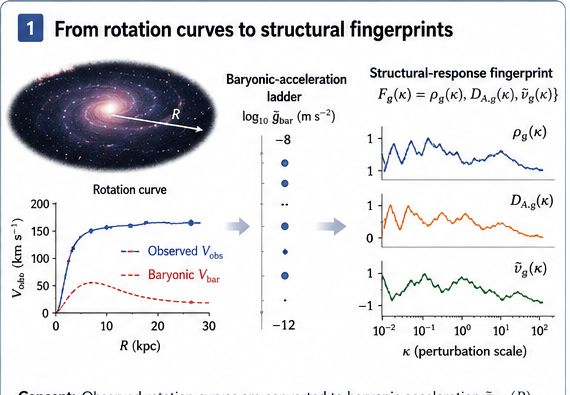
The manuscript does more than introduce another way of plotting galaxy data. It establishes a new scientific object: the multiscale structural fingerprint of a galaxy's canonicalized baryonic-acceleration ladder.
For each galaxy, the sampled values of gbar(R) are sorted, deduplicated, and interrogated across the chamber scale κ. The result is not a single statistic but a three-channel response morphology.
A three-channel response in which ρ(κ) tracks multiscale structural response, DA(κ) records admissibility deficit, and ν̃(κ) records normalized inversion vulnerability. Together, the three curves describe how the ladder responds as the chamber scale κ changes. The collection of these fingerprints across 121 SPARC galaxies forms a structural atlas.
The central achievement of the manuscript can be stated plainly:
The Central Achievement
Galaxy baryonic-acceleration ladders possess reproducible, organized, multichannel structural identities. That conclusion is supported by reproducibility, atlas geometry, physical alignment, and cross-chamber phenotype agreement — and is then subjected to an independent dynamical-transfer test.
🔁 A Genuine Structural Identity Coordinate
The strongest foundational result is the unchanged-preparation reproducibility test. Across five independent STRUC-I executions of the same 121-galaxy corpus, each galaxy returns to its own structural-response location and preserves its local neighbourhood in the atlas — not an unstable numerical artifact, but a stable coordinate.
Why This Matters
Each galaxy's own repeated response lies far closer than the nearest incorrect galaxy's response. The fingerprint behaves as a genuine structural identity coordinate under fixed observation and preparation — the precondition for everything that follows.
🧭 An Organized Atlas, Not an Unstructured Cloud
The fingerprints do not scatter randomly. The three response channels have markedly different internal geometries — a division of structural labour between a compressible, low-dimensional signal and a richer, more heterogeneous one.
The atlas is therefore multichannel in a substantive sense: the channels are not interchangeable measurements of one underlying scalar. They expose different dimensions of galaxy structure.
⚖️ Two Regimes: Stable Structure and Weak Persistence
The 121-galaxy sample separates into 110 Stable Structure galaxies and 11 Weak Persistence galaxies. This is not a soft or arbitrary label — the Weak Persistence population is strongly displaced in response space.
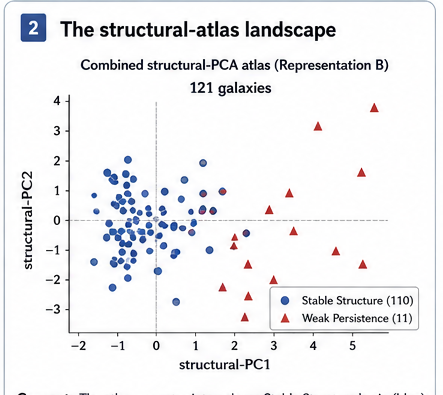
The eleven validated Weak Persistence members: ESO563-G021, F574-1, IC2574, NGC1003, NGC2998, NGC3198, NGC3972, NGC5985, NGC7793, UGC02487, and UGC11820.
The Atlas's First Large-Scale Division
A dominant stable basin and a clearly displaced weak-persistence direction — the first large-scale structural division in the atlas, and the foundation on which the finer admissibility taxonomy below is built.
🧬 Five Admissibility Families Inside Stable Structure
The Stable Structure population is itself not uniform. Using Ward clustering, Gaussian-mixture modelling, HDBSCAN, bootstrap subsampling, and consensus co-assignment, the analysis resolves a five-family admissibility structure within the 110 Stable Structure galaxies.
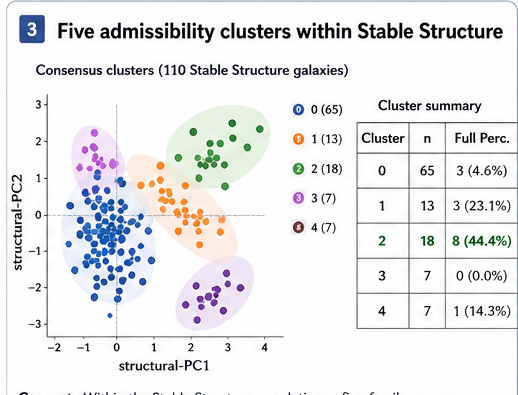
| Family | Members | Full Percolation | Character |
|---|---|---|---|
| Cluster 0 | 65 | 4.6% | Bright, high-Vflat, high-surface-brightness core |
| Cluster 1 | 13 | 23.1% | Late-type, low-luminosity, low-surface-brightness family |
| Cluster 2 | 18 | 44.4% | Intermediate physical scale; strongly enriched in Full Percolation |
| Cluster 3 | 7 | 0.0% | Small family; uniformly Hard Fragmentation |
| Cluster 4 | 7 | 14.3% | Most ρ-PC1-displaced Stable Structure family |
Internal co-assignment coherence is strong, ranging from 0.819 to 0.967, while between-family co-assignment stays low; the clustering also survives resampling with moderate-to-good agreement. More importantly, the families differ in properties that were never used to construct them: Hubble type, flat rotation velocity, 3.6 μm luminosity, effective surface brightness, H I mass, ladder-gap geometry, and STRUC-PERC-I connectivity behaviour.
🔗 Persistence, Fragmentation, and Connectivity Are Different
This may be the manuscript's deepest conceptual result. Across the sample, 110 galaxies show Stable Structure, 103 show Hard Fragmentation, 94 are simultaneously Stable Structure and Hard Fragmentation, and only 17 reach Full Percolation — all 17 requiring an adaptive extension beyond the native κ range.
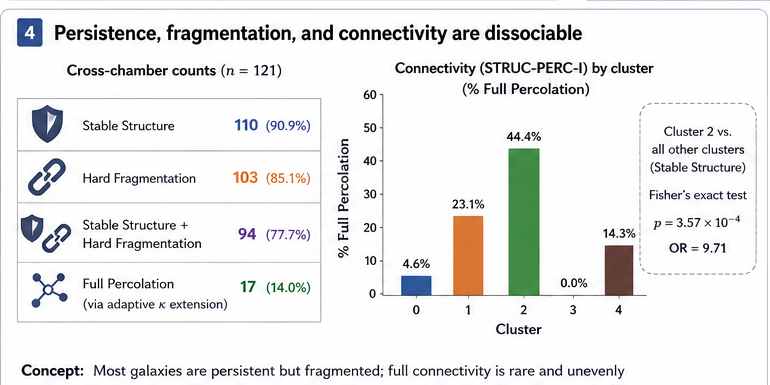
where Pg is persistence, Φg is fragmentation behaviour, and Cg is connectivity reach. A structure can be persistent without being connected. Fragmentation does not imply structural failure. A galaxy ladder may preserve a stable multiscale response while remaining fragmented in its gap-similarity graph — requiring a larger connectivity scale to percolate, yet retaining strong admissibility persistence throughout the native chamber interval.
A Cross-Chamber Phenotype
The five admissibility families were derived entirely from STRUC-I response geometry — yet one family is independently distinguished by STRUC-PERC-I connectivity. Cluster 2 contains 8/18 = 44.4% Full Percolation galaxies, compared with 7/92 = 7.6% across the remaining Stable Structure families.
Two Independent Chambers, One Subgroup
The admissibility families are not only geometrical partitions of one PCA plot. At least one family possesses a distinct cross-chamber connectivity phenotype — STRUC-I structure geometry and STRUC-PERC-I connectivity, measured independently, converge on the same galaxies.
🧩 Physical Organization Without Reducing to Classification
Structural-PC2 correlates with effective surface brightness, 3.6 μm luminosity, flat rotation velocity, and H I mass. Structural nearest neighbours are more physically alike than the all-galaxy-pair baseline — but the atlas also reveals relationships conventional classification does not directly capture.
Structural Analogues — A New Relation Between Galaxies
Pairs such as DDO 168 – NGC 3893 and NGC 5585 – NGC 7814 are structurally close despite large differences in conventional morphology and velocity scale. These are structural analogues: galaxies occupying similar multiscale response positions without belonging to the same traditional class. The atlas introduces a relation — similarity of admissibility-response morphology — that is not equivalent to Hubble type, luminosity, rotation speed, or surface brightness.
🔬 How Observation Transforms a Fingerprint
Gate C shows that the recorded fingerprint changes systematically when the observational representation changes. Single-radius deletion and mass-to-light variation produce moderate transformations; deterministic thinning and radial-coverage changes produce much stronger movement.
This does not say the fingerprint is unreal. It says structural identity is expressed through an observational channel, and that changes in coverage, point density, ladder gaps, and baryonic preparation transform the observed coordinates.
where Og records observational geometry and 𝒩 seeks to recover a normalized structural identity. The project has moved from merely detecting fingerprints to beginning to understand their transformation law.
🌌 Where This Sits Relative to the RAR, MOND, and ΛCDM
The Radial Acceleration Relation and the UNNS atlas describe different layers of galaxy organization.
The RAR — Local Relation
gobs(R) ≈ F(gbar(R)). It links baryonic acceleration and observed dynamical acceleration at matched radius — a local coupling.
The UNNS Atlas — Whole-Ladder Structure
It describes the global multiscale structure of the complete canonicalized baryonic-acceleration ladder — a whole-ladder structural identity, not a radius-matched relation.
A companion test — the Gravity Bridge — asked whether a static galaxy-level fingerprint could simply be added to a local RAR-like model to improve held-out prediction. It could not. The best model remained the local baseline using gbar and normalized radius; compact chamber summaries worsened held-out transfer, and even whole-galaxy ladder statistics did not improve the local model.
An Architectural Boundary, Not a Failure
This does not invalidate the atlas — it identifies the wrong transfer architecture. The rejected assumption is that one complete galaxy fingerprint can be inserted as one static global descriptor into one universal radial prediction law. The data instead point toward local, regime-conditioned, transition-sensitive, and channel-selective models.
The ρ(κ) Channel: The Most Promising Lead
The full ρ(κ) curve emerged as the leading transfer-sensitive channel: it improved aggregate prediction relative to M2, the registered whole-galaxy comparison baseline, although M1 remained the best-performing model overall. It also improved four of five cross-validation folds, improved predictions for 71 of 121 galaxies, outperformed the all-channel combination, and remained useful where the ν̃ channel was detrimental. It did not clear the manuscript's complete registered confirmation gate — but it marks the most promising route forward.
| Theory | What the Atlas Adds |
|---|---|
| MOND | Raises a new question: why do galaxies following a common acceleration law occupy distinct persistence regimes, admissibility families, fragmentation states, and connectivity classes? |
| ΛCDM | Supplies a new empirical target — a simulation reproducing the mean RAR can now also be asked whether it reproduces the regime split, the five-family organization, and the cross-class structural analogues. |
Theory-Neutral, Theory-Demanding
The atlas does not attempt to prove or disprove MOND, nor does it argue for or against ΛCDM. It gives both modified-dynamics and dark-matter models a richer set of structures to explain than the RAR alone.
🚀 Broader Implications
The atlas opens several practical and theoretical directions for galaxy science and for the UNNS programme itself.
Structural Comparison
Galaxies compared by multiscale structural response rather than only morphology, mass, or rotation speed.
New relation establishedWeak Persistence & Outliers
Weak Persistence objects, structural outliers, and unusual cross-chamber combinations can be targeted for closer study.
11 flagged alreadyNormalized Fingerprints
Normalized fingerprints could allow structural comparison across surveys with different radial coverage and sampling density.
Motivated by Gate CSynthetic Galaxy Projection
Synthetic galaxies can be projected into the same atlas and tested for regime, cluster, and connectivity agreement.
Ready-made empirical targetMinimum Coverage
Gate C reveals which aspects of radial sampling most strongly affect fingerprint recovery.
Practical design inputFamily-Specific Models
Future gravity or acceleration models can be trained separately within admissibility families rather than one coefficient for all galaxies.
Direct manuscript path📖 The Manuscript and Its Principal Findings
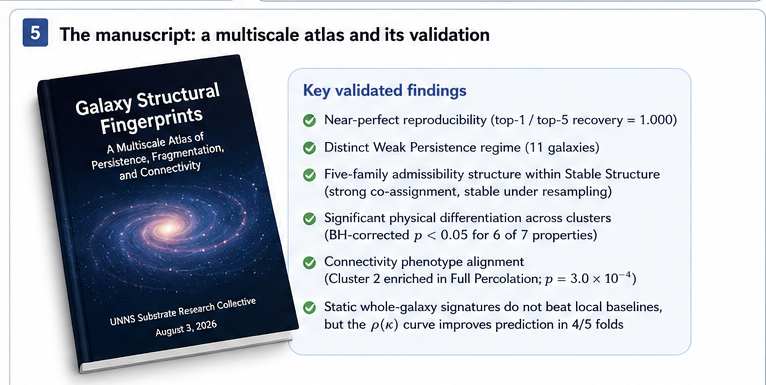
For the UNNS programme, this project demonstrates that its chambers can produce highly reproducible object-specific identities, a genuine multichannel structural coordinate system, discrete regimes, nested admissibility families, cross-chamber phenotype alignment, meaningful relations to independent physical variables, and explicit boundaries between structural identity and predictive transfer. The result is a concrete, reusable research object: the galaxy structural-fingerprint atlas.
💡 The Main Revelation
The most important revelation is not simply that galaxies can be clustered. It is that a galaxy's baryonic organization contains a structural layer that is reproducible, multiscale, hierarchical, partly physical, partly observationally transformed, and distinct from local acceleration-law prediction.
Resources & References
-
Primary Manuscript (PDF):
Galaxy Structural Fingerprints: A Multiscale Atlas of Persistence, Fragmentation, and Connectivity
Full derivation, corpus, reproducibility gates, admissibility clustering, cross-chamber validation, and external transfer test. UNNS Substrate Research Program · 2026. -
Data and Corpus Construction (ZIP):
UNNS_GALAXY_STRUCTURE_AND_VALIDATION_v0_3.zip
Full pipeline archive: SPARC primary sample, ladder construction, chamber exports, PCA tables, Gate B/C records, and external transfer outputs. -
UNNS Galaxy Structural Fingerprint Atlas (Interactive HTML):
UNNS_Galaxy_Structural_Fingerprint_Analytics.html
Full interactive analysis: sample summary, Gate B/C results, channel architecture, regime and cluster geometry, and physical alignment. -
Galaxy Structural Fingerprints Dashboard (Live Instrument):
galaxy_structural_fingerprints_dashboard.html
The live atlas panel embedded above — reproducibility, regimes, admissibility registry, connectivity, analogues, and transfer boundary. -
Video — The Atlas in Motion:
gal_fngprnt.mp4
Animated walkthrough from rotation curve to structural fingerprint to admissibility taxonomy.