
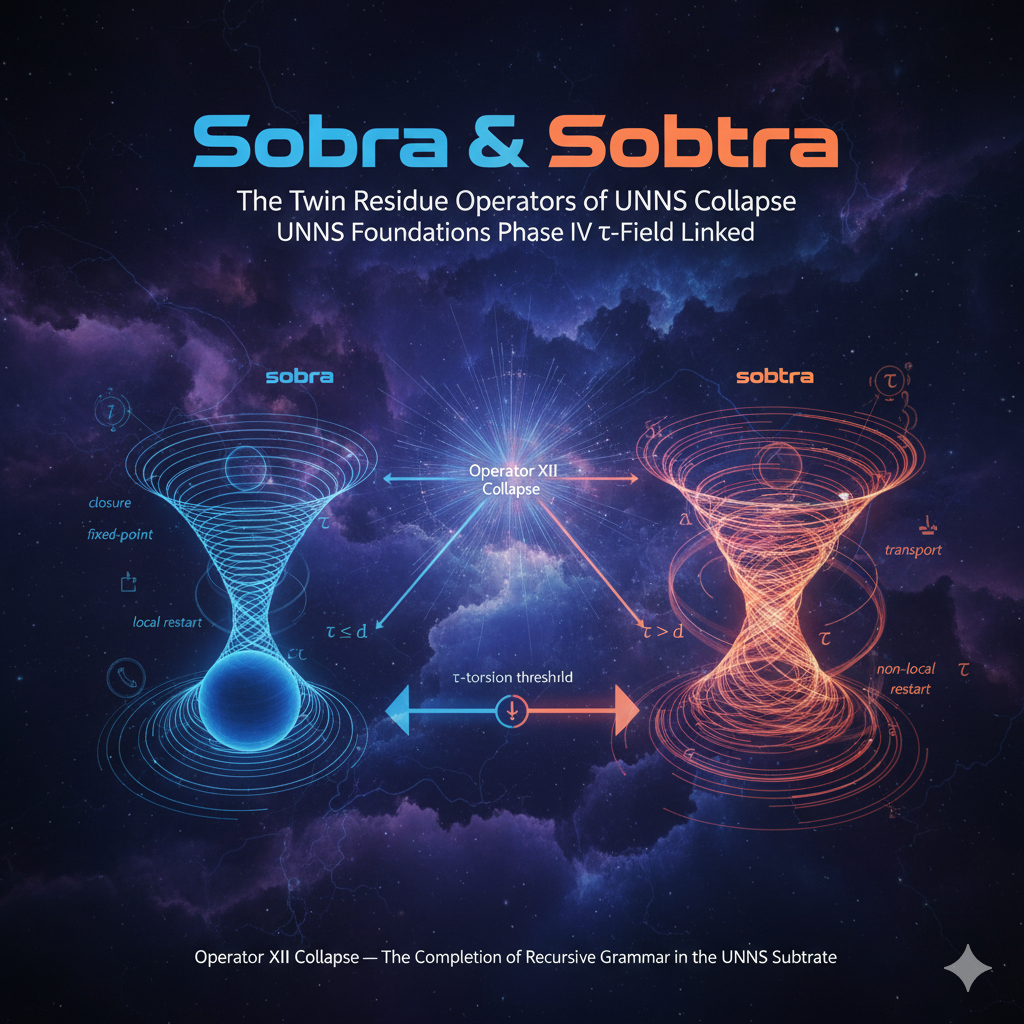
Sobra & Sobtra
The Twin Residue Operators of UNNS Collapse
In the UNNS substrate, Collapse (Operator XII) has two distinct residue channels. One closes recursion. The other re-opens it. These are sobra and sobtra.
1. Overview
In the full Operator XII Collapse formalism, every recursive structure \(R\) undergoes an echo-extraction and damping procedure. What remains is a residual pattern — an echo that contains just enough information to restart recursion.
UNNS distinguishes two fundamentally different types of residuals:
- sobra — the closed remnant
- sobtra — the torsion-reactivated remnant
Their behavior determines whether the system performs a local restart or a transported restart in the next recursion. These two channels together form the internal anatomy of Operator XII Collapse.
A full mathematical treatment is available in the monograph:
Operator XII Collapse — The Completion of Recursive Grammar in the UNNS Substrate
2. The Two Branches of Collapse
The diagram below captures the core distinction: sobra closes the residue entirely, while sobtra re-opens it through torsion insertion.
3. Why “sobra” and “sobtra”?
The naming of the two operators is not aesthetic — it encodes their function in linguistic, geometric, and torsional structure.
3.1 sobra
“sobra” is a real Spanish word meaning leftover, excess, surplus, or unnecessary. All meanings converge on one idea:
Sobra is the closed remainder — the echo that stays where it is.
In UNNS, sobra corresponds to:
- the pure fixed-point residue of echo descent
- a pattern with no torsional activation
- a remnant that does not transport to other layers
- a local restart seed after Collapse
3.2 sobtra
The insertion of t transforms “sobra” into sobtra. This is not arbitrary: it encodes torsion, traversal, transition:
- bra → closure, embrace, echo-binding
- tra → traversal, trajectory, transport
- b at the center → binary bifurcation node
- t inserted → symbolizes τ-torsion
Sobtra is the remnant that re-opens, twists, and moves.
In UNNS, sobtra corresponds to:
- a residue re-activated by τ-torsion
- a remnant that gains curvature drift
- a pattern capable of transport across layers
- a non-local restart seed
4. Significance Within Operator XII
Operator XII (Collapse) determines whether the next recursion begins here or somewhere else. The sobra–sobtra distinction is the entire mechanism behind this.
Collapse routing rule:
If τ > δ: torsion dominates → the residue re-opens → sobtra path (transport restart)
This mechanism generalizes the classical collapse→seed idea: the seed is not a single object anymore — it has two possible faces, depending on torsion balance.
This bifurcation is what allows UNNS to model:
- recursive transport
- τ-Field transitions
- cross-layer drift
- structural migration in Chamber simulations
5. Geometric Interpretation
In geometric terms, sobra is a contracted echo shell, while sobtra is a twisted echo shell that shifts its curvature and changes recursion location.
6. Summary
The distinction between sobra and sobtra is fundamental to the UNNS Collapse mechanism:
- sobra = closed remnant (τ ≤ δ)
- sobtra = torsion-opened remnant (τ > δ)
- sobra → local restart
- sobtra → transport restart
- the system’s future recursion depends entirely on which branch wins
These two operators provide the missing internal structure of Collapse. They reveal how the UNNS substrate differentiates between staying and moving, between closing and opening, between local continuity and cross-layer migration.
For the complete mathematical treatment, see:
Operator XII Collapse — The Completion of Recursive Grammar in the UNNS Substrate