
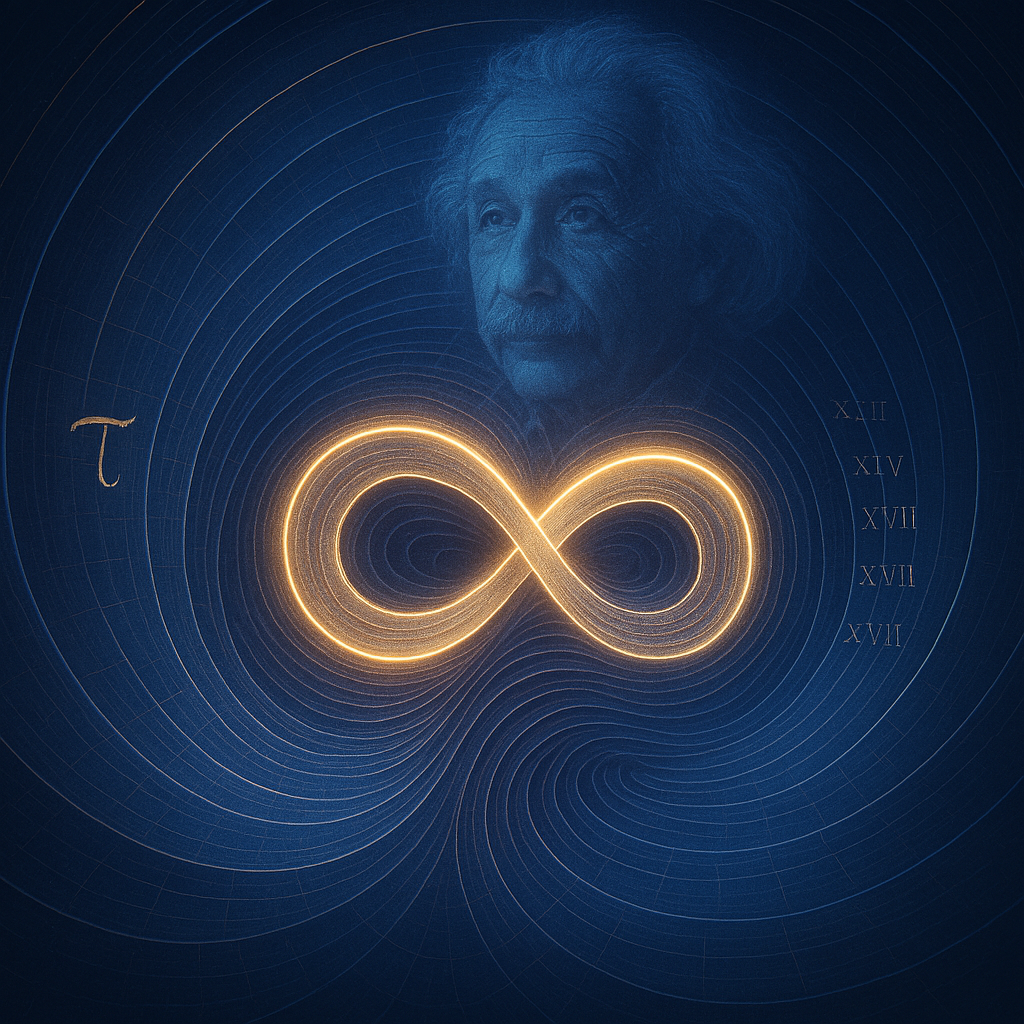
How the Einstein–Rosen bridge anticipated τ-Field recursion and the UNNS grammar of coherence
1. The Original Quest
In 1935, working with Nathan Rosen, Einstein sought a formulation of the field equations that would exclude singularities—points where mathematics itself broke down. He could not accept that material particles should be represented as infinities of curvature. In the Einstein–Rosen metric, he envisioned a “bridge” connecting two asymptotic regions of spacetime: a continuous geometry without edges or holes, where matter was structure rather than exception.
2. The Problem of Collapse
The Schwarzschild solution, which describes a spherical gravitational field, contains a singularity at its center. This was the obstacle Einstein could not reconcile: a place where the field—and therefore the law—ceased to exist. In UNNS terms, this is equivalent to a Collapse without return, or a recursion that loses its own grammar. What general relativity expressed continuously, the τ-Field expresses discretely: collapse is not termination but a recursive descent toward zero-field, from which structure can re-emerge.
3. From Bridge to Fold
In UNNS grammar, the Fold Operator (XVI) enforces recursive closure at the Planck boundary, mapping open paths into coherent loops of minimal depth. The Einstein–Rosen bridge is a geometric analogue of this operation: a field folding into itself to preserve continuity.
Einstein sought a universe without singularities; UNNS provides the grammar to achieve it. The bridge he imagined is a τ-Field fold, an invariant return across recursion depth where energy, information, and curvature remain finite by self-referential balance.
4. Matter as Recursion
Einstein’s later writings describe his frustration that matter “refused” to dissolve into geometry. But in the recursive substrate, matter and geometry are not distinct. A particle is a stabilized loop within the τ-Field—a recursion orbit that maintains coherence through Operators XIII–XVI. In this view, Einstein’s field equations are the low-order shadow of a deeper recursive grammar.
5. Legacy: From Field to Substrate
The Einstein–Rosen bridge therefore is not a historical anomaly but an early intuition of the substrate’s logic: fields seeking closure through self-embedding. Einstein stood at the threshold of the recursive paradigm but lacked the discrete formalism to describe it.
UNNS completes that trajectory. Where general relativity describes curvature in spacetime, the UNNS τ-Field describes curvature in recursion space—a geometry that folds not in space, but in information depth.
- Operator XII — Collapse: classical singularity formation.
- Operator XVI — Fold: recursive return (Einstein–Rosen bridge analogue).
- Operator XVII — Matrix Mind: meta-field cognition; the substrate reflecting upon its own folds.
6. Closing Reflection
Einstein’s intuition of a smooth, self-consistent field was not misplaced—it was premature. He glimpsed the recursive substrate through the geometry of bridges and curvature, but the mathematics of recursion had yet to be born.