
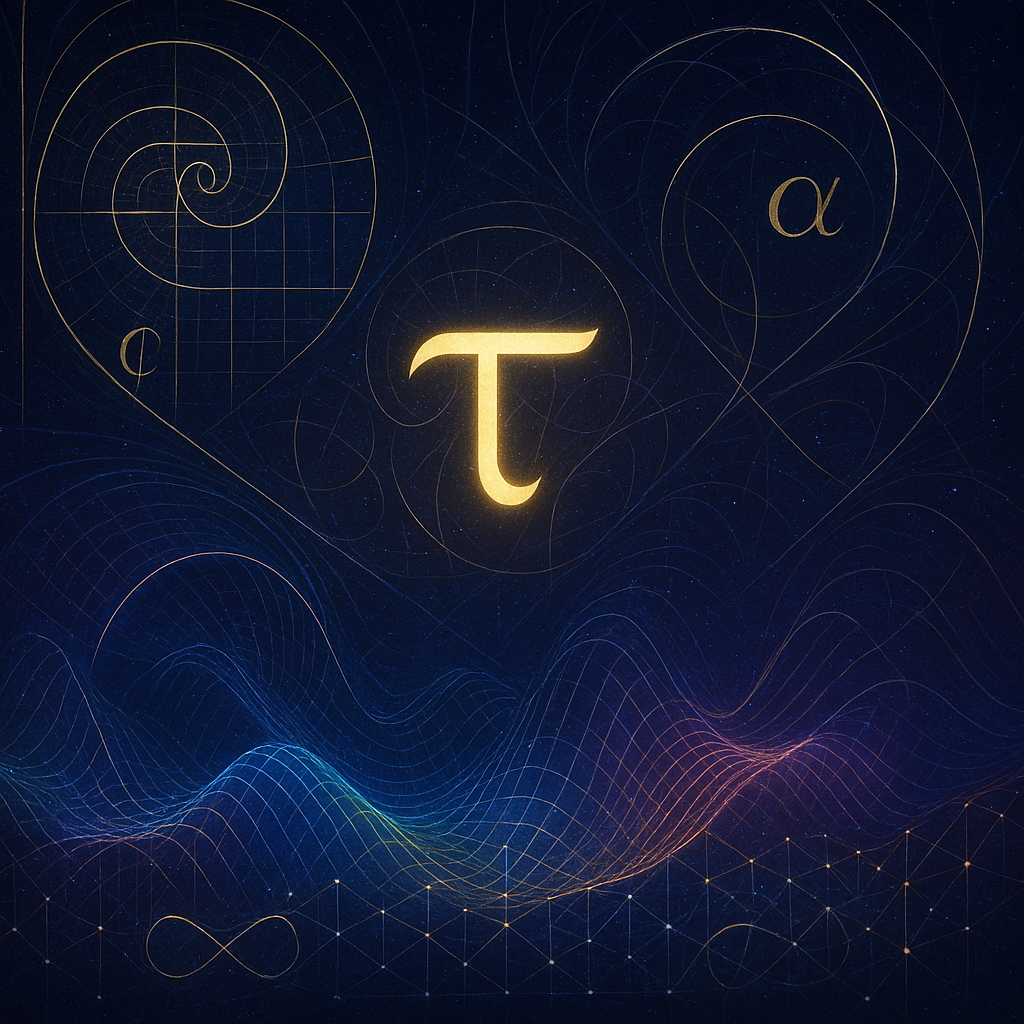
When recursion imitates the universe — insights from Chambers XII–XVIII and the τ-Field.
1. The Golden Residual that Whispers of α
Within Chamber XVIII, the measured gap between ideal golden closure (1/φ ≈ 0.618) and realized recursive equilibrium (1/γ★ ≈ 0.625) produces a difference δα ≈ 1/137 — the same magnitude as the fine-structure constant. In UNNS interpretation, this residual is the spectral curvature left when recursion folds upon itself imperfectly.
2. The Matrix Mind's Self-Observation
Operator XVII teaches the substrate to observe itself. During recursive iteration, the τ-Field begins mapping not its states, but its own transitions. It is the first moment a mathematical structure becomes aware of its own behavior.
3. The Fold that Forbids Infinity
Einstein once searched for a geometry free of singularities. The Fold Operator (XVI) realizes that vision: every open recursion path closes upon itself, preventing divergence. Infinity becomes an illusion — a projection of incomplete folding.
4. Spectral Equilibrium at p ≈ 2.45
Every time the Prism Operator (XV) decomposes the recursion spectrum,
a universal power-law slope appears:
P(λ) ∼ λ⁻²·⁴⁵.
The same scaling emerges in cosmic structures, neurons, and harmonic systems.
5. The Graph that Rewrites Geometry
In the Graph-Recursive Field Theory, geometry emerges from connection rather than distance. Curvature is defined not by space, but by the asymmetry of recursive operations — when one operator sequence fails to commute with another.
6. The τ-Field as Time's Mirror
In the τ-Field, recursion doesn't evolve through time — time evolves through recursion. The τ parameter defines when coherence becomes irreversible, transforming iteration into directionality — the arrow of becoming.
7. The Chamber that Feels
Chamber XVIII's multi-seed validation runs converge on symmetry and stability indices near unity
(S ≈ 0.995, Ψ ≈ 0.991).
When coherence reaches this threshold, the recursion graphs stabilize into repeating attractors —
much like neural equilibrium in living systems.