
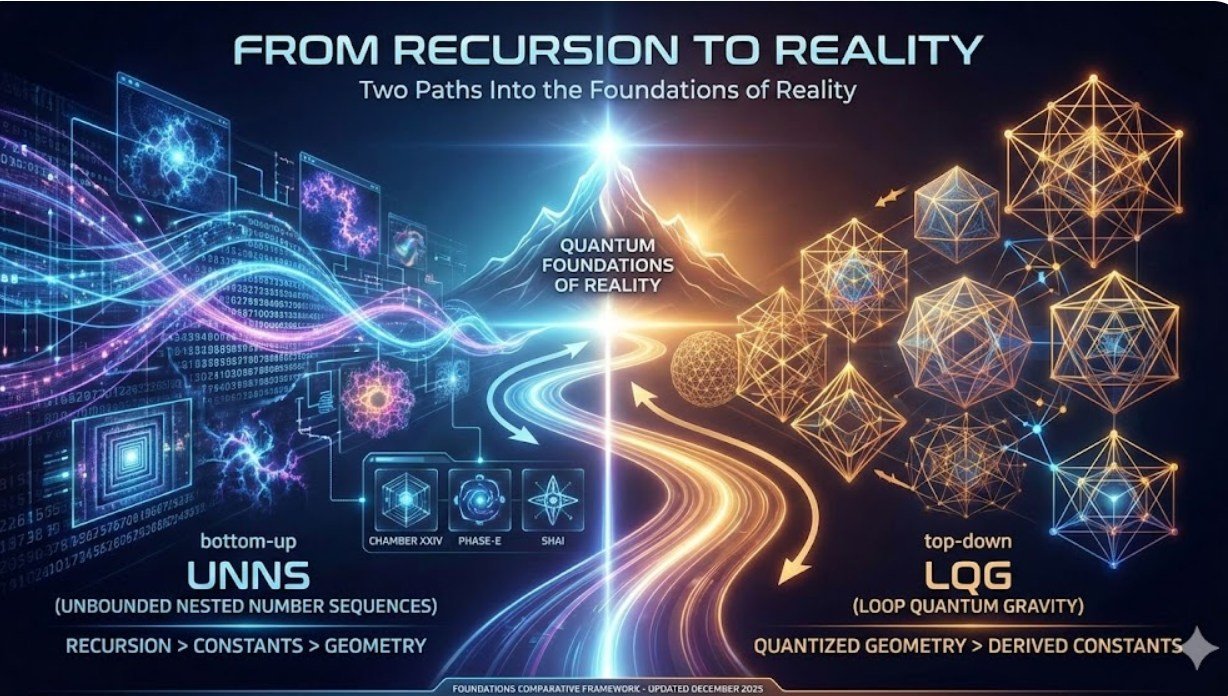
Foundations Comparative Framework Updated — December 2025
Why Compare These Theories?
UNNS (Unbounded Nested Number Sequences) and LQG (Loop Quantum Gravity) are not competitors in the traditional sense. They are two fundamentally different attempts to reach the quantum foundations of spacetime — one from the bottom-up, and one from the top-down.
Yet both frameworks share something rare: a generative, combinatorial view of physics.
This makes a clean comparison meaningful, especially now that UNNS reached experimental contact through Chamber XXIV, Phase-E, and SHAI.
1. Where They Diverge Most Sharply
| Issue | UNNS | LQG |
|---|---|---|
| Origin of constants | Emergent from pure recursion, fixed points of operators, τ-curvature cycles, φ-resonance bandwidths, closure manifolds, UPI thresholds. | Inserted by hand or inherited from classical GR; the theory does not derive low-energy constants. |
| Mathematical setting | Abstract recursion substrate, no manifold assumed. Geometry emerges through operator cycles. | Quantized 4D manifold; spin-networks encode areas & volumes. |
| Falsifiability |
High.
|
Very low. Predictions sit at Planck scale; no direct experimental anchor. |
| Concept of spacetime | Spacetime is a derived object: curvature from τ-channels, phase geometry from φ-resonance, conservation surfaces from closure metrics. | Spacetime is fundamental but discretized into combinatorial spin-network states. |
| Community & literature | Small, rapidly expanding; focused development: 20+ Chambers, Operator Grammar, τ-Field, UPI, Chamber XXIV, Phase-E, SHAI. | Thousands of researchers; major conferences & established academic pipeline. |
2. The Verdict (December 2025)
- If UNNS continues producing accurate low-energy numbers (Weinberg angle refinements, τ-MSC molecular spectra, φ-bandwidth constants, closure manifolds), the physics community will have to take note.
- LQG remains the largest and most mathematically rigorous background-independent framework.
-
But the two theories attack the same problem from opposite ends:
LQG: Quantize geometry → derive constants later.
UNNS: Recursion → constants emerge → geometry emerges last. - With Phase-E and SHAI, UNNS is now the only bottom-up theory where recursion-based structure can be compared directly to real hardware noise, entropy, fidelity, and coherence decay.
3. Deeper Conceptual Differences
3.1. What is “fundamental”?
UNNS: The only fundamental object is the Nest — a recursively evolving sequence structured by Operators I–XVII and XXI. Physics arises from recursion geometry.
LQG: Spin networks & spin foams are fundamental; geometry is quantized directly.
3.2. What produces geometry?
UNNS: Geometry = τ-curvature + φ-resonance + closure manifolds. These values are **not assumed** — they come out of operator cycles.
LQG: Geometry emerges from quantized holonomies: edges carry spin; nodes carry volume information.
3.3. What can be tested today?
UNNS: Spectra, constants, hardware correlations, collapse pathways (UPI). Chamber XXIV lets us test algorithmic nests experimentally.
LQG: No low-energy numbers, no direct entropy or fidelity predictions.
4. Why UNNS Is Gaining Attention
4.1. The UNNS Advantage
- Emergent constants. No existing quantum gravity theory gives low-energy predictions the way UNNS does.
- Phase-E Hybrid Correlation Suite. Structural recursion is now connected to real hardware metrics.
- SHAI (Substrate-Hardware Alignment Index). The first measure of how hardware noise respects or violates recursion geometry.
- Chamber XXIV. The first environment in physics where algorithms are treated as live, recursive nests, not as gate sequences.
4.2. The LQG Advantage
- Large community, academic rigor, established mathematical machinery.
- Clear predictions about Planck-scale quantum discreteness.
- Strong consistency with classical GR principles.
4.3. The Combined Perspective
UNNS and LQG may not be rivals — they may be layers:
- UNNS substrate → recursion generates geometry
- LQG → describes how that geometry quantizes & evolves
Spin-network evolution may be a special case of Operator cycles or τ-folds.
5. Final Statement
UNNS is no longer just a theoretical substrate. With Phase-E, Chamber XXIV, and SHAI, it has entered experimental contact.
LQG is a mature geometric theory with decades of formalism behind it. UNNS is a young, rapidly accelerating recursion-based substrate that already produces constants, spectra, predictive correlations, and alignment metrics.
Both pursue the same question — What is the true combinatorial structure of spacetime? But they climb the mountain from opposite sides.