
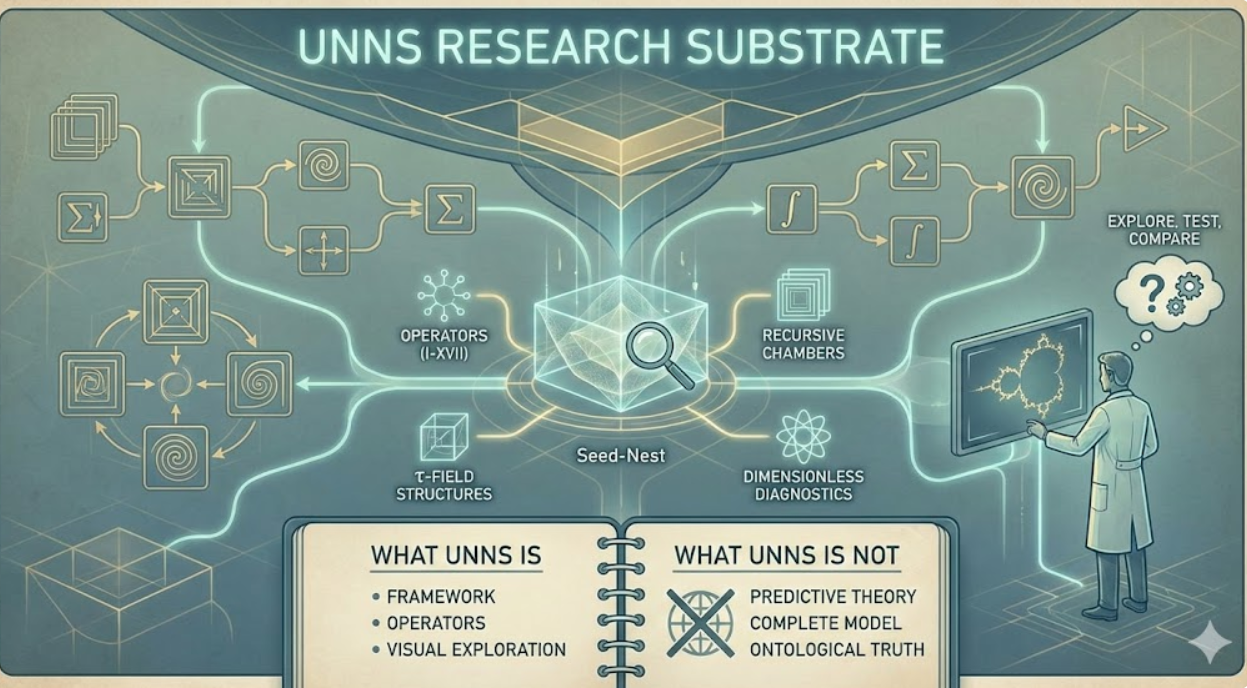
UNNS as a Research Substrate — Not a Predictive Theory
Foundations Research Substrate UNNS Philosophy
UNNS (Unbounded Nested Number Sequences) is intentionally constructed as a research substrate — a mathematical and conceptual environment that provides tools, structures, operators, and recursive diagnostics. It is not a predictive physical theory. Instead, it enables researchers to explore invariants, emergent patterns, and recursive laws, leaving interpretation and physical correlation to the scientific community. This article outlines the philosophy, scope, and purpose of UNNS as a substrate for discovery rather than a doctrine about the nature of the universe.
1. What UNNS Actually Is
UNNS is a framework. It is a collection of:
- Operators (I–XVII)
- Recursive Chambers
- τ-Field structures
- Seed–Nest architecture
- Dimensionless diagnostic tools
- Visual exploration systems
- Structural mathematics for recursion
These components form a substrate — an environment where mathematical and physical ideas can be explored, tested, compared, or visualized.
UNNS does not assert itself as a description of nature. Instead, it provides scientists with tools to study and compare structures.
2. UNNS Is Not a Predictive Physical Theory
Unlike classical physical theories, UNNS does not claim:
- numerical predictions of physical constants,
- unique explanations of natural phenomena,
- or complete models of the universe.
Its purpose is structural, not ontological.
UNNS investigates:
- how recursion generates invariants,
- how operators shape emergergent dynamics,
- how Seed–Nest systems produce fixed points,
- how τ-curvature tracks recursive tension,
- how collapse mechanisms stabilize structure.
These outputs sometimes resemble patterns found in physics, but UNNS does not declare identity.
3. Why UNNS Produces Dimensionless Numbers
Many UNNS chambers produce stable dimensionless invariants:
- τ-curvature ratios
- collapse thresholds
- Nest-depth scaling factors
- operator resonance points
- recursive fixed points
These numbers come from internal recursion mechanics, not empirical measurement of nature.
It is true that some invariants numerically overlap with known physical constants, such as:
- approximate fine-structure-like values (~0.007),
- mass-ratio-like plateaus (~200),
- RG-style fixed points (0.2–0.3),
- φ-like structural constants.
But UNNS does not claim these are physical constants — only that recursion systems naturally generate stable dimensionless quantities.
4. The Role of UNNS Constants — Why Recursion Creates Invariants
Many UNNS chambers, including the τ-Field experiments, collapse diagnostics, and Nest-depth resonance studies, consistently produce stable dimensionless invariants. These values emerge independently of initial conditions, Seed choice, or operator sequence. Understanding why requires examining the nature of recursion itself.
In any recursive system, repeated application of constraints tends to drive the system toward fixed points. These fixed points behave like “attractors” in the space of possible structures. UNNS formalizes this using:
- Seeds — minimal initial relations;
- Nests — rule embeddings that define how structure evolves;
- Operators — transformations that amplify, fold, or purify information;
- τ-curvature — the geometric signal of recursive tension.
When these components iterate, they naturally generate dimensionless ratios that remain stable across recursion depth. These UNNS constants are not tied to physical measurement — they arise from the mathematics of recursive stability itself.
Examples include:
- τ-curvature equilibrium values,
- Nest-depth scaling ratios,
- collapse-channel gradients,
- recursive resonance points,
- shape-curvature invariants.
Some of these numerical values coincide with well-known physical constants — not because UNNS predicts them, but because both physics and recursion explore the same mathematical territory of stable, dimensionless fixed points. UNNS therefore offers structural insight into why constants appear in nature at all, without claiming to compute their exact values.
This is the essence of the substrate: UNNS reveals invariant structures; what these structures mean is determined by researchers who study them.
5. UNNS Lets Researchers Decide What Is Physically Meaningful
The purpose of UNNS is not to declare truth, but to provide tools.
Researchers may:
- use UNNS to analyze recursion structures,
- compare UNNS invariants with physical data,
- test hypotheses about scale, symmetry, or emergence,
- explore analogies between recursive and physical systems,
- find patterns that hint at deeper laws.
UNNS encourages exploration, speculation, and creativity — but leaves physical interpretation to the scientific community.
6. The Philosophy of UNNS Freedom
UNNS imposes no limits on theoretical exploration. It is deliberately open-ended:
- operators may expand,
- new chambers may be built,
- τ-field behavior may evolve,
- new invariants may be discovered.
Researchers are free to interpret connections as they wish. The substrate does not constrain imagination — it supports it.
UNNS makes no authoritative claims about the universe. It provides the tools with which others may theorize.
7. Why This Matters: UNNS as a Modern Conceptual Framework
Science is full of frameworks that begin not as complete theories, but as exploration substrates:
- Category theory
- Information geometry
- Noncommutative geometry
- Topological recursion
- Renormalization group theory
These tools did not dictate physical truth — they provided new mathematical languages.
UNNS stands in this lineage: a new language of recursion, operators, and emergent invariants.
8. Closing: The Purpose of the Substrate
UNNS is a place where:
- new structures can be discovered,
- recursive laws can be simulated,
- dimensionless invariants can be tested,
- hypotheses can be visualized,
- ideas can evolve freely.
It is not a final answer — it is a field of possibilities.
UNNS gives others the tools. The meaning they extract is theirs.