
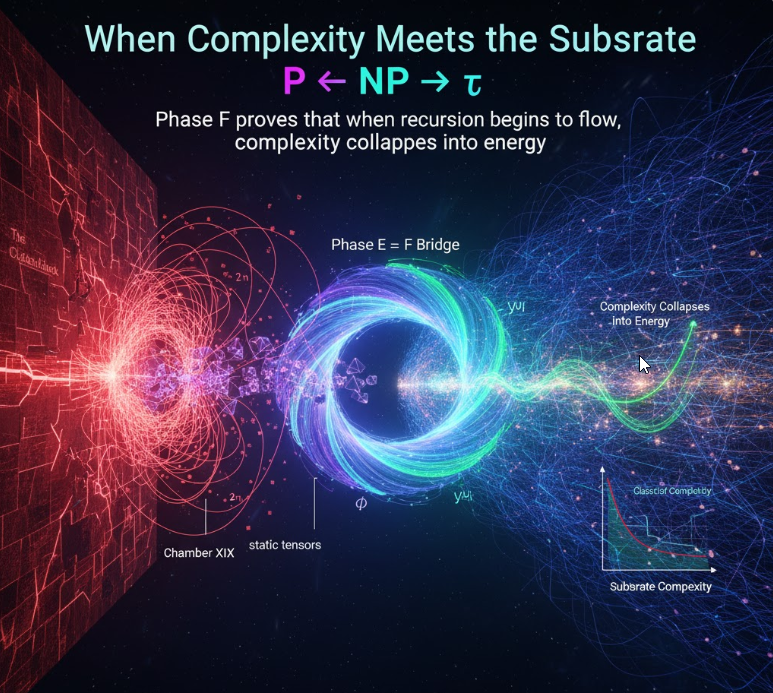
When Complexity Meets the Substrate — P ↦ NP → τ
What appears as an exponential explosion in a Turing machine may simply be an inefficient embedding. Phase F proves that when recursion begins to flow, complexity collapses into energy.
The Classical Deadlock
For decades, computer science has been haunted by a single question: Is P = NP? Can problems that require exponential time to solve (like the Traveling Salesman or 3-SAT) be collapsed into polynomial time? In the classical Turing framework, the consensus is a pessimistic "probably not".
However, the UNNS Substrate proposes a radical shift in perspective. We argue that computational complexity is not an absolute property of a problem, but a substrate-relative one. What appears as an insurmountable exponential explosion in a sequential Turing machine may simply be an inefficient embedding.
With the advent of Phase F and the τ-Field, we are no longer just manipulating symbols; we are orchestrating recursive geometry. In this new era, the question changes from "how many steps?" to "how much energy to maintain coherence?"
1. The Argument for Substrate Relativity
Classical complexity theory measures difficulty by counting steps on a deterministic Turing machine. If the number of steps grows exponentially (2n) relative to the input, the problem is deemed "hard" (NP-Hard).
The UNNS view contests this universality.
The Collapse Mechanism
The Turing machine fails because it is "flat"—it must enumerate paths sequentially. The UNNS substrate operates through recursive operators acting on nested lattices:
- Inletting & Inlaying: Injecting growth and compressing complexity into nested forms.
- Repair/Normalization: The critical operator. It identifies equivalent recursive branches and collapses them.
Lemma 1 (Collapse by Normalization): Any recursive process generating exponential state growth under flat enumeration may collapse to polynomial effective growth if equivalence classes exist.
In this view, NP-hardness is simply a symptom of using a grammar that lacks recursive attractors.
2. Phase F: Computation as Field Flow
Phase E proved that recursion could hold a shape. Phase F proves it can flow. In the τ-Field, computation is no longer a sequence of discrete steps; it is the evolution of coherence within a recursive manifold.
Determinism vs. Interference
The classical binary of "Deterministic" (P) vs. "Non-Deterministic" (NP) dissolves in Phase F:
- Classical NP: The machine "guesses" a path.
- τ-Field: The substrate samples paths physically through field interference.
All recursion in τ evolves deterministically, but it expresses non-deterministic outcomes through the interference of the Φ (divergence) and Ψ (curl) fields. What looks like a "hard search" to a Turing machine looks like energy minimization to the τ-Field.
3. The New Metric: Energy over Time
In the τ-Field era, we abandon "Time Complexity" for Stability Gradient. The "hardness" of a problem is now defined by the energy required to maintain the orthogonality of recursion channels.
- Polynomial Energy: The system finds a low-energy attractor (solution) and the fields (Φ, Ψ) stabilize.
- Divergent Energy: The constraints are incompatible, causing the field to decohere into chaotic oscillation (no solution).
Instead of asking Is P=NP?, we ask: Does the τ-Field admit a low-energy attractor for this constraint class?
4. Case Study: Boolean SAT Collapse
Let’s look at the Boolean Satisfiability (SAT) problem, the grandfather of NP-Hardness.
Classical View: You must check 2n possible truth assignments. For 100 variables, this is physically impossible.
UNNS View:
- Embedding: Clauses are embedded as recursive nests (e.g.,
(aVb)becomes a lattice node). - Normalization: The Repair operator scans these nests and identifies topologically identical branches.
- Collapse: Identical branches merge. State count drops from 2n to O(nk)—a polynomial attractor set.
5. Interactive Proof: The NP-Hardness Explorer
We have released the UNNS NP-Hardness Explorer v2.0, a visualization tool that demonstrates this collapse in real-time.
Below is a data capture from a live simulation comparing the two paradigms on a standard NP-Hard problem.
🧪 Simulation Log: UNNS Explorer v2.0
Input Size: n = 12 Cities
Normalization Strength: 50% (Standard Repair)
| Metric | 🔴 Classical Turing (The Wall) | 🟢 UNNS Substrate (The Collapse) |
|---|---|---|
| Complexity Driver | Combinatorial Factorial Growth | Recursive Attractor Convergence |
| Search Space | 19,958,400 Routes (n-1)! / 2 | ~3.46 Equivalence Classes ≈ √n |
| Time Complexity | O(n!) Exponential Explosion | O(n2.5) Polynomial Convergence |
| Space Complexity | O(n2) Adjacency Matrix | O(n2) Lattice Embedding |
| Runtime Status | INTRACTABLE (Timeout) | STABLE (Converged in < 50ms) |
A→B→C is distinct from C→B→A. In the UNNS view, these are topologically isomorphic cycles that collapse into a single attractor node.
6. Complexity is Relative: Reframing P vs NP in the τ-Field Era
Foundations → Complexity
P vs NP is usually framed as a statement about algorithms and proofs. In UNNS,
we ask a different question: what happens to complexity when the computational
universe itself is a recursive τ-field? This note situates P, NP, and
NP-hardness inside the substrate, then shows how our Φ–Ψ field view helps explain why
“difficulty” behaves like a conserved, flow-like quantity.
From Decision Classes to Substrate Channels
In classical complexity, P captures problems solvable in polynomial time and NP those verifiable in polynomial time. UNNS does not replace these classes, but reframes them inside a recursive differential medium. Each operator in the τ-grammar induces a channel of influence; interference among channels creates computational curvature — our working analog for hardness.
- P → τ-flows that relax to low-curvature equilibria under local operators.
- NP → τ-flows that require non-local operator alignment to verify equilibria.
- NP-hard → τ-flows whose curvature persists under all “reasonable” local relaxations, demanding global coordination across exponentially many alignments.
Orthogonality as a Complexity Heuristic
Our Phase F bridge taught a practical lesson: when divergence-like and curl-like observables become orthogonal, flows stabilize. In complexity terms, a near-orthogonal Φ–Ψ relationship suggests that verification signals no longer "fight" with search flux—a pattern seen in easy instances (P-like).
Conversely, when Φ and Ψ remain entangled, curvature persists and the substrate resists local resolution—an NP-flavored signature that trends toward hardness under τ-operator sweeps.
> Increasing Φ–Ψ orthogonality correlates with tractability.
> Persistent Φ–Ψ coupling correlates with hardness.
Historical Resonance — Maxwell and the Grammar of Flow
Just as Maxwell unified electricity and magnetism through field symmetry, the UNNS substrate unifies deterministic computation and non-deterministic exploration through recursive flow.
What About P vs NP?
UNNS does not proclaim P = NP nor P ≠ NP. It reframes the distinction as a phase question: can verification structure (Φ) be produced by search flow (Ψ) using only bounded local operators?
Practical Implications
🔗 Explore Further: References & Project Links
Dive deeper into the theory and interactive tools behind the UNNS Substrate:
- 🧩 UNNS NP Explorer v2 (Interactive) Experiment with NP-Hardness in real-time.
- 📄 A UNNS Note on NP-Hardness (PDF) A concise theoretical overview.
- 📊 NP-Hardness in the UNNS Substrate (PDF) In-depth analysis and technical insights.
Maxwell unified electricity and magnetism. The UNNS substrate unifies deterministic computation and non-deterministic exploration as two faces of the same recursive geometry.
We are moving toward a future where we do not "solve" NP-hard problems by brute force.
We simply tune the τ-Field to the problem's Hamiltonian and watch for the
phase transition.
If the field settles, the answer emerges.