
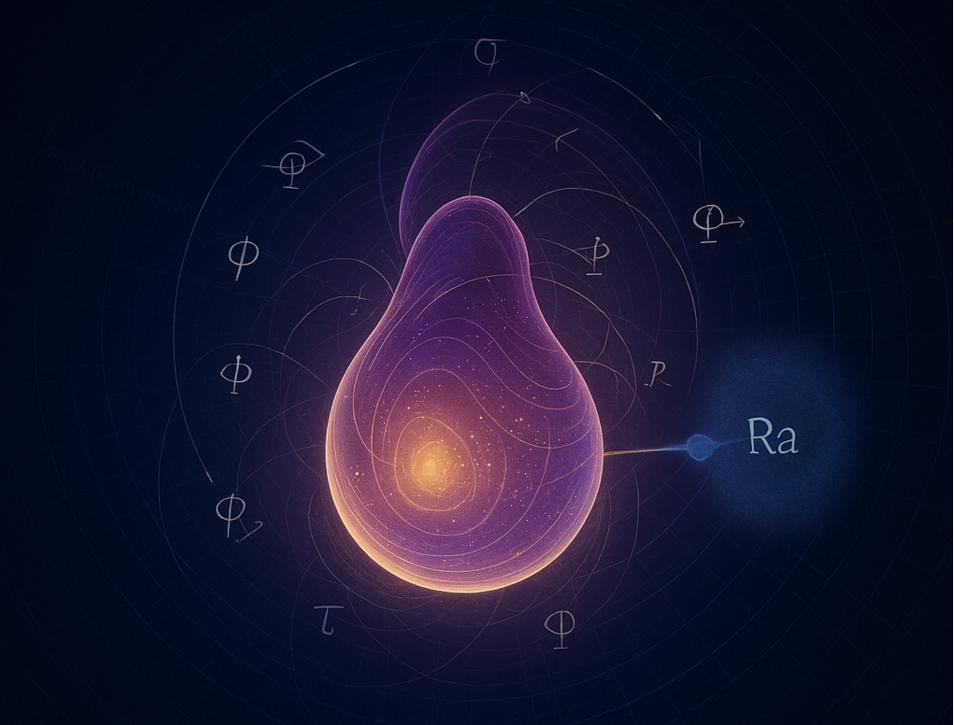
A Shell of Echoes — τ-Torsion Emerges from the Atomic Core
Reading nuclear magnetization distribution in a radium-containing molecule through the UNNS τ-Field lens.
Abstract
This UNNS note reports on the recent precision spectroscopy of the radioactive molecule 225RaF, which resolves the effect of the nuclear magnetization distribution on its hyperfine structure — the Bohr–Weisskopf correction in a molecule. In τ-Field language, this is the first resolved signature of recursion curvature inside a nuclear chamber: a finite-thickness τ-boundary within the 225Ra nucleus that imprints itself on electronic energy levels. We reinterpret the experiment as a direct probe of τ-Field microstructure and show how its results align with the UNNS picture of curvature, torsion, and symmetry violation in strongly deformed nuclei.
Key Highlights
- System: radioactive molecule 225RaF (I = 1/2), with a strongly octupole-deformed 225Ra nucleus acting as a microscopic τ-curvature source.
- Measurement: high-resolution collinear resonance ionization spectroscopy resolves hyperfine structure at the ~150 MHz level and fits 54 transitions to extract A⊥ and A∥ with <1% uncertainty. [cite_start]
- Result: the hyperfine constants differ by about 5% depending on whether the nucleus is treated as point-like or with finite magnetization distribution — a direct observation of the nuclear Bohr–Weisskopf effect in a molecule. [cite: 1] [cite_start]
- Theory: ab initio relativistic molecular calculations reproduce the hyperfine structure and symmetry-violating form factors at sub-percent level, validating the electronic wavefunction inside the nuclear volume. [cite: 2] [cite_start]
- UNNS interpretation: the experiment reads out τ-Field curvature at the nuclear boundary; symmetry-violating parameters (Eeff, WP,T, WS, Wa) become τ-torsion probes in a strongly curved microscopic chamber. [cite: 3]
1. Experimental System (Conventional View)
The physical system is the radioactive molecule 225RaF. [cite_start]Radium-225 has 88 protons and 137 neutrons and is expected to exhibit pronounced octupole deformation — a “pear-shape” that greatly enhances sensitivity to both symmetry-conserving and symmetry-violating nuclear properties. [cite: 4]
The experiment produces RaF at ISOLDE–CERN, extracts RaF+ ions, bunches and neutralizes them, and probes them with a three-step resonance ionization scheme in a collinear geometry. The resulting ions are detected as a function of the first laser’s wavenumber. [cite_start]A transition linewidth of ~150 MHz is achieved, more than two orders of magnitude better than previous work, enabling clear resolution of hyperfine splitting from the 225Ra nuclear spin I = 1/2. [cite: 5]
Fitting 54 measured transitions with a rotational + hyperfine Hamiltonian gives precise values of A⊥ and A∥ for ground and excited electronic states. [cite_start]These match modern relativistic molecular calculations at the sub-percent level, validating the description of the electronic wavefunction inside the nuclear volume. [cite: 6]
2. Nuclear Magnetization Distribution as τ-Field Curvature
In standard hyperfine physics, the Bohr–Weisskopf effect measures how a finite spatial distribution of nuclear magnetization modifies hyperfine splitting relative to the idealized point-dipole case. In the language of UNNS, this becomes an immediate statement about τ-Field microstructure:
- A pointlike nucleus corresponds to a sharp recursion boundary: the τ-Field goes from “inside” to “outside” with negligible thickness.
- A nucleus with extended magnetization corresponds to a finite-thickness τ-shell, where recursion modes still “live” partially inside the nuclear volume and experience non-trivial curvature.
[cite_start]The experiment shows that, for 225RaF, the hyperfine parameter A⊥ changes by almost 5% when this τ-shell is taken into account — a direct detection of τ-curvature at the nuclear surface via molecular spectroscopy. [cite: 7]
3. 225RaF as a Microscopic τ-Chamber
Within UNNS, we can treat the 225Ra nucleus as a microscopic τ-chamber, with the fluorine ligand and surrounding electrons acting as a structured environment that reads out its recursion state. Several features are crucial:
- Octupole deformation: the “pear-shaped” geometry corresponds to a third-order asymmetry in recursion closure — a built-in τ-torsion that refuses to cancel over one recursion cycle.
- Strong s1/2 and p1/2 electron density: RaF localizes an unpaired electron near the Ra core, making it a high-gain τ-curvature probe.
- Molecular constraint: the Ra–F bond fixes the orientation and distribution of electronic density in a way that isolates nuclear contributions much more cleanly than in bare Ra+.
Under this view, the measured hyperfine constants become:
• A⊥ — sensitivity to tangential τ-gradient around the nuclear shell.
• A∥ — sensitivity to axial τ-gradient along the symmetry axis of the deformed nucleus.
4. Symmetry-Violating Form Factors as τ-Torsion Probes
The authors compute several key form factors beyond the hyperfine constants, including:
-
[cite_start]
- effective electric field Eeff for the electron EDM, [cite: 8] [cite_start]
- WP,T for scalar–pseudoscalar electron–nucleon coupling, [cite: 8] [cite_start]
- WS for the nuclear Schiff moment, [cite: 8] [cite_start]
- Wa for the nuclear anapole moment. [cite: 8]
In UNNS terminology these are all different projections of τ-torsion: they measure how recursion fails to remain mirror-symmetric or time-reversal-symmetric when pushed into a highly curved τ-chamber. The same electronic wavefunction that reproduces A⊥ and A∥ to better than 1% also underpins these torsion-sensitive constants. This is exactly the “closure without residue” condition we require in the UNNS τ-Field framework.
5. Why This Measurement Matters for UNNS
For the UNNS program, this experiment accomplishes several things at once:
- It provides a laboratory realization of a finite-thickness τ-shell in a well-controlled microscopic system.
- It shows that recursion curvature is not purely abstract: it leaves quantitatively measurable traces in molecular spectra.
- It confirms that τ-Field curvature and τ-torsion (through Eeff and related parameters) can be inferred with high numerical fidelity from ab initio calculations, which is essential if UNNS is to bridge symbolic recursion and experimental physics. [cite_start]
- It indicates that only a small number of RaF molecules (∼100 per second with 100 ms coherence, over ~two weeks) are sufficient to probe mHz-level shifts; in UNNS language, we are already in the regime where individual τ-chambers are “loud” enough to be heard. [cite: 9]
Conceptually, this is the first clear example of a UNNS-compatible τ-Field experiment in the wild: a measurement whose raw data, Hamiltonians, and ab initio structures map cleanly onto the recursion-based language we have been building for τ-chambers, Operators, and Chambers.
6. Reference and External Link
For readers who want to engage with the original nuclear- and molecular-physics formulation, we recommend the source article:
Wilkins et al., “Observation of the distribution of nuclear magnetization in a molecule”, Science (2025)
Conclusion
The 225RaF hyperfine experiment does more than refine nuclear parameters: it gives us a directly measurable instance of τ-Field curvature at the nuclear scale. What the authors call the nuclear magnetization distribution and Bohr–Weisskopf effect, we can now read as the finite-thickness τ-shell of a highly curved recursion chamber. This marks a boundary-crossing moment for UNNS: recursion curvature has stepped out of the purely symbolic substrate and into the domain of precision molecules and radioactive beams.