
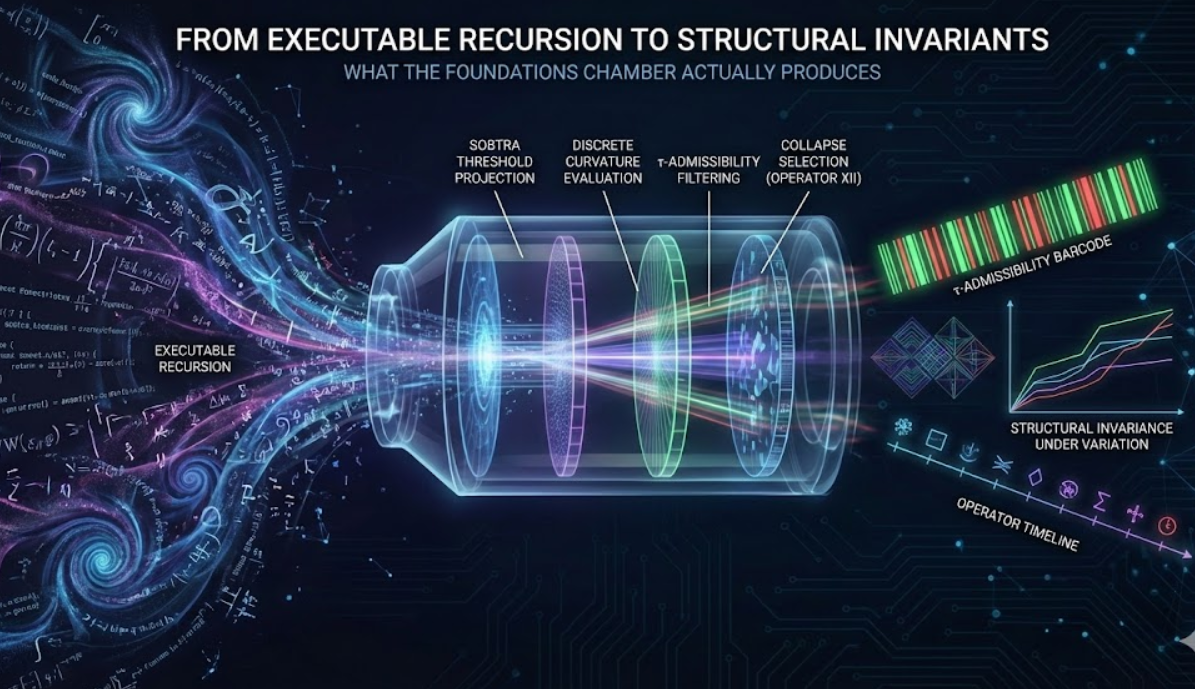
What the Foundations Chamber Actually Produces
Abstract
The UNNS τ-Filtered Observability — Foundations Chamber is not a visualization tool, nor a simulation in the conventional sense. It is an executable instrument designed to extract structural invariants from recursive dynamics under observability constraints.
This article clarifies what kind of results the Chamber produces, how they should be interpreted, and why they are neither numerical constants nor empirical predictions. Instead, the Chamber exposes relations that persist under controlled variation—the defining feature of structural invariants in mathematics and physics alike.
1. What Counts as a Result?
When a run completes in the Foundations Chamber, no single number is presented as “the answer.”
This is intentional.
The primary outputs are structured datasets describing how a recursive process behaves under:
-
Sobtra threshold projection
-
discrete curvature evaluation
-
τ-admissibility filtering
-
collapse selection (Operator XII)
A result, in this context, is not a value, but a pattern that persists across:
-
parameter variation
-
τ-threshold adjustment
-
multi-run comparison
This places the Chamber closer to tools like:
-
phase-space analysis
-
renormalization flow diagrams
-
spectral decompositions
than to numerical solvers.
2. Primary Observables Produced by the Chamber
Each execution produces several observable layers. None are optional.
2.1 State Trajectory
The raw recursive sequence
x₀, x₁, x₂, …, xₙ
This is not yet an invariant—it is the substrate on which invariants are extracted.
2.2 Sobtra Decomposition
Each step is decomposed into:
-
retained component (Sobtra)
-
rejected component (residue)
This separation is structural, not heuristic. It enables the next layer.
2.3 Discrete Curvature Profile
For each step n, curvature κₙ is computed as:
κₙ = ‖rₙ₊₁ − rₙ‖ / (‖xₙ‖ + ε)
This quantity measures local instability of recursion under projection, not geometric curvature.
The κ-profile over time is a first-order diagnostic of structural stress in the system.
2.4 τ-Admissibility Mask
A step is admissible if:
κₙ ≤ Λ
This produces a binary admissibility sequence that partitions the run into:
-
τ-stable segments
-
collapse-triggering segments
This mask is one of the Chamber’s most important outputs.
2.5 Operator Assignment
Each step is labeled according to its local behavior:
-
Φ (growth-aligned)
-
Ψ (rebalancing)
-
τ (stable continuation)
-
XII (collapse)
The operator timeline is derived, not assumed.
3. What Makes an Invariant?
An invariant in the Foundations Chamber is anything that survives structured variation.
Examples:
-
Survival ratio remains stable across Λ adjustments
-
Collapse locations align across multiple runs
-
Operator dominance patterns persist under noise changes
-
Path persistence remains constant in comparison mode
None of these are single values.
They are relations that do not disappear when conditions change.
4. Why These Are Not Numerical Constants
The Chamber deliberately does not output universal constants.
Why?
Because:
-
constants depend on scale, normalization, and units
-
UNNS analysis operates on structural relations, not measurement scales
Instead, the Chamber identifies:
-
invariant proportions
-
stable classifications
-
persistent structural transitions
This is analogous to how:
-
critical exponents matter more than raw values
-
universality classes matter more than parameters
5. Multi-Run Comparison as a Test of Invariance
The Compare tab performs a specific task:
It tests whether structural features persist across independently generated runs.
What is compared:
-
admissibility overlap
-
survival ratios
-
collapse alignment
-
operator frequency stability
If a feature survives comparison, it qualifies as structural.
If it disappears, it is classified as contingent.
This distinction is the core contribution of the Chamber.
6. How to Read the Exported JSON
The exported JSON files are not logs—they are analysis objects.
Recommended workflow:
-
Identify admissibility mask
-
Locate collapse indices
-
Examine κ-distribution
-
Track operator transitions
-
Compare across runs
The included files:
-
test_run_valid.json -
test_run_comparison.json
provide reference baselines for this process.
7. Why This Matters
Many mathematical and physical systems produce large amounts of data but few invariants.
The Foundations Chamber reverses this:
-
it restricts observability
-
enforces admissibility
-
treats collapse as structural
-
compares survival, not values
What remains are facts about structure, not interpretations.
8. Summary
The Foundations Chamber does not answer what a system is.
It answers what survives.
Those survivals—when consistent, reproducible, and comparison-stable—are structural invariants.
This is the kind of fact the Chamber is designed to produce.
Resources
Primary Materials
Test Data
- 💾 test_run_valid.json — Single validated run
- 💾 test_run_comparison.json — Multi-run comparison dataset
- 💾 test_run_varied_params.json
- 💾 test_run_mixed_operators.json
- 💾 test_run_low_lambda.json
- 💾 test_run_high_lambda.json