
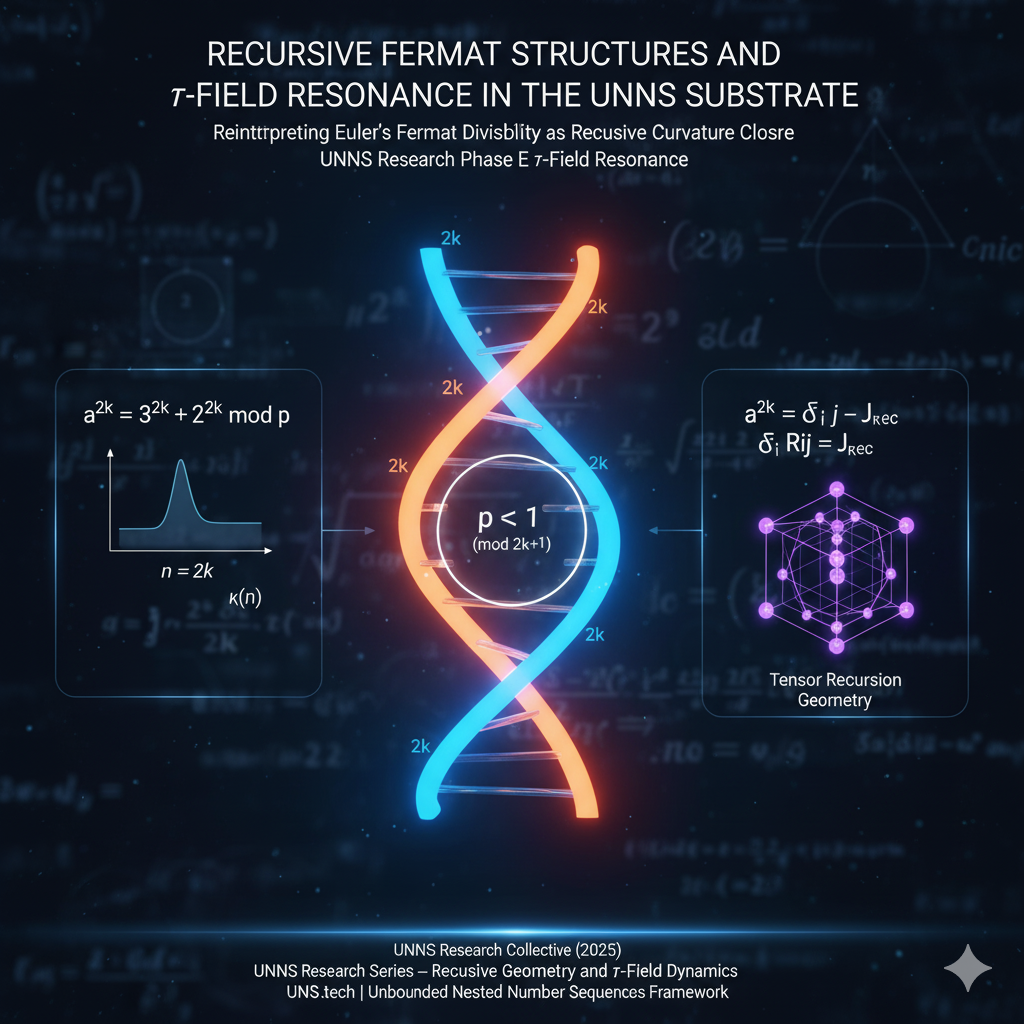
Reinterpreting Euler’s Fermat Divisibility as Recursive Curvature Closure
1. Classical Background
Euler showed that if a prime p divides a Fermat number Fk = 22k + 1, then
This congruence ties the prime divisor directly to the recursion depth 2k of the exponent. The same structure appears in generalized Fermat-type numbers such as
where prime divisors again obey constraints of the form p = 1 + 2k+1 m. In classical number theory this is a statement about multiplicative orders in the finite field ℤp. In the UNNS interpretation, it is a statement about recursive closure of a dual τ-system.
2. From Recurrence to τ-Fields
Consider the recurrence
The characteristic equation r² − 5r + 6 = 0 has roots r₁ = 3 and r₂ = 2, so the closed form is
In UNNS, we interpret the pair (τ₁, τ₂) = (3, 2) as a two-channel τ-field system. At recursion depth n, the system can be represented as a vector
The interaction between the channels is captured by a simple difference tensor:
where Oi and Oj are recursion operators acting on the respective τ-channels. For the pair (3, 2) at depth 2k, one obtains:
R21 = 32k + 22k.
The second component R21 is exactly the generalized Fermat structure 32k + 22k. Thus, what appears classically as an isolated algebraic pattern is, in UNNS, a coupled τ-field configuration.
3. Recursive Resonance and Modular Closure
In the UNNS substrate, a recursion is said to reach coherence when its differential tensor returns to its initial phase after a finite depth expansion. For the dual system (3, 2), phase coherence at level 2k occurs when
which can be rearranged as
That is, the multiplicative order of 3 · 2−1 in ℤp is exactly 2k+1. Hence:
which recovers Euler’s congruence. In the UNNS interpretation, this condition states that the two τ-channels rejoin after 2k+1 steps, closing a discrete curvature loop. The prime p acts as a spectral modulus enforcing this loop symmetry.
4. Geometric Interpretation in the UNNS Substrate
Let ℛ denote the recursive manifold generated by the two τ-flows. A heuristic curvature measure may be defined in terms of the exponent:
The change in curvature across a depth jump is then
When this difference approaches a minimum or an effective fixed point (in a discrete sense), the system exhibits a balance between the 3-channel and 2-channel growth rates. This balance corresponds to a resonant configuration of the recursive manifold and is aligned with the modular closure condition above.
5. Toward Tensor Recursion Geometry
The two-channel system discussed here is the simplest nontrivial instance of what we call tensor recursion geometry. In the multi-τ setting, we promote the difference
to a genuine recursion curvature tensor. For more channels, i,j range over a larger index set of operators:
In the continuous limit, Rij becomes the discrete analogue of a field strength tensor. The dual Fermat structure is then reinterpreted as a particular slice of this tensor, where only two channels are active and their resonance is constrained by the modular law.
6. Phase F Outlook: Unified Recursive Field Equations
Phase E of the UNNS program introduces explicit multi-τ coupling and tensor formulations. The analysis here serves as a minimal discrete example: a two-operator resonance manifesting as a generalized Fermat condition.
Phase F aims to extend this structure into a continuous recursive field theory, with equations of the schematic form
where Jjrec denotes a recursive flux density and ∇ is a suitable discrete/continuous derivative operator on the recursion manifold. The Fermat-type congruences then appear as special cases of a more general principle: recursive fields seek closure by quantizing curvature into phase-locked orbits.
7. Summary
Euler’s theorem on Fermat and generalized Fermat numbers has long been regarded as a deep result in classical number theory. Within the UNNS substrate, it can be seen instead as an early glimpse of a broader law: dual recursive channels (here, 3 and 2) achieve coherence only when their growth is phase-locked at specific depths, registered by primes of the form p = 1 + 2k+1 m.
This reinterpretation moves the discussion from individual integers to τ-fields and curvature tensors, aligning discrete arithmetic with the emerging framework of tensor recursion geometry and the forthcoming unified recursive field equations of Phase F.
📘 Reference — UNNS Phase E Tensor Geometry
For a full theoretical development of the Phase E Chamber XIX results—including the derivation of recursive Fermat structures, antisymmetric τ-field coupling, and the emergence of golden-ratio γ★–μ★ resonances—see:
Recursive Fermat Structures and τ-Field Resonance in the UNNS Substrate (PDF)