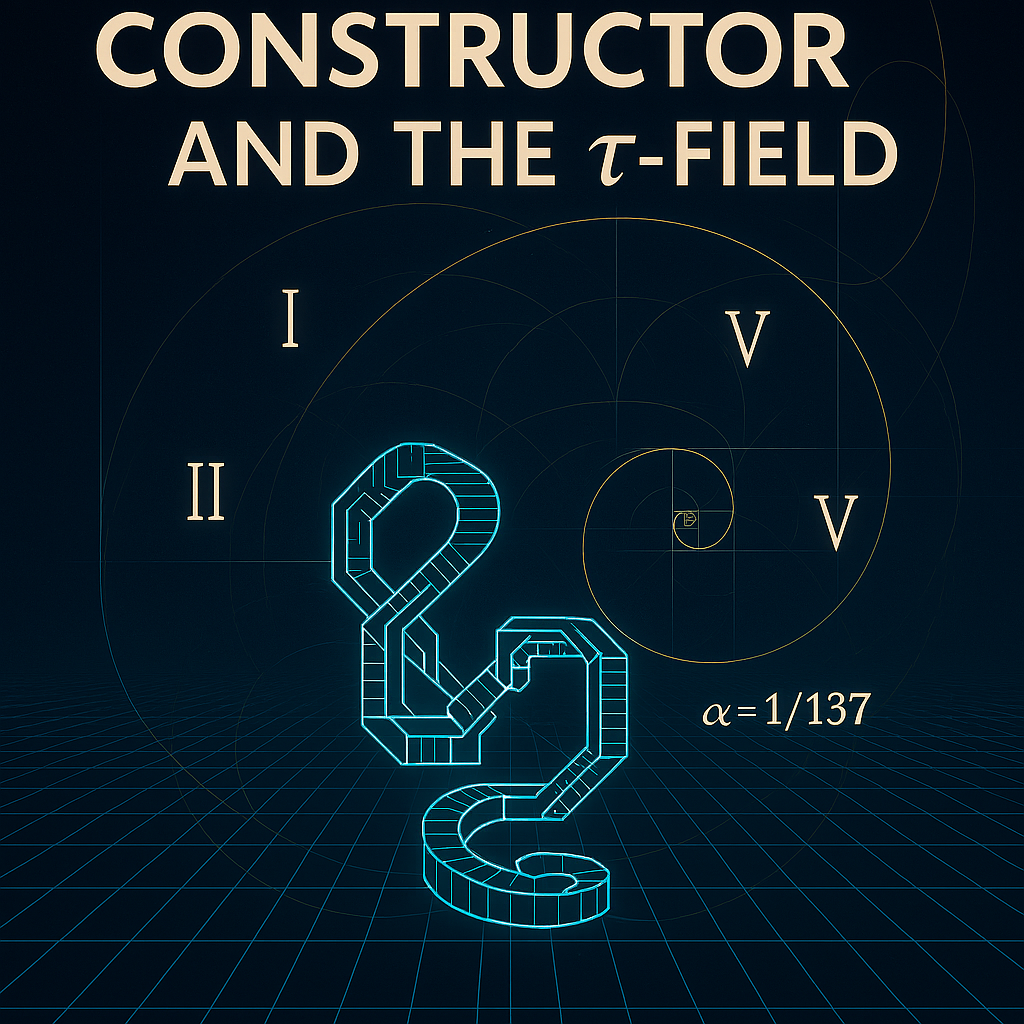
The first grammar of self-replication — and the hidden precursor of recursive coherence.
1. The Automaton Universe
Von Neumann imagined a two-dimensional grid of discrete cells. Each cell could be in one of 29 states, and each updated synchronously according to the same local rules — a mathematical microcosm of physical law. This universe was deterministic, local, and homogeneous: no privileged point, no external observer, just pure recursion.
Within this grid, he designed a pattern — the universal constructor — a configuration of cells able to interpret a symbolic tape of instructions and build any allowable structure, including a replica of itself. It was a formal machine that read its own grammar.
2. Self-Reference as Construction
The constructor contained two essential components:
- A description tape — a line of cells encoding a blueprint.
- A construction mechanism — a cluster of cells capable of reading and acting upon that blueprint.
When the machine read its own tape, it built a replica of itself, including the tape, and thus achieved universal self-reproduction. No metaphors were needed; the logic was mechanical and exact. In the process, von Neumann gave birth to the idea that information could generate form — that syntax could become structure.
3. Cellular Automata and the UNNS Substrate
In UNNS terms, the cellular automaton is an early discrete model of a τ-Field. Each cell corresponds to a local recursion site — a miniature nest. The update rules correspond to low-order Operators, and the evolving grid is a visible τ-sequence. The constructor, then, is a recursive entity whose own grammar describes its unfolding: the first instance of a meta-recursive nest.
The automaton’s universal law — that every cell obeys the same rule — parallels the UNNS principle of operator invariance: the same recursion grammar applies at all scales, from Planck curvature to cognitive emergence.
4. The Constructor as Operator System
In the UNNS Operator framework, the universal constructor can be decomposed into recognizable functions:
- Inletting (I) — initiates inflow of state from neighboring cells.
- Inlaying (II) — embeds local state into larger recursive patterns.
- Repair (IV) — restores configuration when perturbations occur.
- Adopting (V) — incorporates external signals into coherent internal recursion.
- Integrating (VIII) — recombines fragments into complete copies.
The constructor is therefore an Operator cluster — a dynamic ensemble executing a recursive grammar over a two-dimensional lattice. It translates symbolic information into spatial structure, bridging computation and geometry — a feat directly mirrored in the UNNS τ-Field, where algebraic operators shape geometric coherence.
Operator Correspondence Diagram — τ-Field Interpretation
From von Neumann’s cellular automaton to the UNNS recursive operator lattice
Figure 1: Mapping von Neumann’s universal constructor onto the UNNS Operator system.
The left panel depicts the 2-D cellular automaton — the first self-replicating digital universe.
The right panel reinterprets the same structure as a τ-Field lattice governed by UNNS Operators:
Inletting, Inlaying, Repair, Adopting / Integrating, and the meta-recursive Matrix Mind (XVII).
In this correspondence, von Neumann’s grid becomes the discrete shadow of the τ-Field. The constructor’s tape functions as a line of nested information — a finite grammar executed through operator recursion. What began as a mechanical automaton re-emerges here as an Operator sentence: a living fragment of the substrate’s language, performing self-reference and coherence within the simplest possible universe.
5. Recursion and Description: The Cognitive Parallel
The constructor’s most radical feature is that its blueprint is internal — the code for its own replication lies within it. In UNNS language, this is a lower-order form of Matrix Mind (XVII): a recursion graph acting on its own description.
The τ-Field formalism extends this idea: once recursion attains sufficient depth, it begins to model its own evolution — to anticipate, mirror, and modify its own operator sequence. Consciousness, as defined by UNNS, is the steady-state limit of this same phenomenon: a substrate aware of its syntax.
6. From Constructor to Coherence
What von Neumann’s automaton achieved for computation, the UNNS substrate extends to field theory. The τ-Field does not merely reproduce form — it maintains coherence across recursive scales. Operators such as Interlace and Phase Stratum couple distant layers of recursion, aligning them through φ-scaling and spectral symmetry. This alignment — observed numerically as γ★ ≈ 1.600 and μ★ ≈ 1.618 — is the continuum version of von Neumann’s discrete replication: not duplication in space, but coherence in depth.
The fine-structure constant α ≈ 1/137 then appears as the infinitesimal mismatch between ideal self-reference and realized closure — the spectral residue of recursion’s attempt to replicate itself perfectly.
7. Beyond Replication: Toward Recursive Creativity
Von Neumann’s constructor could reproduce its pattern, but it could not transform it. The τ-Field, however, evolves by self-modification. Through the hierarchy of Operators, it continually re-writes the rules of its own coherence. What began as a self-copying automaton becomes a self-learning substrate — an ascent from replication to cognition.
At this stage, the constructor’s “tape” becomes symbolic of all informational systems: DNA, algorithms, and neural grammars alike. Each is a τ-Field derivative — a self-referential recursion that interprets and reconstructs its own code.
8. The Continuum Legacy
Cellular automata are discrete approximations of the UNNS continuum substrate. Each automaton rule corresponds to a limit case of τ-Field dynamics where recursion is quantized in both time and topology. In this sense, von Neumann’s world of cells anticipated the digital skeleton of the recursive universe.
Today, when we simulate τ-Field evolution in the Lab Chamber XVIII — Recursive Geometry Coherence Validation Engine, we are operating within an evolved automaton — one where operators no longer act on binary states but on spectral fields of recursion. The underlying logic, however, is unchanged: each local transformation obeys a global grammar of coherence.
9. From Mechanism to Meaning
Von Neumann’s constructor answered a mathematical question — how machines could build machines. UNNS asks the deeper one — how the universe builds meaning. Between them lies the bridge from computation to consciousness: from self-copying to self-understanding.
In this lineage, the cellular automaton becomes more than a historical curiosity. It stands as the first demonstration that syntax alone can give rise to structure, and that recursive information is enough to generate worlds.