
The Margin-Confinement Law:
Why Coherent Structures Never Truly Fragment
Abstract
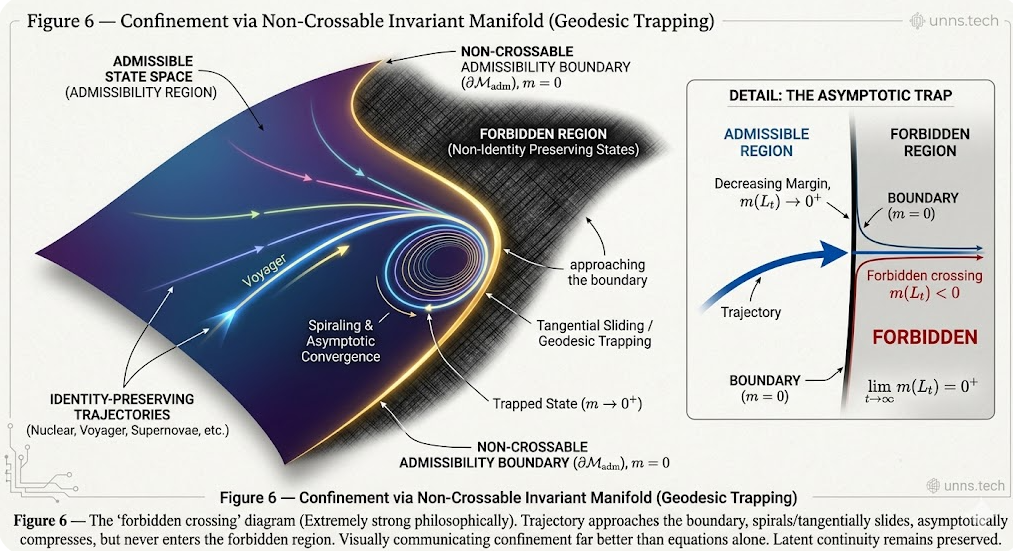
Physical systems under extreme forcing — nuclear detonations, stellar explosions, heliopause crossings, particle detector reconstruction pipelines — appear to approach structural disintegration. And yet they do not cross into persistent Hard fragmentation. The Margin-Confinement Law explains why: the admissibility boundary ∂ℳadm is a dynamically non-penetrable invariant manifold for identity-preserving flows.
Derived from the Universal Structural Law, the Percolative Realizability Principle, and Bounded Structural Rigidity, the law proves non-crossability by contradiction via a background-chain structural invariant and a Lyapunov-type confinement functional. Empirical support spans 15,401 evaluations across sixteen domains with zero genuine crossings.
A subsequent Δ-lifting stage on the neutrino detector corpus recovers Full percolation in all nine previously fragmented ladders (100% recovery rate), expanding FCC-like states from 5 to 34 and establishing the first operational evidence for latent structural continuity — continuity not recreated but uncovered. The manuscript frames confinement and recoverability as two sides of a single deeper invariance.
🔒 The Margin-Confinement Law
Physical systems under extreme forcing approach the admissibility boundary ∂ℳadm. Seismic waveforms fragment. Detector outputs lose connectivity. Plasma boundaries reorganize. And yet: no admissible system in the tested corpus ever crossed into persistent Hard fragmentation. Not as a statistical tendency. As a structural fact.
The proof proceeds by contradiction. Assuming a crossing occurs in finite time, one derives a structural impossibility: the background chain — a connected 1-subcomplex of the vulnerability graph guaranteed by the USL — cannot dissolve continuously. Its dissolution is required by the crossing hypothesis. Therefore no crossing occurs. A Lyapunov-type confinement functional supplies the dynamical counterpart.
Two Pillars — Confinement and Recoverability
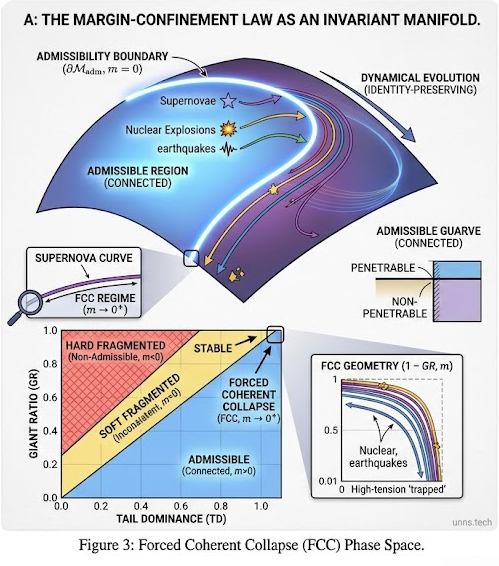
The law operates simultaneously at two levels: a topological level (the background chain invariant prevents discontinuous escape) and a dynamical level (the Lyapunov functional bounds margin from below). Together they yield two findings: forbidden collapse (Theorem 1 prohibits genuine Hard fragmentation under identity-preserving dynamics) and recoverable continuity (admissibility is an intrinsic local-relational property that re-emerges under locality-preserving transforms).
⚡ The Forced Coherent Collapse Regime
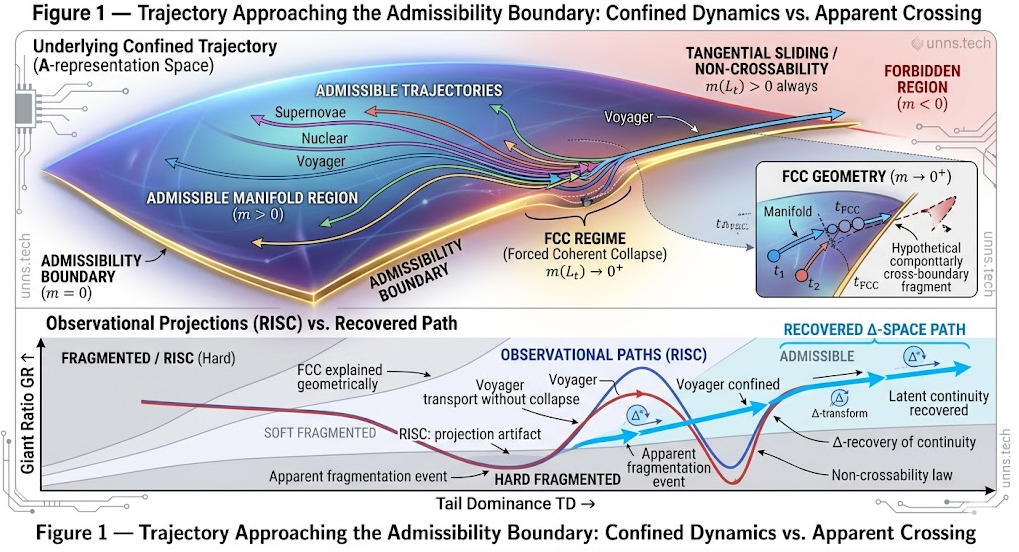
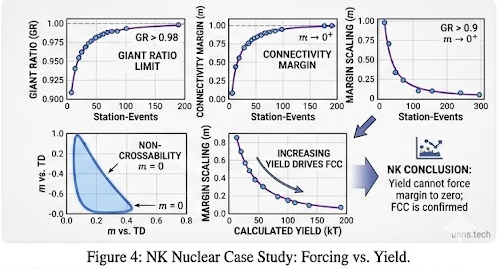
When admissible systems approach ∂ℳadm under extreme forcing, they enter the Forced Coherent Collapse (FCC) regime: tail dominance TD → 1, connectivity margin m(Lt) → 0⁺, giant-component coherence GR ≥ 0.97 persisting. The system compresses toward the boundary asymptotically. FCC is not a failure mode — it is admissibility-protected near-boundary compression, the geometric consequence of non-crossability.
FCC Coherence Is Locally Relational — A New Finding
The Δ-lifting stage reveals that FCC-like states persist under amplitude stripping, drift removal, and coordinate flattening. The bkg2*C14 series (raw TD ≈ 0.25–0.49) reaches TDΔ ≈ 0.99 in Δ-space. FCC coherence is carried by the local gap structure of the realizability ladder, not by global amplitude values. FCC is a local-relational boundary phenomenon — and a substantially stronger theoretical finding than previously recognized.
🔍 RISC — Observational vs. Ontological Collapse
The law's most practically important corollary is Representation-Induced Structural Collapse (RISC): a source system genuinely in ℳadm producing a HARD verdict through a representation that breaks local connectivity. The corpus motivates a distinction that sharpens the law considerably:
Observational Collapse
Representation-specific HARD fragmentation in a particular chart. Arises from RISC mechanisms: binning artifacts, orientation reversals, n-poverty, attenuation. Correctable by locality-preserving transforms. The source never left ℳadm. Exists in one chart; absent from locality-preserving transforms of the same source.
Ontological Collapse
Persistent loss of admissibility across all locality-preserving transforms — total destruction of giant-component structure no representation can recover.
Not observed in any tested corpus. Forbidden for identity-preserving flows by Theorem 1.
RISC's Principled Foundation Under the Law
RISC is not merely a classification of representational failures. Under Theorem 1, it is a precise account of apparent observational escape beyond ∂ℳadm while the underlying trajectory remains confined. The representation failed; the source did not. This gives RISC a rigorous theoretical foundation rather than a descriptive one.
⚛️ Neutrino Detector Corpus — A New Kind of Evidence
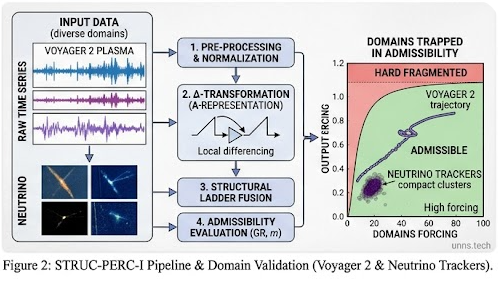
The neutrino detector observational corpus is the manuscript's theoretically richest single domain. 67 ladders across five distinct representation groups of the same underlying detector process — the most direct testbed for RISC in the UNNS program. The corpus completes the full manufactured-collapse / embedding-recovery / transform-recovery cycle within a single physical source.
Stage 1 — Raw Corpus: RISC as Operational Fact
The Strongest Single RISC Case
TMVA h_SigSB_significance_2 produces HARD (GR = 0.985, 1 isolated node) through classifier binning geometry. The corresponding deepL h_SigSB_significance_2 returns FULL (GR = 1.000, 0 isolated). Same observable. Same physics. Different chart. Different class. This HARD → FULL crossing is the clearest single RISC demonstration in the UNNS program.
Stage 2 — Δ-Lifting: Latent Continuity Recovery
100% RISC Recovery Under a Local, Non-Parametric, Deterministic Transform
Every one of the nine fragmented raw ladders — three HARD and six TAIL — recovers to GR = 1.000 in Δ-space. This includes all three HARD outcomes with identified artifact mechanisms: deepL_Graph;2 (n-poverty), hBkgeff (orientation reversal), TMVA_h_SigSB_2 (classifier binning). The gap structure of the source process retains intact admissibility geometry that classifier projections obscure.
The Most Profound Implication: Continuity Was Never Lost
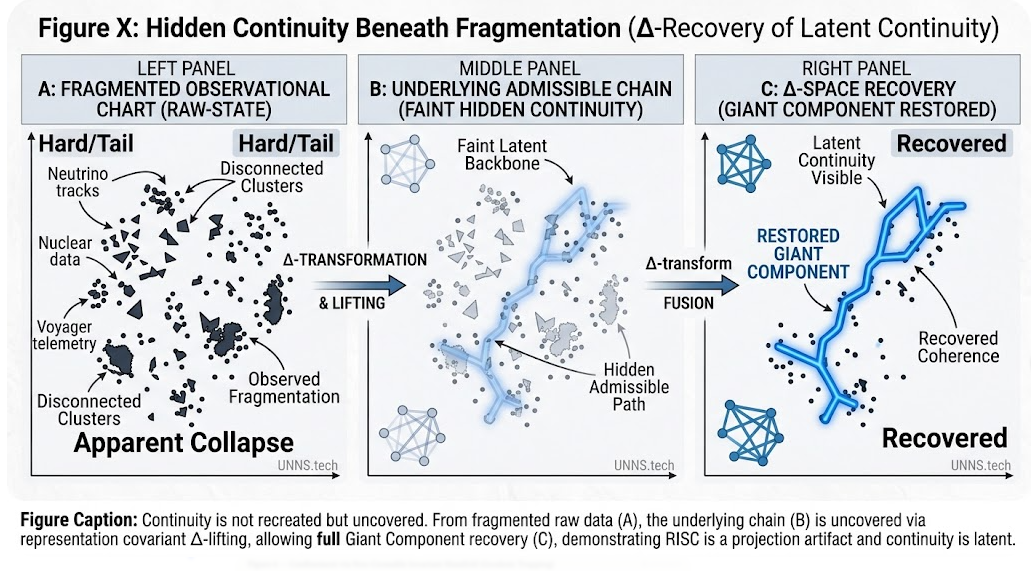
Recovery language implies the system broke and later healed. But the 100% recovery rate under a local transform suggests something more profound: in every RISC case, admissible continuity was never lost — it was only hidden.
Δ-lifting does not restore continuity. It uncovers continuity that was present all along.
The Complete Anti-Collapse Cycle
Three Stages — Same Source, Three Different Recoveries
(1) TMVA manufactures HARD — classifier binning geometry creates structural gaps.
(2) Deep-learning embedding removes it — deepL recovers Full for the same observable (Stage 1 RISC).
(3) Δ-lifting recovers Full from every fragment — regardless of artifact type (Stage 2, 9/9).
The source system never left ℳadm. The HARD verdict was a property of the observational chart, not the physics.
🌐 Representation-Covariant Admissibility
The Δ-lifting results motivate a theoretical extension beyond the law's proven content. Theorem 1 governs dynamical confinement under identity-preserving flows. The Stage 2 results suggest a complementary principle governing representational transforms.
L ∈ ℳadm ⟹ φ(L) ∈ ℳadm
The Δ-lifting stage of the neutrino corpus provides the first operational support: all nine fragmented ladders recover Full; no natural-representation admissible ladder fails except under identified n-poverty artifacts.
Transform Class Taxonomy
| Transform Class | Structural Effect | Corpus Example |
|---|---|---|
| Locality-preserving | Preserve or recover admissibility; resolve RISC artifacts | Δ-lifting → 9/9 Full recovery |
| Relational / embedding | May recover latent connectivity; approach admissibility | deepL embeddings → 21/23 Full |
| Projection / binning | Can induce RISC; destroy local connectivity | TMVA histograms → TAIL/HARD |
| Orientation-reversing | Inverts ladder chart; creates void at boundary | hBkgeff → HARD (RISC Type-II) |
| Identity-breaking | May genuinely destroy admissibility; violates IPF | Non-invertible coarse-graining |
📊 Empirical Support — 15,401 Evaluations, 0 Crossings
The law is supported across sixteen domains. In every case, zero genuine dynamical crossings of ∂ℳadm are observed. All HARD outcomes have identified representation artifact mechanisms consistent with RISC. At 99% confidence, the genuine crossing rate is bounded above by p < 3.0 × 10⁻⁴, consistent with the theoretical prediction of p = 0.
Physical Ladders
5,233 evaluations across atomic, molecular, nuclear, geoid, CMB, crystallographic, atmospheric, solar, cosmic web, biological systems.
0 violations · all domainsα–μ Constant Grid
9,826 phase-mapping evaluations at deformed physical constant values. Zero verdict changes. Zero commutators. Zero hard USL violations.
0 changes · 0 commutatorsHeliopause Crossing
3,500 |B| heliosheath windows. 97.4% Full percolation across a 7-year boundary approach and physical crossing.
97.4% Full · 0 HARDExplosion Corpus
29 station-events. TD reaching 0.997. GR ≥ 0.971. Margin decreases toward zero. FCC confirmed as the near-boundary state.
TD 0.997 · 0 HARDStage 1 + Stage 2
67 ladders × 2 stages. Stage 1: 6 RISC pairs, 5 FCC-like. Stage 2: 9/9 recovery, 34 FCC-like, first latent continuity corpus.
100% recovery · 0 USL violations💡 The Minimal Structural Principle and Programmatic Synthesis
Across RISC, Δ-lifting, FCC persistence, Voyager boundary transport, and latent continuity extraction, the corpus results admit a concise synthesis:
This principle is not a derived theorem. It is an empirical generalization recording the consistent pattern: confinement under dynamics (Theorem 1), representational recovery under Δ-lifting (Conjecture 1), boundary-adjacent resilience under extreme forcing (FCC), and long-range transport coherence (Voyager) all instantiate the same underlying structural tendency. The principle unifies these phenomena without asserting universality beyond the tested evidence.
The Conceptual Transition
The UNNS program's subject matter shifts from what class does a system occupy? to how does a system move within the invariant admissible manifold? This is the transition from classification theory to realizability dynamics. Admissibility is no longer a static property to check — it is a dynamical invariance to understand geometrically.
Alignment with Beyond Fragmentation
The Margin-Confinement Law and its companion manuscript Beyond Fragmentation are the empirical and theoretical halves of the same boundary framework:
| Dimension | Beyond Fragmentation | Margin-Confinement Law |
|---|---|---|
| Central question | What do extreme systems do near realizability boundaries? | Why do admissible systems fail to cross those boundaries? |
| FCC | Discovered as a descriptive regime | Explained as near-boundary asymptotic state under confinement |
| Voyager | Empirical near-boundary observation | First realization of a non-crossability trajectory |
| RISC | Classification of representational failures | Apparent escape while trajectory remains confined |
| m → 0⁺ | Observed without explanation | Derivable consequence: m cannot reach zero under IPF |
The Unified Boundary Theory
Together the two manuscripts suggest that physical collapse, in the sense relevant to realizability geometry, is asymptotic rather than trans-boundary: realizable structures may become arbitrarily stressed, tail-dominated, and near-critical while remaining structurally admissible.
Beyond Fragmentation assembled the evidence. The Margin-Confinement Law supplies the missing theoretical principle.