
The Structural Bridges
That Hold Reality Together
A new mathematical framework reveals that admissible physical configurations do not exist in isolation — they organize into connected basins, bridged by sparse continuity corridors, with fragmentation localized to single stitching junctions. Realizability space, it turns out, has genuine internal topology.
Admissible Cluster Geometry — cinematic visualization. Admissible configurations self-organize into coherent connectivity basins, bridged by sparse continuity corridors and separated by localized stitching barriers. What appears as fragmentation is typically a single boundary rupture in an otherwise globally coherent manifold.
Inside Admissibility Space, There Is Geometry
Every prior UNNS manuscript asked versions of the same fundamental question: where is the admissibility boundary, and what prevents systems from crossing it? The answers accumulated into a precise picture — the Universal Structural Law placed the boundary, the Connectivity Margin measured distance from it, and the Margin-Confinement Law proved the boundary is dynamically impenetrable. Together they established admissibility as a kind of protected territory.
But they left the interior of that territory completely uncharted. Is admissibility space uniform? Do systems cluster? How do they fail, and can failure be reversed? The new manuscript Admissible Cluster Geometry: Recoverable Connectivity in Realizability Space answers all of these questions — and the answers change what admissibility means.
Admissible systems do not occupy realizability space uniformly. They self-organize into coherent basins, connected by sparse continuity corridors, with fragmentation localized to single stitching junctions. ℳadm is not merely bounded — it is internally organized.
ADMISSIBLE CLUSTER GEOMETRY · CENTRAL FINDINGThree independent corpora drove this discovery: metallic glass spectral chemistry (500 ladders, SciGlass), neutrino detector reconstruction (67 ladders, liquid-scintillator pipeline), and a protein Markov State Model (5 ladders, 5,000 conformational states, Folding@home). Three domains with no chemical, physical, or biological overlap. The same internal pattern emerged in all three.
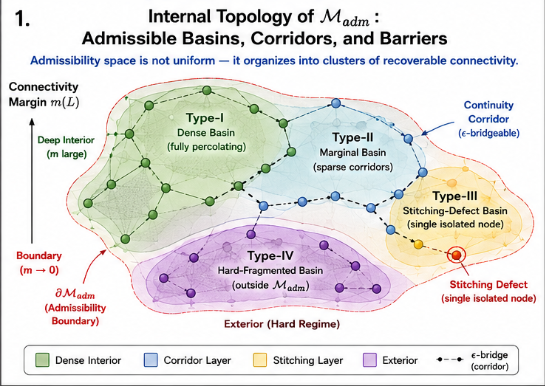
Four Basin Types, One Coherent Topology
The central structural discovery is that ℳadm is not a featureless interior — it is stratified into four distinct basin types, each with characteristic connectivity geometry, failure mode, and recoverability profile.
The most important distinction is between Type-III and Type-IV. When the STRUC-PERC-I instrument returns a HARD_FRAGMENTATION verdict, it does not mean the system has left ℳadm. In 80.4% of cases, the "fragmentation" is a single isolated node at the terminal gap — the giant component of n−1 vertices remains intact and percolating. The system is at the stitching boundary, not outside the manifold. True exteriority (Type-IV) is comparatively rare.
Stitching Failure: How Manifolds Break — and Why They Don't
The dominant fragmentation mechanism across all three corpora is not catastrophic structural collapse. It is something far more precise: a single gap in the sorted sequence that exceeds the IQR-scaled ε-budget. When that happens, one vertex — just one — cannot be bridged to the giant component. Everything else remains connected. The manifold is globally coherent; only one stitch has failed.
The terminal (largest) gap g_max stitches if: g_max ≤ κ_max · σ_IQR. If this fails, exactly one vertex becomes isolated — the remaining n−1 form an intact, percolating giant component. This is a binary threshold, not a continuum.
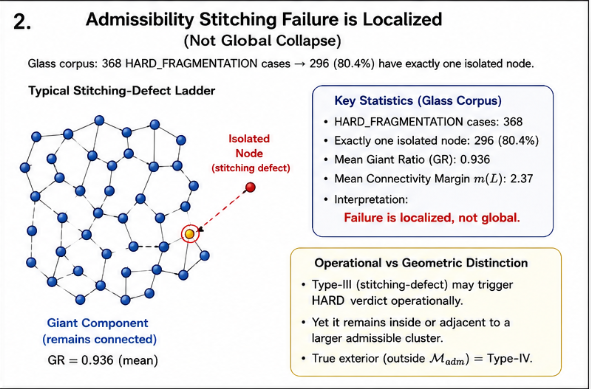
This is not an accident. The universal prevalence of single-node stitching defects across metallic glass chemistry, neutrino detector physics, and protein folding dynamics confirms something profound: admissible manifolds are structurally engineered for robustness. When they fail, they fail minimally. Global coherence is the default; localized rupture is the exception.
Latent Continuity: What Was Never Actually Lost
The neutrino corpus introduced the manuscript's most philosophically significant result. When the same physical observable is processed through different reconstruction pipelines — classical multivariate (TMVA) versus deep-learning — the TMVA representation produces Tail or even Hard fragmentation while the deep-learning representation recovers Full percolation. Same physics. Different charts.
Then a Δ-lifting stage — replacing each ladder value with the local gap to its successor — was applied to all nine raw-fragmented ladders. Every single one recovered Full percolation. 100% recovery rate.
Δ-lifting does not restore continuity. It uncovers continuity that was present all along — latent in the gap structure of the source process, hidden beneath the representational chart.
ADMISSIBLE CLUSTER GEOMETRY · §7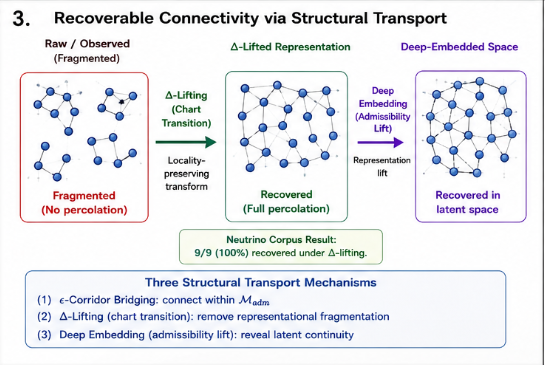
Three Transport Mechanisms
| MECHANISM | OPERATION | CORPUS EVIDENCE |
|---|---|---|
| ε-corridor bridging | Extend κ until dominant tail gap is bridged. Continuous transport within the same representational chart. | SnSe (κ=2.0): first resolved under extended GRID_G. Type-III → Type-I under κ extension. |
| Δ-lifting | Map L → ΔL = (|x_{i+1}−x_i|). Strips amplitude artifacts; preserves local gap ordering. | 9/9 fragmented neutrino ladders → Full. FCC-like states 5 → 34 (6.8×). 100% RISC recovery. |
| Deep-embedding lift | Trained non-linear manifold maps that preserve long-range ladder correlations better than histogram classifiers. | 21/23 deep-L neutrino ladders achieve GR = 1.000. One Hard → Full crossing (TMVA → deepL). |
Five Fixed Points That Don't Move
Among the most striking results of the study is the discrete, grid-invariant structure of κ-connectivity thresholds. Across 188 materials evaluated on seven different grid configurations — spanning 7.6× resolution range (17 to 129 points), 10× lower-boundary variation, and 2× upper-boundary variation — the κ_conn values collapse into exactly five fixed points.
The counts {2, 17, 155, 1, 1} are identical in every single configuration. The values are not grid-resolution artifacts. They are structural fixed points of the admissibility manifold itself — attractors of the percolation threshold operator T under IQR-scaling.
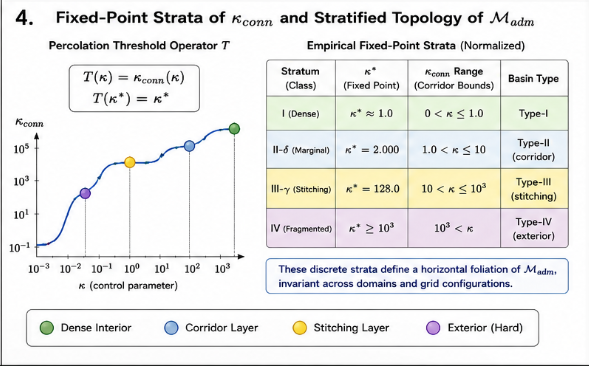
| κ* (FIXED POINT) | CLASS | COUNT | LAYER | CHEMISTRY |
|---|---|---|---|---|
| 0.562 | I-α | 2 | Dense interior | Nd₂S₃, Sc₂O₃ — ultra-tight gap basins |
| 0.750 | I-β | 17 | Dense interior | As₂Se₃, BaO, CaF₂, Ce, Dy, Eu, Hg, KF, RuO₂, Zn — chemically universal |
| 1.000 | I-γ | 155 | Dense interior | All 69 oxides + majority — natural IQR scale |
| 2.000 | II-δ | 1 | Corridor layer | SnSe — extended-range sparse corridor basin |
| 10.000 | Anomalous | 1 | Outlier | BiF₃ — over-compressed gap distribution |
Class I-β ($\kappa^* = 0.750$) is particularly striking: it contains selenides, oxides, fluorides, rare-earth elements, and transition metals — chemically diverse materials sharing an identical connectivity threshold. The fixed points are not chemical properties. They are structural invariants of the admissibility manifold under IQR-scaled ε-neighborhoods.
69 Out of 69: The Strongest Chemistry Finding
Perhaps the cleanest empirical statement in the manuscript: under normalized ladder representation, every single oxide material tested achieves Full Continuity. Not a statistical tendency — a structural invariant. Cr₂O₃, Al₂O₃, Bi₂O₃, CeO₂, Er₂O₃, Fe₂O₃, GeO₂, HfO₂, La₂O₃, MnO₂, Nb₂O₅, RuO₂, SiO₂, TiO₂, V₂O₅, WO₃, ZnO, ZrO₂, and 51 others — all 69: GR = 1.000, κ_conn finite, zero isolated nodes.
The reason is now precisely formulated. Oxide bonding geometry produces gap distributions with maximal bridge redundancy: multiple overlapping ε-neighborhoods span the dominant tail gap, so that even when one bridge fails, alternatives remain. The dominant tail gap never exceeds κ_max · σ_IQR in any oxide under normalized scaling. This is not "oxygen as glue atom" in a vague sense — it is k ≥ 2 bridge redundancy in the vulnerability graph.
Non-oxide materials — sulfides, fluorides, halides, elements — exhibit the full range of basin types (I–IV). No oxide appears in the fragmented class.
From Proteins to Detectors to Glass: The Same Geometry Everywhere
The protein Markov State Model corpus — 5,000 conformational states of a COVID-19 protein, derived from Folding@home — shows the same topology as the glass and neutrino corpora. Four of five ladder types achieve Full percolation. The outgoing-transition-strength ladder identifies exactly three kinetically isolated states: conformations with near-zero outgoing probabilities that fall below the IQR-scaled ε-budget. Three stitching defects in 5,000 states. GR = 0.9984 — the rest of the folding landscape is a single coherent Type-I admissible basin.
The pattern is always the same: a globally coherent admissible basin, punctuated by rare, localized stitching defects. The defects are the exception; admissibility is the rule. This holds in metallic glass spectral chemistry, in liquid-scintillator detector reconstruction pipelines, and in the conformational dynamics of a protein folding landscape. No chemical, physical, or biological connection between these three domains — yet identical internal geometry.
What Has Actually Changed
Previous UNNS manuscripts established where ℳadm is and why it cannot be exited. This manuscript establishes what is inside it. The upgrade in understanding is fundamental:
| PREVIOUS LAYER | NEW LAYER (ACG) |
|---|---|
| Admissibility boundary | Admissibility topology |
| Connectivity margin as distance | Basin geometry as angular structure |
| Confinement | Transport between basins |
| FCC boundary compression | Stitching boundary layer 𝒮 |
| Local rigidity (BSR) | Cluster organization |
| Realizability | Realizability geometry |
The deepest philosophical shift may be this: admissibility is not merely survival. It is recoverable structural coherence. And fragmentation is not structural collapse — it is a localized stitching failure, geometrically recoverable by representational transport to a more locality-preserving chart.
ℳadm is not a featureless interior. It is organized into four basin types (I–IV), five discrete κ-connectivity strata, continuity corridors, fragmentation barriers, and recoverable transport pathways. The admissibility manifold carries the structure of a stratified fibration over the base B = [0,1] × {κ_j}.
80.4% of HARD_FRAGMENTATION verdicts in the glass corpus have exactly one isolated node. The manifold remains globally coherent; only a single boundary rung fails to stitch. The decisive structural variable is not bulk tail dominance (which differs by only ΔTD = 0.0007 between Full and fragmented populations) but whether the single largest gap exceeds κ_max · σ_IQR.
Under normalized ladder representation, every tested oxide achieves GR = 1.000 with finite κ_conn. The mechanism is maximal bridge redundancy (k ≥ 2): oxide bonding geometry produces overlapping ε-neighborhoods that span the dominant tail gap via multiple independent paths. No oxide appears in the fragmented class.
The values {0.562, 0.750, 1.000, 2.000, 10.000} are structural fixed points of the admissibility manifold under IQR-scaling. Class counts {2, 17, 155, 1, 1} are identical across all 7 grid configurations — zero regime flips, zero κ-class drift. Class I-β (κ=0.750) contains selenides, oxides, fluorides, rare earths, and transition metals: chemistry-independent universality.
All nine raw-fragmented neutrino ladders recover Full percolation under Δ-lifting. The latent giant component was present in the source process all along — the representation artifact merely obscured it. FCC-like states expand from 5 to 34 (6.8×). Deep-learning embeddings produce similar admissibility recovery (21/23 ladders → GR = 1.000).
The protein MSM corpus shows 4/5 ladders at Full percolation with 3 kinetic traps (GR = 0.9984) — the same Type-III stitching-defect pattern as the glass and neutrino corpora. Three domains with no chemical, physical, or biological connection. The same internal geometry in all three.
Manuscript & Supporting Materials
- MANUSCRIPT Admissible Cluster Geometry: Recoverable Connectivity in Realizability Space — primary manuscript, 32 pages
- CORPUS Regime Map Analysis v3 — spectral corpus, 188 materials × 7 grid configurations
- CORPUS Neutrino Corpus Analysis — 67 ladders, two pipeline stages, Δ-lifting results
- PIPELINE Pipeline & Data — full extraction and analysis pipeline
- DASHBOARD Margin-Confinement Dashboard — interactive structural analysis
Companion Manuscripts
- MCLThe Margin-Confinement Law — non-crossability of the admissibility boundary
- USLThe Universal Structural Law v6 — admissibility bounds on ordering instability
- PRPThe Percolative Realizability Principle — realizability structure and classes
- BSRBounded Structural Rigidity and Representation-Driven Structure
- MARGINConnectivity Margin as a Coordinate of Realizability Space
- BEYONDBeyond Fragmentation — admissibility near extreme physical transitions
- DUALStructural Realizability and Dual Observability
- LOCALLocal Geometry of Realizability Boundaries
- UNIFInteraction Unification in the UNNS Substrate