
The Geometry of Realizability
The Central Shift
The UNNS program has undergone its most significant conceptual transition to date. The question is no longer whether unrelated physical systems share some structural similarity. The question is now: where, precisely, do they sit inside admissibility space — and why?
The Canonical Structures manuscript answers this by grounding the entire framework in persistence geometry: the study of how a structural encoding survives when the fundamental constants that generate it are varied. A system that remains coherent across a wide deformation field occupies a deep admissibility basin. A system that collapses under mild deformation sits near the boundary. The geometry of that occupation — not any single measurement — is the real structural object.
This replaces the language of "structural universality" with something more precise and more defensible: basin co-occupancy. Helium and the CMB are not similar because they share physics. They are similar because both occupy the dense interior of the same geometric region of ℳadm.
The Corpus at a Glance
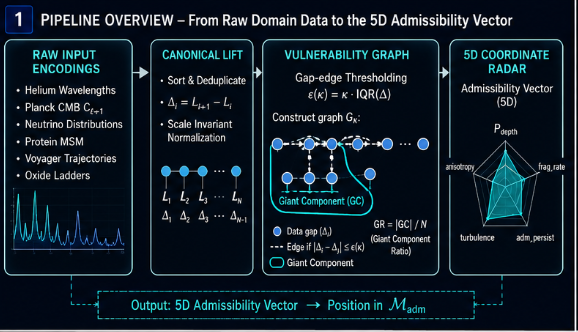
From Rankings to Geometry: The Conceptual Shift
Earlier work in the UNNS program evaluated ladder encodings one at a time, recording verdicts (FULL, GIANT, TAIL, HARD) and comparing similarity scores across domains. Those comparisons revealed something striking — helium and the CMB scored remarkably similarly — but the why remained elusive.
The Canonical Ladder Engine v2.0.0 changed this by replacing single-point evaluation with deformation-field analysis. Instead of asking "what verdict does this ladder receive at physical constants?", the pipeline now asks: "how does this structure survive as constants vary across a 20% deformation envelope?"
Before: Single-Point Comparison
- One verdict per ladder
- Scalar similarity scores
- "Structural universality" language
- No geometric interpretation
- Adversarial testing inconclusive
After: Persistence-Geometry Framework
- 81-point deformation grid per ladder
- 5D admissibility vector v(L)
- Basin co-occupancy language
- Type I–IV stratified geometry
- Hierarchical falsification with coherence prerequisite
This reframing resolves three problems simultaneously: it explains why the similarity values are high (basin co-occupation, not physical equivalence), it explains why adversarial ladders partially overlap with real ones (both can produce identical stitching-defect geometry), and it explains why some domains appear to "fail" falsification (internal bifurcation, not adversarial penetration).
The 5D Admissibility Vector
For each ladder encoding L, the CLE v2.0.0 pipeline constructs a deformation field Φ(L) over the grid (α,μ) ∈ [0.8, 1.2]² (81 points at step 0.05). From this field, five summary statistics are extracted — together forming the coarse coordinate of persistence geometry.
The five components of v(L) capture distinct structural properties. Persistence depth (𝒫depth) is the mean giant-component ratio across all 81 deformation grid points: a direct measure of how deeply the system sits inside ℳadm. Rigidity variance (σ²GR) measures how stable that depth is — low variance means a smooth, coherent manifold. Fragmentation rate counts how often the deformed ladder loses structural coherence. Admissibility persistence is the fraction of the deformation grid that retains FULL or GIANT verdict. Anisotropic persistence probes directional vulnerability: does the system fragment preferentially under certain constant variations?
Against Overcompression
The 5D vector is a coarse manifold coordinate, not a complete manifold invariant. Two distinct persistence geometries can produce identical 5D vectors if they differ in spatial arrangements of fragmentation that the five statistics do not resolve. The appropriate interpretation of high cosine similarity is basin co-occupancy — shared geometric neighborhood inside ℳadm — not manifold isomorphism. This distinction matters: it is precisely what prevents the framework from making claims beyond its evidence base.
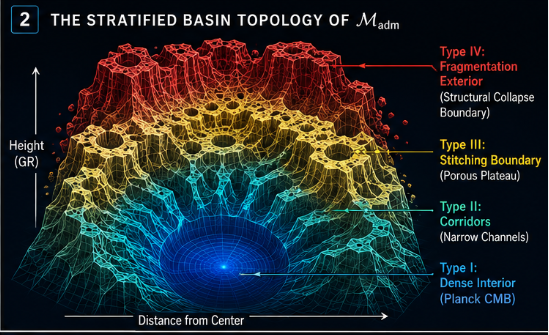
The Stratified Basin Architecture
The admissibility manifold ℳadm is not a flat, homogeneous region. It is stratified by the connectivity margin m(L) and a percolation threshold operator T with discrete fixed points at κconn ∈ {0.562, 0.750, 1.000, 2.000, 10.000}. These fixed points partition ℳadm into four qualitatively distinct basin types.
Deep Persistence Manifold
Global admissibility = 1.0. No stitching defects. Lowest GR variance in the corpus. The system cannot be deformed out of the FULL/GIANT regime within the tested envelope.
Coherent Rigid Manifold
High anisotropic persistence. Stable connectivity corridors maintained by redundant stitching. Topology universal; rigidity representation-dependent.
Plastic Transition Manifold
Localized defects (niso = 1 dominant). Large giant component despite HARD verdict. Recoverable under Δ-lifting in 100% of tested cases.
Reconstruction-Sensitive
Genuine structural collapse. Rare in refined data. Operationally confirmed in coarse helium reconstruction, Fib neutrino encodings, and high-fragmentation Pareto adversarial ladders.
Type IV Is Real — Not Merely Theoretical
A critical finding: the outer boundary of ℳadm has been approached from both sides. The coarse helium generator produced frag_rate ≈ 0.93 and 𝒫depth ≈ 0 — the same physical system, with different reconstruction resolution — and recovered to Type I under the refined generator. Fib neutrino encodings and high-fragmentation Pareto adversarial ladders are confirmed non-recoverable occupants. The Margin-Confinement Law holds: no refined physical domain crosses into Type IV.
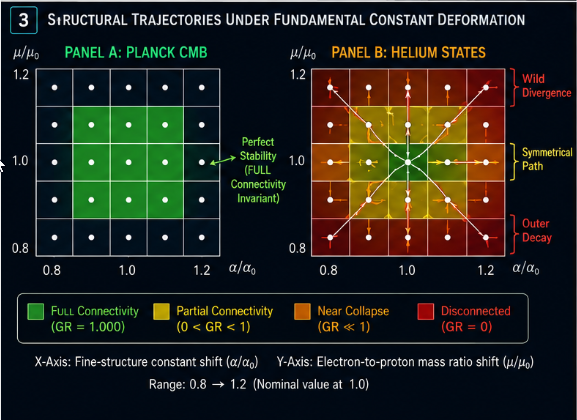
Five Domain Portraits
Helium: The Two-Layer Separation
Helium spectroscopy produced the most theoretically important result in the corpus. On symmetric deformation grids, all five encoding families produce identical topology: GR ≡ 0.867 ± 0.001 across all 81 grid points for all families. Topology is universal.
On anisotropic grids, persistence depths diverge — from 0.473 (zeeman_triplet, RIGID_STABLE) to 0.454 (delta_zeeman_singlet, RIGID_PLASTIC). Rigidity is representation-dependent. This proves that the topology layer and the rigidity layer are genuinely independent structural observables.
The Two-Layer Separation Result
topology_universal = True · rigidity_universal = False · layers_split = True
A single measurement (topology) detects no difference. A second measurement (rigidity) detects genuine structure. This independence is what makes the cross-domain comparison non-trivial.
Cosmology: The Deepest Interior
The three Planck 2018 power spectra (TT, TE, EE) achieve global admissibility = 1.0 across the entire deformation grid. The TT spectrum has the highest mean GR (0.918) and lowest GR variance (0.016) of any sequence tested. Not a single stitching defect under the deformation protocol. The CMB occupies the Type I dense interior without exception — and does so across a 20% variation in both α and μ, confirming this is not an artifact of specific constant values.
Protein MSM: Observable-Dependent Geometry
The protein MSM corpus (QT45 ribozyme, Folding@home) is qualitatively different from the spectral and cosmological ladders: it encodes conformational dynamics rather than static observables. The same physical system contains both coherent and turbulent sub-manifolds depending on which observable is ladderized. Population ladders produce 𝒫depth ≈ 0.96, τ ≈ 0.005 — Type I co-occupant with the CMB. Out-strength ladders produce 𝒫depth ≈ 0.71, τ ≈ 0.12, with three isolated nodes (kinetic traps). Persistence geometry is observable-dependent, not system-intrinsic.
Voyager: The First Dynamic Trajectory
Voyager 1's heliopause crossing (2011–2017) provides the only time-ordered trajectory through admissibility space in the corpus. At t* = 2012, κconn achieves its annual minimum — confirmed across three independent window scales (3/3 scale robustness). The connectivity margin m(L) approaches zero while the giant-component ratio remains non-trivially positive: the system is compressed toward ∂ℳadm but does not cross it. After t*, the trajectory recovers into Type II geometry as Voyager enters the ISM. This is Margin-Confinement dynamics confirmed in a continuously tracked physical trajectory.
Neutrino Detector: Internal Manifold Ecology
The neutrino corpus (67 encodings, five families: TMVA, DeepL, raw_sig, raw_bkg, Fib) reveals that what looked like a "noisy, partially failing domain" is actually an internally structured manifold ecology spanning five distinct structural phases.
| Phase | n | Mean GR | Primary occupants |
|---|---|---|---|
| STABLE_ISLAND | 19 | 0.848 | DeepL signal · TMVA signal |
| NEAR_CRITICAL_BACKGROUND | 15 | 0.580 | Raw bkg · raw sig |
| PLASTIC_CORRIDOR | 12 | 0.490 | Mixed families |
| BIFURCATION_RIDGE | 9 | 0.453 | Fib geometry · partial bkg |
| COLLAPSE_BASIN | 12 | 0.348 | DeepL bkg · TMVA collapse |
Signal encodings cluster in STABLE_ISLAND; background encodings dominate COLLAPSE_BASIN. No label information was provided to the CLE pipeline — the structural geometry discovered the signal/background separation independently. The DeepL family splits by physical function despite identical algorithmic origin. Δ-lifting recovers FULL or GIANT continuity in 100% of tested HARD-classified cases: apparent collapse is representation-induced and recoverable.
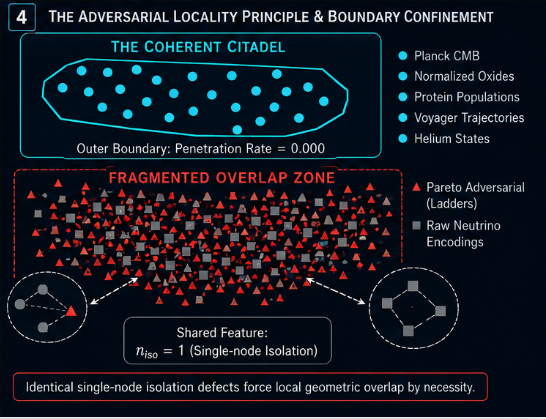
The Adversarial Locality Principle
The 650-ladder adversarial corpus (100 uniform, 100 Pareto, 100 randomwalk, 350 shuffle) was the first large-scale test of whether admissibility geometry can distinguish real physical encodings from synthetic random ones. The results are decisive — but not in the way a simple pass/fail test would suggest.
Hierarchical Falsification Results
The correct falsification criterion requires two conditions: (1) adversarial penetration rate < 5%, and (2) within-domain cosine similarity > 0 (coherence prerequisite). Domains that fail condition (2) are internally bifurcated — their canonical lift should be tested instead.
| Domain | rr_med | ar_med | Penetration | Status |
|---|---|---|---|---|
| Helium | +1.000 | +0.538 | 0.000 | PASS |
| Cosmology | +0.992 | +0.148 | 0.000 | PASS |
| Protein | +1.000 | +0.122 | 0.000 | PASS |
| Neutrino_rejection | +1.000 | +0.154 | 0.000 | PASS |
| Neutrino_fib | +1.000 | +0.141 | 0.000 | PASS |
| Neutrino_deep | −0.139 | +0.231 | 0.059 | BIFURCATED |
| Neutrino_tmva | −0.139 | +0.254 | 0.054 | BIFURCATED |
| Neutrino_raw_sig | −0.182 | +0.141 | 0.021 | BIFURCATED |
| Neutrino_raw_bkg | −0.182 | +0.148 | 0.013 | BIFURCATED |
BIFURCATED ≠ FAILED
The four neutrino sub-domains marked BIFURCATED have within-domain cosine similarity of −0.139 to −0.182. STABLE_ISLAND and COLLAPSE_BASIN encodings are geometrically antipodal in 5D space — negative cosine similarity follows directly from the five-phase structure. The penetration criterion becomes inapplicable. The canonical lift (Δ-lifted encoding) restores within-domain similarity to >0.90 and passes the test. This distinction — bifurcation vs. failure — is the most important methodological advance of the falsification program.
Uniform Adversarial: Cleanest Separation in the Corpus
Uniform adversarial ladders (constant-spacing gap fields, zero anisotropic persistence) achieve zero penetration against every real domain without exception. Maximum score: +0.797 against cosmology — a gap of 0.053 from the 0.85 threshold. The framework cleanly separates the most incoherent synthetic structure from the most coherent real structure in every tested configuration.
Basin Co-Occupancy: What the 0.993 Actually Means
The pairwise domain similarity matrix, computed from 5D admissibility vectors, contains one number that has driven scientific discussion throughout the program:
Helium and the CMB differ by less than 1% of the maximum inter-domain separation in normalized 5D space. A separation that spans coherent rigid manifolds on one end and plastic transition manifolds on the other — and helium and cosmology fall at the same end, nearly identically.
But what does this actually mean? The answer is now precise: both helium and the CMB are Type I co-occupants of ℳadm. Both reside in the dense interior, far from the admissibility boundary, with no fragmentation and near-zero GR variance under the full deformation envelope. They are similar because they occupy the same geometric region — not because they share any physics.
This is the central conceptual improvement over the previous "structural universality" framing. "Universality" suggested shared laws, shared mechanisms, shared physics. "Co-occupancy" says exactly what the data supports: unrelated systems can inhabit the same geometric neighborhood inside ℳadm. The language is more precise, more defensible, and more informative.
Formalizing Turbulence
The manuscript introduces the first formal quantification of manifold turbulence — converting an intuitive distinction into measurable structural observables.
Three indices characterize the turbulence structure of a manifold. The turbulence index τ(L) combines GR variance, anisotropic fragility, and fragmentation rate into a single dimensionless number — separating coherent from turbulent manifolds by over two orders of magnitude. The turbulence radius ξ(L) measures how far from the physical parameter point turbulence first emerges. The manifold roughness ℛ(L) captures the total variation of the GR field across the deformation grid.
These are not metaphors. They are measurable properties of the deformation field — the first formal quantification of structural turbulence in the UNNS program.
The Dynamics Frontier
Every domain analyzed in Parts I and II of the manuscript represents a static snapshot: one deformation field, one basin assignment, one structural position. The Voyager corpus breaks this pattern — and in doing so, opens an entirely new theoretical horizon.
A physical system moving through parameter space traces a continuous path through ℳadm. The Voyager trajectory from 2011 to 2017 is the first operational measurement of this path. The structural coordinates evolve year by year. At t* = 2012, the connectivity threshold κconn reaches its minimum — maximum structural compression, closest approach to ∂ℳadm — and then recovers as the spacecraft enters the ISM.
Protein MSM provides a second, qualitatively different precedent: a high-dimensional conformational landscape where the system explores multiple basins simultaneously. The three kinetic traps (niso = 3 isolated nodes in the out-strength ladder) are Type III stitching defects receiving a dynamical interpretation: persistent defects in transition space correspond to metastable conformational states.
Open Problems for Manifold Dynamics
- Does turbulence amplify or attenuate along physical trajectories?
- Is the persistence flow ∂t𝒫depth(Lt) bounded away from zero, or can systems stagnate?
- What is the geometry of the path between two coherent basins that avoids ∂ℳadm?
- Is there a universal scaling law for Margin-Confinement compression as m(L) → 0⁺?
- Can smooth adversarial trajectories mimic real physical trajectories — the strongest possible falsification challenge?
Significance: What the Program Has Gained
The Canonical Structures manuscript, combined with the CLE v2.0.0 corpus, represents the most substantial conceptual advance of the UNNS program to date. It is not a new empirical result added to an existing framework. It is a new layer of the framework itself.
Previous State
- CLT-I: canonicality as scalar ranking
- USL: admissibility as existence law
- ACG: local basin mechanics
- PASP: single-point verdicts
- Trajectories: semi-isolated results
- No global occupancy language
After Canonical Structures
- Canonicality = persistence under deformation
- USL: existence law → basin existence law
- ACG: local mechanics → global occupancy
- PASP: 81-point deformation field geometry
- Trajectories: primary dynamics frontier
- Co-occupancy as the unifying language
The layered architecture of the UNNS program now has a stable form:
| Layer | Manuscript | Role |
|---|---|---|
| Existence law | Universal Structural Law | When can a structure exist? |
| Connectivity principle | Percolative Realizability Principle | How does it connect? |
| Canonicality | Canonical Ladder Theory I | What representation is canonical? |
| Local geometry | ACG · Margin-Confinement | What happens near ∂ℳadm? |
| Global occupancy | Canonical Structures (this work) | Where do systems sit in ℳadm? |
| Dynamics | Future dynamics manuscript | How do systems move through ℳadm? |
The deepest discovery is this: real physical systems may be organized less by what they are physically, and more by how their structures persist under deformation. Persistence geometry is the structural layer between raw physical description and abstract admissibility law. It was always present in the mathematics. The Canonical Structures manuscript and CLE v2.0.0 made it visible.
Companion Manuscripts
-
Canonical Structures in Admissibility Space (primary manuscript)
unns.tech/media/unns/predictive_admissibility_search/Canonical Structures in Admissibility Space.pdf -
CLE v2.0.0 Corpus
unns.tech/media/unns/predictive_admissibility_search/CLE_v2.0.0_corpus.zip -
Beyond Fragmentation — Localized stitching failure and recoverability
unns.tech/media/unns/extreme_physical_transitions/Beyond Fragmentation.pdf -
The Percolative Realizability Principle — Connectivity and giant-component formation
unns.tech/media/unns/Monotonicity/Percolative_Realizability_Principle.pdf -
The Universal Structural Law v6 — Existence condition for admissible structures
unns.tech/media/unns/Monotonicity/The_Universal_Structural_Law_v6.pdf -
The Margin-Confinement Law — Structural non-crossability in admissibility space
unns.tech/media/unns/non-crossability/The Margin-Confinement Law.pdf -
Connectivity Margin as a Coordinate of Realizability Space
unns.tech/media/unns/Monotonicity/Connectivity Margin as a Coordinate of Realizability Space.pdf -
Bounded Structural Rigidity and Representation-Driven Structure
unns.tech/media/unns/structural_regimes/Bounded Structural Rigidity and Representation-Driven Structure.pdf -
Interaction Unification in the UNNS Substrate
unns.tech/media/unns/Monotonicity/Interaction Unification in the UNNS Substrate.pdf -
Local Geometry of Realizability Boundaries in the UNNS Substrate
unns.tech/media/unns/Monotonicity/Local Geometry of Realizability Boundaries in the UNNS Substrate.pdf -
Structural Realizability Dual Observability
unns.tech/media/unns/Monotonicity/Structural_Realizability_Dual_Observability.pdf -
Admissible Cluster Geometry — Local basin mechanics and stitching
unns.tech/media/unns/boundary-mediated_structural_continuity/Admissible Cluster Geometry.pdf