
When Collapse Does Not
Mean Fragmentation:
Boundary Routing Across
Admissible Structural Regimes
Core Result
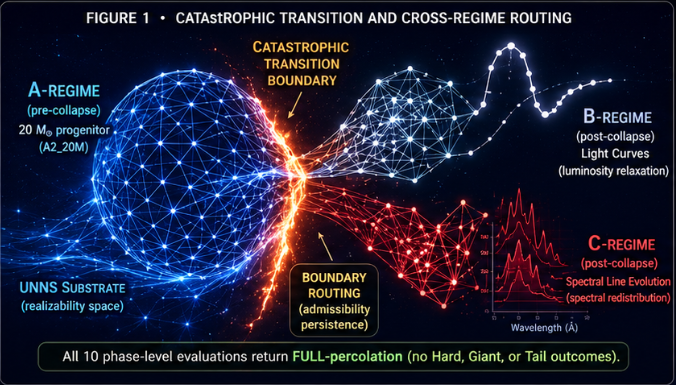
The Stellar Boundary Dynamics I corpus processes pre-supernova radial profiles, post-collapse light curves, and post-collapse spectral time series through STRUC-PERC-I v2.5.0 and a unified ABC tri-domain bridge. All 10 phase-level evaluations return Full-percolation with zero Hard, Giant, or Tail outcomes. But the structural coordinates change dramatically across representations: κ-connectivity spans five decades from Phase A to Phase C, and tail dominance escalates from zero to 0.959.
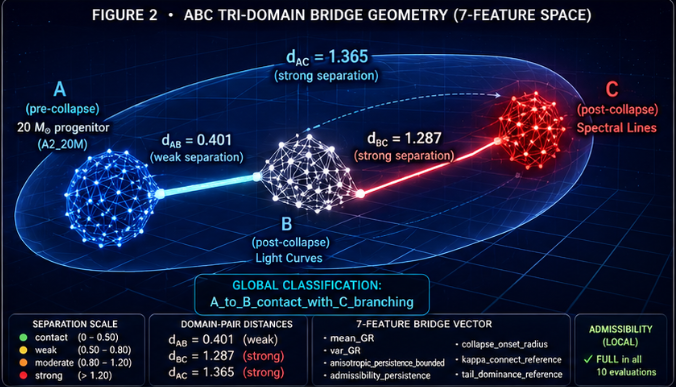
The ABC bridge classifies the global routing geometry as A_to_B_contact_with_C_branching: the pre-collapse structure (A) and post-collapse light curves (B) are weakly separated (d = 0.401), while the spectral evolution layer (C) branches strongly away from both (dBC = 1.287, dAC = 1.365). This is not a simple A→B→C chain. It is admissible regime routing.
The manuscript introduces four formal structures: a definition of admissible boundary-routing events, a proposition that Full-percolation does not imply cross-regime equivalence, a pilot-corpus empirical theorem, and the Boundary Routing Conjecture — applicable beyond supernovae to any multi-observable catastrophic physical event.
🌟 The Main Discovery: Collapse as Routing
The central result of the Stellar Boundary Dynamics corpus is not merely that supernovae remain structurally admissible after collapse. That result, while striking, is the expected outcome under the Margin-Confinement Law. The real discovery is subtler and more consequential:
This is what the final ABC bridge classification establishes. When all three observational layers of a core-collapse supernova are embedded in a common seven-feature bridge-vector space, the routing geometry is:
This geometry reverses the naive expectation. The pre-collapse stellar interior and the post-collapse light-curve response are structurally close — A and B remain in weak contact, with the 20 M☉ progenitor (A2_20M) sitting nearest to SN1993J in the bridge space. But the spectral evolution layer (C) branches away strongly, placing it far from both A and B. Two different physical observables of the same event class occupy structurally distinct positions — and the bridge measures that separation precisely.
🔑 The Conceptual Gain: Full-Percolation ≠ Cross-Regime Equivalence
The strongest theoretical result of the corpus is captured in Proposition 6.2 of the manuscript. It is simple to state and far-reaching in its implications:
Full(A) ∧ Full(B) ∧ Full(C) ⇏ A ≈bridge B ≈bridge C
All three phases are internally admissible. The bridge geometry shows they are not the same structural regime.
Earlier UNNS work focused on the binary question: does a system remain admissible, or does it collapse into Hard fragmentation? This corpus reveals a second layer of structure. A system can be Full-percolating in every representation it is tested against, while those representations occupy structurally separated positions in bridge space. The UNNS vocabulary is now refined:
Local Structural Viability
Measured by STRUC-PERC-I percolation verdicts. A phase-level evaluation returns Full when its ladder connects with giant ratio GR = 1.000 and zero isolated nodes.
All 10 evaluations in this corpus are locally viable. Pre-collapse profiles, light curves, and spectral series all return Full-percolation.
Verdict is not the same as regime identity.
Global Regime Relation
Measured by bridge geometry. The ABC bridge computes centroid distances between domains in the unified 7-feature vector space, revealing whether phases are continuous, weakly separated, or strongly separated.
A and B are weakly separated (d = 0.401). C is strongly separated from both (d > 1.28).
Bridge geometry is required to determine regime relation.
Why This Distinction Matters
Percolation establishes that a system is structurally viable — it has not fragmented. Bridge geometry establishes whether two systems occupy the same structural regime. These are different questions. A corpus can show 100% Full-percolation while simultaneously showing strong cross-regime separation. That is precisely what this corpus does. The distinction between local viability and global regime identity is probably the most important conceptual contribution of the entire manuscript.
📊 What the Data Showed: Three Layers, One Event Class
The corpus constructs three observational phases from a single class of physical events — core-collapse supernovae — and processes each through the full UNNS structural pipeline: domain ladder construction, STRUC-PERC-I evaluation, alpha-application, v2 normalization review, and bridge comparison.
Radial Profiles
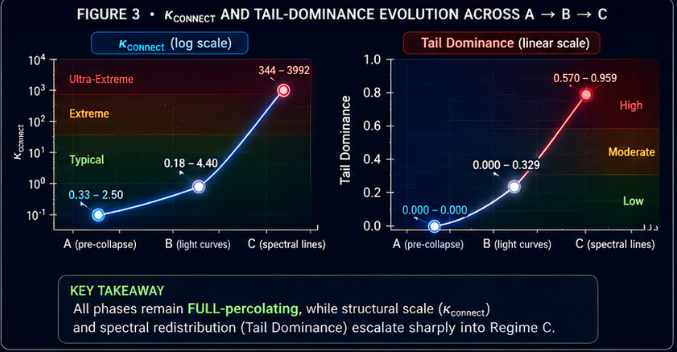
2 MESA terminal pre-SN snapshots from Zenodo 5556959. A1_12M (12.09 M☉) and A2_20M (19.98 M☉), n = 64 rungs each. κ = 1–2 · Tail dominance = 0.000.
The pre-boundary support structure of the stellar system. Composition-channel dominance up to 254.5× in A2_20M required v2 normalization.
Light Curves
6 core-collapse SNe from OSC/AstroCats. SN1987A · SN1993J · SN1999em · SN2011dh · SN2012aw · SN2013ej. κ = 0.18–4.40 · TD = 0–0.329 (SN2012aw only).
The luminosity relaxation channel. SN2012aw anomaly: highest κ and only non-zero tail dominance in Phase B.
Spectral Series
2 spectral time series from WISeREP. SN1993J (685 rows · 99 spectra) and SN2012aw (198 rows · 84 spectra). 8 line-window features per spectrum. κ = 201–3992 · TD = 0.570–0.959.
The spectral redistribution channel. SN2012aw achieves κ = 3,992 and TD = 0.959 — the highest structural coordinates in the entire corpus.
The κ-Connectivity and Tail-Dominance Trajectory
Although every evaluation returns Full, the structural coordinates change dramatically across phases. This is the central observation that motivates the boundary-routing theory:
The Key Insight: Admissibility Persists, Structural Scale Escalates
Phase A structures percolate at κ = 1–2. Phase C structures percolate at κ = 201–3,992. That is a factor of 200–2,000 in the required connectivity scale. Tail dominance goes from exactly zero in Phase A to 0.959 in C2 (SN2012aw). And yet the percolation verdict never changes. Full-percolation is maintained across five decades of structural scale change. This confirms the representation-dependent nature of structural position: the same physical event class occupies vastly different coordinates depending on which observable channel is used.
🌀 Two Object Archetypes: Contact-Chain vs Branching-Anomaly
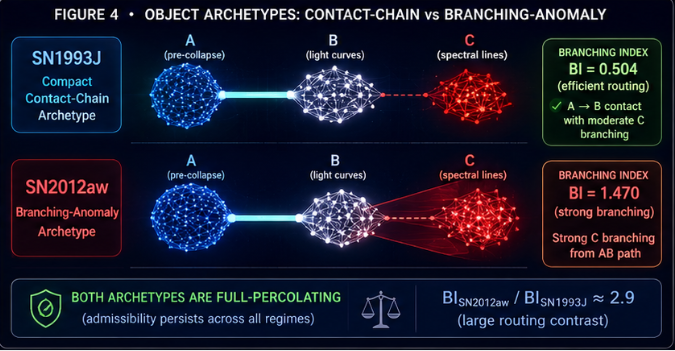
Within the pilot corpus, two objects span the full range of boundary-routing behavior. SN1993J and SN2012aw appear in both Phase B (light curves) and Phase C (spectral series), making full three-layer chain analysis possible. Their routing geometries are strikingly different:
SN1993J — Contact-Chain Archetype
Chain: A2_20M → B_SN1993J → C1_SN1993J
A→B distance: 0.150 (corpus minimum)
B→C distance: 0.654
A→C distance: 0.661
Branching index: BI = 0.504
The chain is nearly equilateral: dAC ≈ dBC. SN1993J demonstrates that the stellar boundary can be traversed with near-linear structural inheritance across all three observable layers. It is the closest object to the A domain across the entire Phase B corpus.
Compact geometry · coherent routing · near-linear inheritance.
SN2012aw — Branching-Anomaly Archetype
Chain: A2_20M → B_SN2012aw → C2_SN2012aw
A→B distance: 0.438
B→C distance: 1.908
A→C distance: 2.009
Branching index: BI = 1.470
The B→C step (1.908) is nearly 3× SN1993J's B→C step (0.654). SN2012aw's spectral layer (C2) is the most structurally displaced object from its progenitor in the entire corpus — yet it remains fully percolating. This is the defining characteristic of a persistent admissible anomaly.
Elongated geometry · anomalous routing · 2.9× branching contrast.
The Theoretical Significance of SN2012aw
SN2012aw is not an outlier in the sense of failure. It is Full-percolating in Phases A, B, and C. It is an outlier in the sense of routing extremity: it occupies the most displaced position from its progenitor in each successive observable layer. This gives the theory a useful new category: the persistent admissible anomaly. An object that remains inside ℳadm at all times, but that maps to extreme high-κ / high-TD regions of structural space. Anomaly ≠ failure. Anomaly = extreme admissible routing position.
📐 The Formal Spine: Definition, Proposition, Theorem, Conjectures
The manuscript establishes a compact formal layer sufficient to express the boundary-routing theory precisely without overclaiming universality from a pilot corpus.
Full(A) ∧ Full(B) ∧ Full(C) ⇏ A ≈bridge B ≈bridge C
The ABC bridge gives dAB = 0.401 (weak sep.), dBC = 1.287 (strong sep.), dAC = 1.365 (strong sep.).
⚙️ Orthogonal Structural Drivers: A→B and B→C Are Different Moves
A feature-level analysis of the ABC centroid shifts reveals a technically significant finding: the A→B and B→C transitions are governed by different structural coordinates. The boundary does not produce one uniform deformation. Different observable channels activate different structural dimensions.
A→B Transition Driver
Dominant feature shift: collapse_onset_radius (+0.250)
The geometric coordinate describing where photometric-response onset begins relative to the pre-collapse radial structure. Moving from radial profiles to temporal brightness trajectories shifts this coordinate sharply, while tail dominance and κ-connect remain near zero.
A geometric onset coordinate governs the entry into the light-curve regime.
B→C Transition Driver
Dominant feature shifts: tail_dominance (+0.740) and kappa_connect (+0.525)
Moving from light curves to spectral series activates the connectivity-depth and gap-outlier dimensions. The spectral layer requires far larger κ-scale to percolate and has far higher tail dominance — both signatures of the heterogeneous, multi-feature spectral line landscape.
Connectivity scale and redistribution heterogeneity govern the spectral branch.
Why Orthogonal Drivers Matter
If A→B and B→C were the same structural move at different scales, one would expect the same feature coordinates to dominate both transitions. They do not. The boundary event is not one simple deformation — it activates different structural coordinates depending on which observable channel is entered. This mechanistically explains why A–B and B–C are not merely two steps along a single path. They are structurally orthogonal transitions, which is exactly what the routing geometry shows: C does not continue from B in the direction established by A→B. It branches.
🔗 Relation to the UNNS Theoretical Architecture
The Stellar Boundary Dynamics corpus connects to and extends several foundational UNNS manuscripts. Each connection is precise and additive rather than merely confirmatory.
Margin-Confinement Law
The Margin-Confinement Law establishes that identity-preserving trajectories cannot cross ∂ℳadm into persistent Hard fragmentation. The stellar corpus supports this: even catastrophic collapse data returns Full-percolation in all 10 evaluations, with zero Hard outcomes. But this manuscript extends the law in a new direction:
MCL Extension: Beyond Confinement
The Margin-Confinement Law tells us: physical systems remain admissible. Boundary routing adds: admissible systems can still split into non-equivalent regimes. Confinement within ℳadm is compatible with strong cross-regime separation. This corpus provides the first instance in which that separation is directly measurable through bridge geometry on real astrophysical data.
Percolative Realizability Principle
The PRP gives the local structural verdict: Full, Giant, Tail, or Hard. This corpus shows that the local verdict is necessary but not sufficient for a complete structural description of a multi-observable event. Bridge geometry adds the inter-regime layer:
PRP + Bridge = Complete Structural Picture
Percolation establishes local structural viability. Bridge geometry establishes cross-regime relation. A corpus can show 100% Full-percolation while exhibiting strong separation between regimes — as this corpus does. Both tools are required for a full structural diagnosis.
Admissible Cluster Geometry
The ACG manuscript describes ℳadm as internally structured into basins and bridgeable regions. Stellar Boundary Dynamics adds a dynamic mechanism:
ACG Extended: Dynamic Basin Generation
ACG asks: how do admissible clusters exist and connect? Stellar Boundary Dynamics asks: how can a catastrophic physical event route a system between such clusters? The corpus shows that collapse itself may generate or activate distinct admissible basins — A, B, and C as three separate basins, produced by the collapse event. This complements the static ACG picture with a dynamic view of how basins arise through boundary-routing.
🌐 Broader Implications: Beyond Supernovae
The boundary-routing pattern identified in the stellar corpus is not inherently astrophysical. It is a structural template:
The General Pattern
A = pre-boundary support state
B = first post-boundary relaxation observable (close to A)
C = second post-boundary redistribution observable (strongly separated from both A and B)
Drivers of A→B and B→C are orthogonal structural coordinates, not a single deformation.
Possible physical analogues where the same three-layer boundary-routing architecture may apply:
| Domain | Layer A (pre-boundary) | Layer B (first observable) | Layer C (second observable) |
|---|---|---|---|
| Earthquake rupture | Pre-stress field | Seismic waveform | Aftershock field |
| Phase transitions | Pre-transition material | Thermal response | Structural phase signature |
| Biological collapse | Pre-perturbation regulatory state | Population response | Molecular expression response |
| Plasma events | Pre-flare magnetic field structure | Emission curve | Spectral redistribution |
The Boundary Routing Conjecture (Conjecture 6.6) is proposed as a general structural principle testable across all these domains through the same bridge-vector methodology. Stellar collapse is the first test case — the clearest, highest-energy instance — of a theory that may prove domain-general.
✨ The Revelation
In older language, catastrophe means rupture, discontinuity, fragmentation, or loss. The Stellar Boundary Dynamics corpus proposes a different structural possibility. The pre-collapse star cannot continue as the same object through collapse. Identity-preserving continuity fails. But the structural system does not become incoherent. Instead, it appears in downstream observational regimes — light curves and spectral evolution — that are each internally connected, each admissible, and structurally distinct from one another.
This gives the UNNS program a new theoretical object and a new structural claim:
Not just a dataset. Not just a manuscript. A new structural theory of what catastrophic boundaries do — and evidence that the first hard test, stellar core collapse, passes.
Manuscript and Resources
- Primary manuscript: Stellar Boundary Dynamics: Catastrophic Transition as Routing Between Admissible Structural Regimes
- Corpus analytics: stellar_boundary_dynamics_analytics.html
- Corpus archive: stellar_boundary_dynamics.zip
Companion Manuscripts
- The Margin-Confinement Law: Structural Non-Crossability in Admissibility Space
- The Universal Structural Law v6
- Percolative Realizability Principle
- Admissible Cluster Geometry
- Beyond Fragmentation: The Forced Coherent Collapse Regime
- Connectivity Margin as a Coordinate of Realizability Space
- Bounded Structural Rigidity and Representation-Driven Structure
- Local Geometry of Realizability Boundaries in the UNNS Substrate
- Structural Realizability and Dual Observability
- Interaction Unification in the UNNS Substrate