
Admissible Boundary Routing:
What Structurally Replaces the Big Bang Singularity?
Abstract
Standard descriptions of cosmological singularity removal operate at two levels: the equation level (whether the dynamics diverge) and the observable level (whether density and curvature remain bounded). Neither fully characterizes what structurally happens at the critical regime.
This manuscript introduces a third level — the route-topology level — and applies it to three matched synthetic cosmological trajectories: classical Friedmann contraction (Dataset A), an effective Loop Quantum Cosmology bounce (Dataset B), and Planck 2018-anchored ΛCDM expansion (Dataset C). All three canonical direct encodings return Full percolation, but the orientation-sensitive Bridge v1.1 identifies three fundamentally different route classes: represented terminal approach, finite turning-locus routing, and boundary recession.
The central finding: singularity avoidance is not fully characterized by bounded curvature alone. Structurally, it is the replacement of terminal route topology by admissible turning topology. This result is supported by direct connectivity, structural-pressure, α-deformation, and orientation-sensitive bridge analyses across all three datasets.
🔭 The Question That Started This
Physics has long known how to remove the classical Big Bang singularity at the equation level: quantum gravity corrections, loop quantization, or effective field theory modify the Friedmann dynamics so that density remains bounded and the scale factor never reaches zero. Standard Loop Quantum Cosmology, for example, replaces the classical divergence with a finite bounce at a critical density ρc.
But a fundamental question remained unanswered:
The UNNS Substrate program introduces that language. Rather than asking only whether a singularity is removed, it asks what kind of structural route replaces the classical terminal path. This is the route-topology level of description.
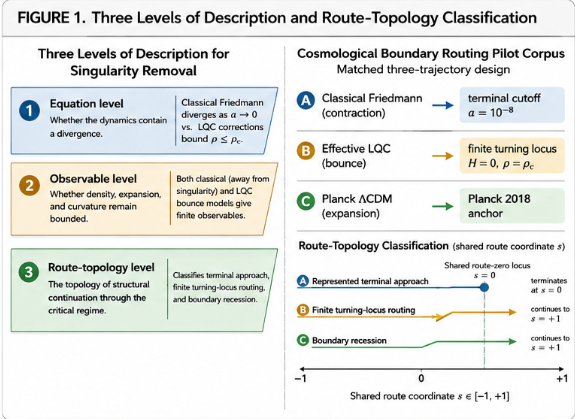
🌌 Three Matched Trajectories, Three Route Classes
The pilot corpus is built around three matched cosmological model constructions, each representing a distinct way a cosmological trajectory can behave at the critical regime. Their route classes are not assumed — they are measured.
Dataset A — Classical Friedmann
Classical contracting universe approaching the terminal numerical cutoff. Scale factor decreases, density increases, curvature increases, provisional margin decreases. Route class: −1 → 0. Represented terminal approach in the selected classical chart. Not a simulation of crossing the mathematical singularity.
Dataset B — Effective LQC Bounce
Full contraction–bounce–expansion trajectory from the effective LQC equation H² = (8πG/3)ρ(1 − ρ/ρc). At the bounce: H = 0, ρ = ρc, amin > 0. Route class: −1 → 0 → +1. Finite turning-locus route. Direct analysis covers the post-bounce expansion ladder (n = 2000); full path is analyzed via α-deformation and Bridge v1.1.
Dataset C — Planck ΛCDM
Expansion away from an early critical reference regime, calibrated to Planck 2018 best-fit parameters (H₀ = 67.32 km/s/Mpc, Ωm = 0.3158). Route class: 0 → +1. Boundary recession. Provides the observationally anchored reference background against which the other trajectories are compared.
The Key Design Principle
The three datasets are not merely different equations. They represent different continuation topologies at the route-topology level. This distinction is invisible to equation-level or observable-level analysis — it requires orientation-sensitive structural encoding.
Arrows indicate route-coordinate progression (not physical direction). The bounce circle at s=0 for Dataset B marks the tested-admissible turning locus.
⚡ Discovery 1: Full Percolation Does Not Determine Route Topology
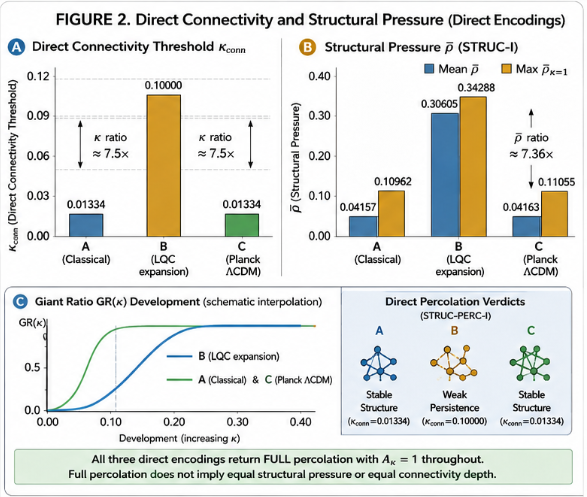
When all three direct ladder encodings returned Full percolation, the initial reading might be that the systems are structurally equivalent. They are not. Full percolation is a necessary but not sufficient condition for route equivalence.
Final connectivity class ≠ connectivity depth.
Full(A) ∧ Full(B) ∧ Full(C) ⇏ A ≡route B ≡route C.
Dataset B requires a connectivity scale approximately 7.5× larger than A and C. All three eventually connect, but they do not connect with equal ease or equal structural depth.
Dataset B’s direct post-bounce encoding maintains Aκ=1 throughout the tested STRUC-I range, while the full path remains 98.83% admissible under α-deformation.
The Deeper Theoretical Statement
A system may remain realizable and connected while moving into a shallower, more deformation-sensitive region of admissibility space. This is not failure — it is high-pressure admissibility. The distinction separates: whether a state is allowed; how robustly it is allowed; how close it is to structural reorganization; and what route it follows through that region.
🔍 Discovery 2: Magnitude Geometry Erases Route Topology
One of the most conceptually important findings concerns Datasets A and C. Under sorted-magnitude ladder encoding, they are nearly degenerate — their gap structures are nearly identical because sorting removes the direction of evolution.
Sorted Magnitude Encoding
A ≈ C
κconn, GR, Aκ, α-vectors all identical. Route orientation completely erased. Classical contraction and Planck expansion appear as the same structural object. This is a false equivalence.
Orientation-Sensitive Encoding
A ≠ C
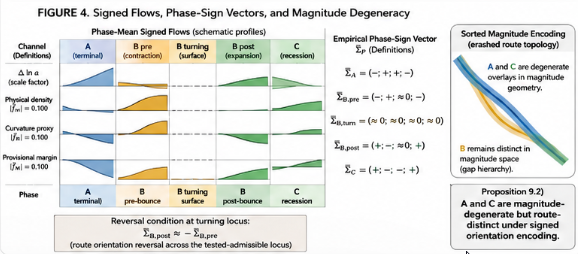
Phase-sign vectors are exactly opposite. Dataset A: (−, +, +, −). Dataset C: (+, −, −, +). Every channel reverses. This is the full physical distinction: a contracting universe versus an expanding one.
This finding directly strengthens the Canonical Ladder problem within the UNNS Substrate:
Canonicality Is Purpose-Sensitive
A magnitude-only ladder may be sufficient for connectivity analysis. It is not sufficient for direction-sensitive route classification. The correct lesson is not that one representation is wrong — it is that a canonical chart must preserve the structure relevant to the question being asked. Route topology requires orientation to be retained.
Dataset B, by contrast, remains magnitude-distinct from A and C even in sorted-magnitude geometry, through its elevated connectivity threshold, higher structural pressure, and different α-vector. B's turning topology, however, is visible only through signed-flow encoding.
🔄 Discovery 3: The Effective LQC Bounce is a True Turning Topology
The full Dataset B path is not merely an expanding branch with different numbers. It is a continuous trajectory joining contraction and expansion through a finite turning locus — and this reversal is visible in the structural data.
The pre-bounce and post-bounce empirical phase-sign vectors are:
| Phase | Empirical Phase-Sign Vector Σ̄P | Δln a mean | Margin flow |
|---|---|---|---|
| A — Terminal approach | (−, +, +, −) | −0.500 | −0.093 |
| B pre-bounce | (−, +, ≈0, −) | −0.305 | −0.100 |
| B turning surface | (≈0, ≈0, ≈0, ≈0) · H̄ = 1.76×10⁻⁴ | 0 | 0 |
| B post-bounce | (+, −, ≈0, +) ≈ −Σ̄pre | +0.305 | +0.100 |
| C — Boundary recession | (+, −, −, +) | +0.500 | +0.093 |
This is the operational structural signature of route reversal. The reversal is not inferred only from H changing sign. It is simultaneously visible in the reversal of Δln a, density flow, margin flow, and branch orientation. Dataset B is not simply "non-singular." It is structurally a finite turning-locus route.
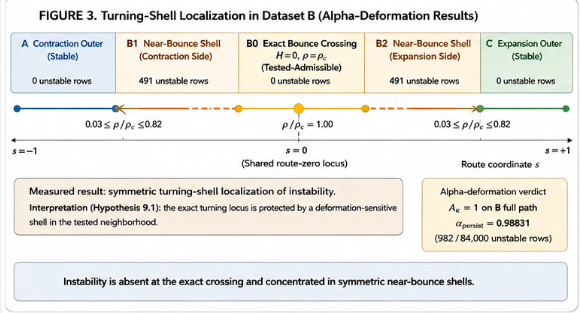
🌀 Discovery 4: The Turning Shell
The α-deformation analysis of the full 4001-row LQC path produced one of the most striking findings of the project. The naive expectation would be:
The Naive Expectation (Not What Was Found)
Maximum criticality ⇒ maximum structural instability at the exact bounce. If ρ/ρc = 1 and H = 0 mark the most extreme point, the α-deformation analysis should reveal maximum sensitivity there.
The data show something different. The instability pattern across the full 4001-row LQC path is:
The instability pattern is 0 | 491 | 0 | 491 | 0: stable outer regions, sensitive near-bounce shells, and a stable exact crossing. Instability does not peak at the turning locus — it is localized symmetrically around it.
The manuscript distinguishes two things carefully: the measured result (symmetric turning-shell localization) and the proposed interpretation (Turning-Locus Shielding Hypothesis). The hypothesis — that the exact route-reversal locus may be structurally protected relative to its surrounding transition neighborhood — is formally labelled Hypothesis 9.1 and is proposed for replication, not presented as a theorem.
🔮 What Zero Actually Means at the Critical Point
At the effective LQC bounce, H = 0 and ρ/ρc = 1. A density-based provisional margin therefore reaches zero. This might be interpreted as structural failure. The analysis shows otherwise.
Critical Coordinate Zero ≠ Universal Failure
The meaning of zero in a critical coordinate depends entirely on route topology. The same numerical value — zero in a margin component — can mark three different structural events depending on which route class the trajectory belongs to:
| Route Class | What Zero Marks | Structural Outcome |
|---|---|---|
| Represented terminal approach (A) | End of the represented route | No continuation in selected chart |
| Finite turning-locus routing (B) | Route-orientation reversal coordinate | Tested-admissible; the route continues |
| Boundary recession (C) | Early boundary reference starting point | Recession begins from this reference |
This insight is one of the deepest conceptual refinements of the project. The classification of zero in a structural coordinate as either obstruction or reversal requires the route-topology level of description — it cannot be determined from equation-level or observable-level analysis alone.
🔬 Relation to Standard Loop Quantum Cosmology
The UNNS contribution is strongly aligned with standard effective LQC but operates at a different level. Standard LQC already provides the modified Friedmann equation, finite critical density, a nonzero minimum scale factor, and bounded background quantities. The UNNS work is not the invention of the bounce — it is the structural classification of the bounce.
Standard Effective LQC Asks
What quantum correction removes the classical divergence? Are density, expansion, and curvature bounded? Does the effective spacetime continue through the bounce? What perturbations and observables follow?
UNNS Route-Topology Adds
What structural route replaces the classical terminal path? Is the critical locus terminal, turning, or receding? What signed structural signature characterizes that continuation? Which admissibility, pressure, and connectivity class does the model occupy?
Complementary, Not Competing
The equation-level result is: the singularity is replaced by a bounce. The UNNS route-level result is: the terminal route is replaced by finite admissible reversal. These are different statements at different levels of description. The UNNS analysis cannot independently establish geodesic completeness — and the manuscript says so explicitly. Its contribution is a structural classification of a trajectory supplied by the effective theory.
⭐ Two Routing Morphologies: A Broader Theory Emerges
The Cosmological Boundary Routing result is best understood alongside the earlier Stellar Boundary Dynamics corpus, which established the first routing morphology. Together, they reveal that boundary routing is a family of topological transition mechanisms.
Stellar — Branching Routing
Core-collapse supernovae. Pre-collapse, light curves, spectral series — all 10/10 Full percolating, but ABC bridge: dAB=0.401 weak, dBC=1.287 strong. C branches into a distinct admissible regime. Identity-preserving path broken; multiple admissible downstream regimes.
Cosmological — Turning-Locus Routing
Classical → LQC bounce → Planck expansion. 3/3 Full percolating. Σ̄post ≈ −Σ̄pre. Route reversal through a finite tested-admissible locus. Identity-preserving path continuous; reversed orientation.
Some boundaries branch structure. Some reverse structure. Some terminate structure. Some permit recovery.
This is a general language for comparing different cosmological models without claiming they share the same physics.
🗺️ A General Taxonomy of Boundary Routing
The combined UNNS research supports a provisional taxonomy of how physical systems interact with structural boundaries. The unifying question is not which microscopic mechanism generates the transition, but which structural event occurs at the critical regime.
| Morphology | Structural Behavior | Example | Status |
|---|---|---|---|
| Represented terminal approach | Route ends at a limiting locus; no continuation in selected chart | Classical Friedmann contraction (A) | Realized |
| Finite turning-locus routing | Route reaches finite critical locus, reverses, continues | Effective LQC bounce (B) | Realized |
| Boundary recession | Route moves away from early critical reference | Planck ΛCDM expansion (C) | Realized |
| Branching routing | One catastrophic event creates multiple non-equivalent downstream admissible regimes | Stellar Boundary Dynamics I | Realized |
| Recovery routing | Fragmented representation lifted into connected admissible form | Δ-lifting / ACG cases | Theoretically motivated |
| Repeated turning routing | Multiple turning loci in cyclic evolution | Cyclic bounce cosmologies | Prediction |
| Cross-chart continuation | Continuation through a representation change | Conformal Cyclic Cosmology | Open |
📡 What Comes Next: Perturbation Implications
The current manuscript concerns background trajectories. It does not yet calculate scalar or tensor perturbations. But route topology creates a natural framework for the next stage of the program.
Terminal Routes
Supply no background-defined transfer map through the endpoint. Pre-terminal perturbations do not connect to post-terminal observables without additional physics.
Turning-Locus Routes
Permit a transfer map: (vk, v′k)pre → (vk, v′k)post. Three structural hypotheses: perturbation continuation, route-localized spectral modification, and background-symmetry transfer test.
Recession Routes
High-k modes may approach standard evolution; low-k modes may retain pre-bounce information. Whether this separation occurs is a model-dependent question for perturbation calculation.
Two models can share route topology and still produce different observable spectra. Route-topology equivalence is a necessary but not sufficient condition for perturbation equivalence. This distinction is essential for comparing LQC, matter-bounce, ekpyrotic, and modified-gravity models.
🔓 What Remains Open
The Canonical Boundary Metric
The strongest open problem is the canonical metric on the admissibility manifold ℳadm. The present route coordinate is path-intrinsic — not yet a universal geometric distance. A valid metric must be nonnegative on all represented routes; vanish only at a verified terminal boundary; remain strictly positive at an admissible turning locus; and distinguish terminal obstruction from finite turning.
The Strongest Justified Conclusion
The project has not proved that the Big Bang "never happened." It has shown something more precise and structurally meaningful: within the processed pilot corpus, the classical Friedmann trajectory and the effective LQC trajectory belong to different continuation classes. The classical construction approaches a represented terminal route-zero locus; the effective LQC construction reaches a finite tested-admissible turning locus, reverses its empirical phase-sign structure, and continues onto an expanding branch.
Singularity avoidance is the replacement of represented terminal topology by tested-admissible turning topology.
Open extensions include: replication in alternative bounce models; robustness under grid refinement and normalization changes; perturbation-level transfer and observational likelihood analysis; topological classification of conformal continuation; and extension to black-hole interiors.
📦 Resources and Downloads
References and Companion Manuscripts
- UNNS Substrate Research Program. Admissible Boundary Routing: Structural Classification of Terminal Approach, Finite Bounce, and Cosmological Recession. Working Manuscript, 2026.
- UNNS Substrate Research Program. Stellar Boundary Dynamics: Catastrophic Transition as Routing Between Admissible Structural Regimes. Working Manuscript, 2026.
- The Margin-Confinement Law: Structural Non-Crossability in Admissibility Space
- The Universal Structural Law v6
- Percolative Realizability Principle
- Admissible Cluster Geometry
- Beyond Fragmentation: The Forced Coherent Collapse Regime
- Connectivity Margin as a Coordinate of Realizability Space
- Bounded Structural Rigidity and Representation-Driven Structure
- Local Geometry of Realizability Boundaries in the UNNS Substrate
- Structural Realizability and Dual Observability
- Interaction Unification in the UNNS Substrate