
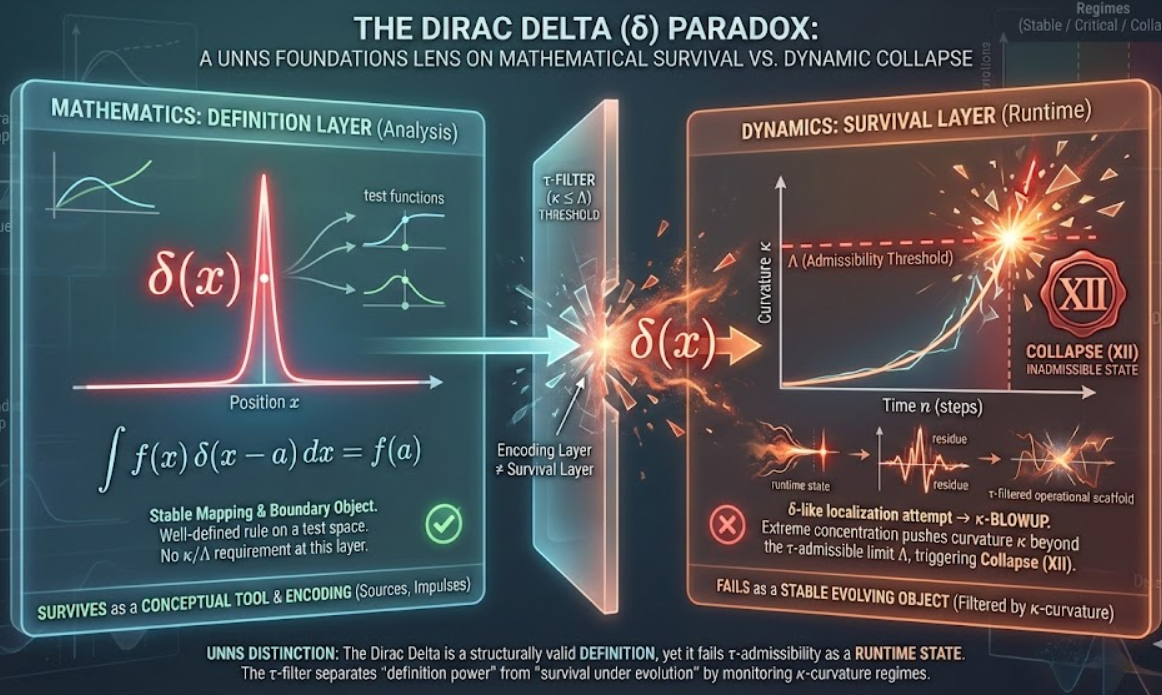
Separating definition power from survival under evolution
A UNNS foundations lens: δ(x) is structurally valid as a limit-object, yet it fails τ-admissibility as a runtime state. This article separates “definition power” from “survival under evolution” using κ-curvature, Λ thresholds, and Collapse (XII).
1) The two places δ lives
In classical analysis, δ is a distribution: it is defined by how it acts under integration against test functions. In dynamics, δ behaves like an “infinite localization” target. UNNS treats these as two different questions: What can be defined? versus What can survive as an evolving object?
∫ f(x) δ(x − a) dx = f(a)
UNNS translation
- δ as a definition: an evaluation rule (a valid mapping on a test space).
- δ as a state: an attempted runtime configuration with extreme concentration.
- UNNS distinction: “well-defined” does not imply “τ-admissible.”
Quick classification (UNNS)
δ can be treated as a boundary object: it marks the limit of compression, where residue variation becomes large and κ rises beyond Λ.
This is why δ appears constantly in physics notation (sources, impulses, Green functions): it is an encoded boundary, not a stable runtime survivor.
2) UNNS runtime scaffold: Sobtra → residue → curvature κ → admissibility
The Foundations Chamber implements a minimal but explicit runtime pipeline: generate a state series, apply Sobtra threshold clamping, compute residue, then compute a stability proxy κ and classify steps by Λ. The point is not “one model”; the point is an observable structure: κ defines regimes.
        Generator: xn+1 = xn + δ + εn

        Sobtra clamp: sn = xn if |xn| < θ, else 0

        Residue: rn = xn − sn

        Curvature: κn = |rn+1 − rn| / (|xn| + 10−9)

        Admissible step: κn ≤ Λ
Figure A. δ is stable as a definition (mapping), but δ-like localization as a runtime target typically pushes κ above Λ and is classified as collapse-selected (XII).
3) Why δ fails in dynamics: κ blow-up and regime classification
A δ-like configuration concentrates “mass” into a narrow region. In a τ-filtered runtime, this tends to create large residue changes across steps, which increases |rn+1 − rn| and therefore increases κ. When κ exceeds Λ, the step is classified as inadmissible and labeled by Collapse (XII).
Figure B. A δ-like compression event is represented as a κ surge. The τ-filter turns “allowed / not allowed” into an observable regime: admissible steps satisfy κ ≤ Λ; steps above Λ are classified as collapse-selected (XII).
Stable regime
κ ≤ Λ for most steps; operator chains remain composable under τ-filtering.
Critical regime
κ frequently approaches Λ; small parameter shifts change survivability outcomes.
Collapse-dominated regime
κ exceeds Λ repeatedly; Collapse (XII) becomes frequent and truncates composition.
4) Why δ still “works” in physics notation
Physics uses δ to represent idealized sources, impulses, and point-like constraints. In UNNS terms, this is an encoding choice: δ is a compact symbol for a boundary condition, not a claim that a δ-state survives as a τ-admissible trajectory.
Figure C. δ is frequently used as a compact way to encode forcing (sources, impulses). UNNS keeps that utility, then evaluates whether the resulting evolution remains τ-admissible. The “encoding layer” and “survival layer” are not the same claim.
5) Connection to quantum uncertainty: stability across dual descriptions
In quantum mechanics, sharp localization in one description corresponds to broad spread in a dual description (Fourier duality). UNNS reads this as a stability principle: pushing toward δ-like localization increases tension elsewhere and tends to raise κ under the τ-filter. The uncertainty bound is then read as a survival constraint across coupled channels, not a requirement to instantiate δ as a physical state.
Figure D. The δ-limit corresponds to extreme localization. Under a coupled dual description, that extremity pushes stress into the other channel. UNNS treats the familiar “uncertainty” pattern as a stability band that supports τ-admissible evolution across coupled views.
6) Try it live: Regime Lens (Figure B as a module)
If you want Figure B to be a live instrument (not a static sketch), embed a regime viewer that renders κ and Λ, and highlights stable / critical / collapse regimes as you tune Λ.
Live Figure B. A τ-filter regime lens: κ profile + Λ threshold + regime classification. (If your Joomla editor strips iframes, place this inside a custom HTML module with iframe allowed.)
Conclusion
The Dirac delta survives in mathematics because it is defined as an action (a rule on test functions). It fails as a dynamic state because δ-like localization typically drives κ above Λ, which the τ-filter classifies as inadmissible, producing collapse-selected steps (XII). UNNS keeps both facts simultaneously by separating the definition layer from the survival layer, and by turning “allowed” into a measurable regime.
Takeaway (one line)
δ is a valid boundary definition, while δ-like runtime states are regime-extreme and are typically filtered by τ-admissibility (κ ≤ Λ) and Collapse (XII).
Resources
Foundations context and the executable instrument used for κ/Λ regime classification: