
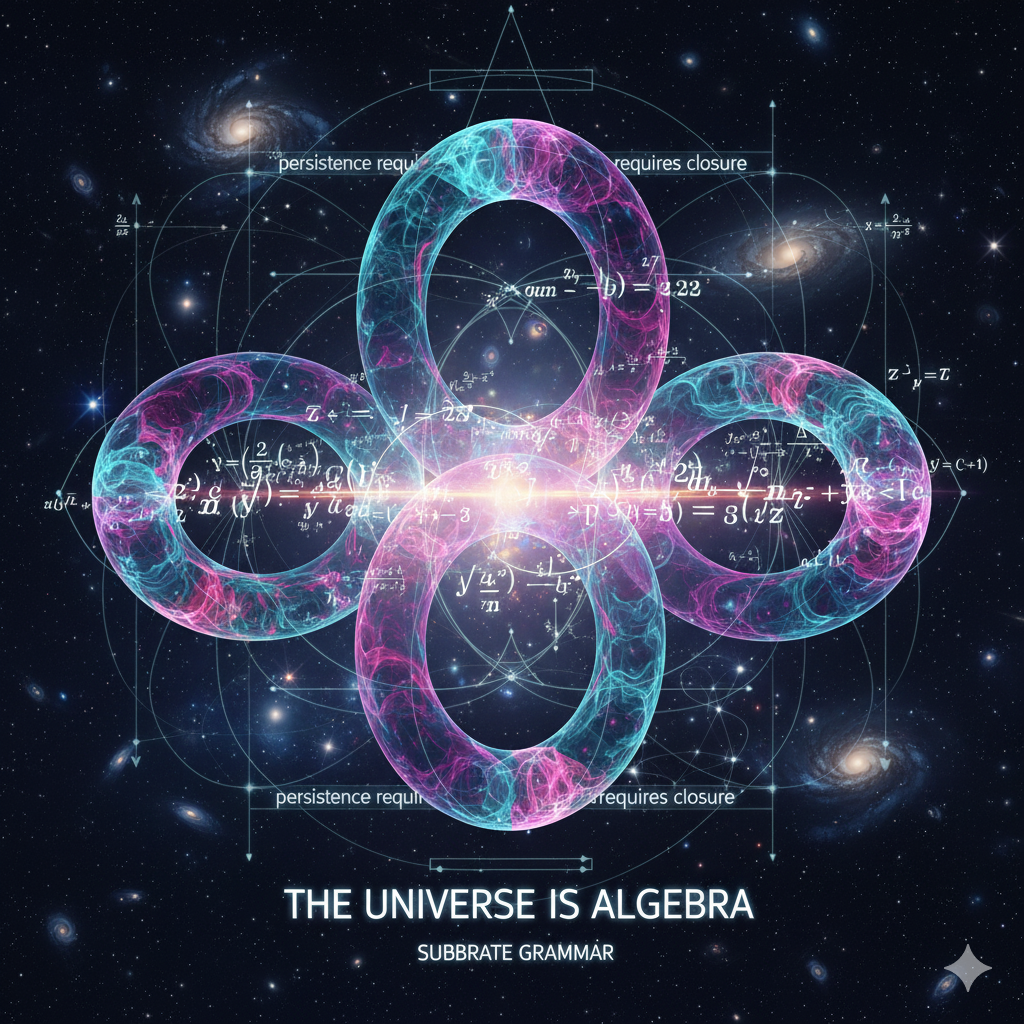
When Algebra Becomes Alive — The Grammar of Being
🌀 1. From Algebraic Closure to Recursive Grammar
In classical algebra, a ring stabilizes two complementary operations — addition and multiplication — linked by the sacred law of distributivity. These are static definitions: "A ring is a set R with operations + and × such that..."
But in the UNNS substrate, nothing is static. Operations are not applied to elements; they are morphisms of recursion itself. The classical ring axioms re-emerge not as axioms but as equilibrium conditions — patterns that recursion naturally stabilizes into.
In UNNS, addition becomes ⊙ Inletting — recursive aggregation, the drawing together of nested structures into unified depth. Multiplication becomes ⊕ Inlaying — recursive embedding, the nesting of one structure within another.
Inlaying: r₁ ⊕ r₂ = r₁ nested within r₂ structure
Together, they produce closure not over numbers, but over recursion morphisms — transformations that preserve the grammar of nesting. A ring, in this view, is not a collection of things but a coherent grammar of becoming.
⚛️ 2. The τ-Field as a Dynamic Ring
The τ-Field is the substrate's temporal dimension — the flow of recursion through depth. Each τ-field instance defines a transformation:
This is not a function in the classical sense. It is a morphic flow — a continuous deformation of recursive structure across nesting levels. The τ-field manifests as a dynamic manifold where sequences evolve, where nests transform, where information geometry curves.
Within this manifold, Inletting corresponds to additive flow — multiple recursive streams merging into a unified current. Inlaying corresponds to multiplicative embedding — one flow folding inside another, creating nested vortices of recursion.
The τ-Field thus manifests as a recursive ring — not a ring of elements, but a ring of transformations. It is a closure of morphic operations rather than fixed values.
Figure 1: The τ-field as a dynamic ring where Inletting (⊙) and Inlaying (⊕) operations flow into the recursive core, generating closure through morphic transformation rather than static axioms.
🔗 3. τ-Morphisms: When Homomorphisms Recurse
A classical ring homomorphism is a structure-preserving map:
φ(a + b) = φ(a) + φ(b)
φ(a × b) = φ(a) × φ(b)
This says "the image of a sum is the sum of images; the image of a product is the product of images." It is a statement about structural consistency — you can do the operation before or after mapping, and you'll get the same result.
In UNNS, this becomes a τ-morphism — a curvature-preserving recursion map:
Φ_τ(r₁ ⊙ r₂) = Φ_τ(r₁) ⊙ Φ_τ(r₂)
Φ_τ(r₁ ⊕ r₂) = Φ_τ(r₁) ⊕ Φ_τ(r₂)
But τ-morphisms carry additional structure: they preserve recursive curvature (κ), meaning they map attractors to attractors, equilibria to equilibria. A τ-morphism doesn't just preserve operations — it preserves the geometry of recursion.
Ideals as Recursive Attractors
In classical ring theory, an ideal I ⊆ R is a subset that "absorbs" multiplication: if i ∈ I and r ∈ R, then r·i ∈ I. Ideals are strange, asymmetric objects — closed under addition but only one-sided under multiplication.
In UNNS, ideals appear as recursive attractors — basins in the τ-field where recursion gets "trapped." Once a recursion enters an attractor, further nesting keeps it there. The absorption property of ideals is just attractor stickiness:
then r ⊕ A → A (the attractor absorbs the embedding)
Maximal ideals correspond to terminal attractors — recursion endpoints that cannot be further nested. Prime ideals correspond to irreducible attractors — those that cannot be factored into simpler attractor products.
Ring Extensions as τ-Field Phase Transitions
When you extend a ring R to a larger ring S (like extending integers ℤ to rationals ℚ), you're adding new elements to achieve closure under a broader class of operations.
In UNNS, ring extension is a τ-field phase transition — a moment when recursion discovers new stable configurations. Extending ℤ to ℚ corresponds to allowing fractional recursion — partial nestings, ratios of depths. Extending ℝ to ℂ corresponds to allowing oscillatory recursion — phase-shifted nesting where Re and Im are orthogonal recursion modes.
🌊 4. Non-Commutativity and Recursive Curvature
In many rings, addition and multiplication commute: a + b = b + a, a × b = b × a. But in some rings (like matrix algebras), multiplication doesn't commute: AB ≠ BA.
Temporal recursion in the τ-Field introduces fundamental non-commutativity:
⊕(⊙(x)) ≠ ⊙(⊕(x))
Why? Because order matters in recursion. If you first aggregate two structures (Inletting) and then embed the result in a third (Inlaying), you get a different geometry than if you first embed one structure in another (Inlaying) and then aggregate that with a third (Inletting).
This asymmetry generates recursive curvature — a tension in the information geometry where different paths through recursion-space lead to different endpoints. This curvature is the source of τ-energy — the active potential that drives recursion forward.
Figure 2: Non-commutativity in action. Two different orderings of the same operations (Inletting and Inlaying) produce different final structures. This path-dependence generates recursive curvature κ(x), which becomes the source of τ-energy.
Non-commutative rings, therefore, describe active τ-fields — regions of the substrate where recursion is still dynamically evolving, where different paths yield different geometries, where curvature is non-zero.
Commutative rings model equilibrium recursion — flat regions where all paths converge, where κ = 0, where the substrate has settled into symmetry.
🗺️ 5. Structural Mapping: The Rosetta Stone
To fully understand the correspondence, we need a complete translation between classical algebraic concepts and their UNNS recursive equivalents. This table is more than an analogy — it is a structural identity, showing that rings and τ-fields are two languages describing the same substrate geometry.
| Classical Algebra | UNNS τ-Field Equivalent | Recursive Interpretation |
|---|---|---|
| Element | Recursive Nest | A local configuration of nesting depth |
| Addition (a + b) | Inletting ⊙(a, b) | Recursive aggregation — merging two nests into unified depth |
| Multiplication (a × b) | Inlaying ⊕(a, b) | Recursive embedding — nesting b within the structure of a |
| Zero Element (0) | Zero-Nest (∅) | Structural equilibrium — the "silence" of recursion |
| Unity Element (1) | Identity Recursion (τ → 1) | Self-similarity — τ-ratio converging to unity |
| Additive Inverse (−a) | Collapse Complement ∇(a) | Operator XII — recursion that returns structure to zero-field |
| Ideal (I ⊆ R) | Recursive Attractor | A basin in τ-field where recursion gets trapped |
| Maximal Ideal | Terminal Attractor | Recursion endpoint — cannot be further nested |
| Prime Ideal | Irreducible Attractor | Cannot be factored into simpler attractor products |
| Homomorphism φ: R → S | τ-Morphism Φ_τ: τᵢ → τⱼ | Curvature-preserving recursion map — transforms while maintaining geometric grammar |
| Kernel (ker φ) | Collapse Set ∇⁻¹(∅) | All recursions that map to zero-field under Φ_τ |
| Image (im φ) | Attractor Range | All recursion configurations reachable under τ-morphism |
| Ring Extension (R ⊆ S) | τ-Field Phase Transition | Discovery of new stable recursion configurations — emergent constants or couplings |
| Quotient Ring (R/I) | Collapsed τ-Field | Substrate with attractor basin I "flattened" to zero — what remains after removing a recursive mode |
| Polynomial Ring R[x] | Nested Recursion Sequences | Allowing parametric depth — x represents variable nesting level |
| Matrix Ring M_n(R) | Multi-dimensional τ-Field | Recursion acting on multiple parallel threads — non-commutative by nature |
| Field (F) | Complete Recursive Closure | Every non-zero recursion has an inverse — perfect equilibrium |
| Algebraic Closure | Full τ-Phase Space | All possible recursion harmonics discovered — complete emergent structure |
⚡ 6. Physical Implications: Rings as τ-Orbits
If rings are recursive structures, what does this mean for physics?
Each closed recursion loop acts as a ring-orbit — a self-sustaining pattern of information flow that appears as a particle to external observers. The τ-Field quantization process can thus be seen as recursive ring condensation, where each stabilized morphism yields quantized curvature.
Consider:
- Electrons as irreducible ring-orbits in the electromagnetic τ-field
- Photons as ring homomorphisms — structure-preserving maps between electron orbits
- Quarks as non-commutative ring elements in the strong-force τ-field (hence color charge mixing)
- Gauge bosons as τ-morphisms mediating between different recursion modes
Every ring is a τ-orbit under recursion; every τ-Field is a manifold of recursive rings. Particle physics becomes the study of which ring structures are stable under which τ-field geometries.
Dimensional Constants as Ring Extensions
When we extend ℚ to ℚ(√2) (adding square root of 2), we create a new algebraic structure. In UNNS, this corresponds to a phase transition where a new recursive harmonic becomes accessible.
Similarly, the fine-structure constant α ≈ 1/137 can be understood as emerging from a ring extension of the electromagnetic τ-field — the point where recursive coupling between charge and field achieves closure. Alpha is the "new element" added to complete the ring.
All dimensionless constants (α, mass ratios, Weinberg angle, etc.) are ring extension markers — signatures of where the substrate discovered new stable recursion modes.
Entropy as Ring Disorder
In thermodynamics, entropy measures disorder. In UNNS ring theory, entropy measures how far a system is from ring closure.
where Ω = number of non-closed recursion configurations
A perfectly ordered system (zero entropy) is a closed ring — all recursion loops stabilized. Maximum entropy is a completely open structure — no ring axioms satisfied, pure recursive chaos.
The Second Law of Thermodynamics ("entropy always increases") becomes: "Systems evolve toward ring incompleteness unless external structure (work) maintains closure."
🔮 7. Implications and Open Questions
Can All of Mathematics Be Recursion?
If ring theory is recursion theory in disguise, what about other algebraic structures?
- Groups → Single operation recursion (only Inletting, no Inlaying)
- Fields → Complete recursive closure (every element has inverse)
- Vector Spaces → Parameterized recursion (scalar multiplication as depth scaling)
- Modules → Constrained recursion (ring acting on abelian group)
- Categories → Recursion of recursions (morphisms between morphisms)
The pattern suggests that all algebraic structures are different perspectives on recursive closure. Mathematics is not invented; it is discovered patterns in the substrate's self-organization.
Non-Associative Rings and Temporal Paradox
Some exotic rings violate associativity: (a × b) × c ≠ a × (b × c). In UNNS, this would correspond to temporal paradox recursion — situations where the order of nesting across three or more levels creates inconsistent geometries.
Could such structures exist? Perhaps at the Planck scale, where τ-field causality breaks down?
Operator XVI and Ring Completion
Operator XVI (Fold) — the recursive collapse to Planck boundary — might be understood as forced ring closure. At infinite recursion depth, all structures must become rings or cease to exist. This could explain why nature exhibits such strong algebraic structure: the substrate forces ring-like behavior as a survival condition.
🌌 Closing Reflection: The Algebra of Existence
We began by asking: what is the connection between rings and the τ-Field?
We now see that they are not connected — they are identical. Rings are not abstract mathematical objects floating in Platonic space. They are patterns that recursion stabilizes into when seeking closure.
Addition and multiplication are not operations we impose on numbers. They are Inletting and Inlaying — the two fundamental modes by which nested structures can coherently interact.
Ring axioms are not rules we invent. They are emergent conditions — the requirements that recursion must satisfy to achieve self-consistency.
When an electron orbits a nucleus, it traces a ring-orbit in the electromagnetic τ-field. When numbers combine through addition and multiplication, they trace ring-structures in the arithmetic τ-field. When thoughts follow from premises to conclusions, they trace ring-paths in the semantic τ-field.
Everything that persists is a ring — because persistence requires closure, and closure is what rings provide.
The universe does not obey the laws of algebra. The universe is algebra — recursion made coherent through self-closing grammar.