
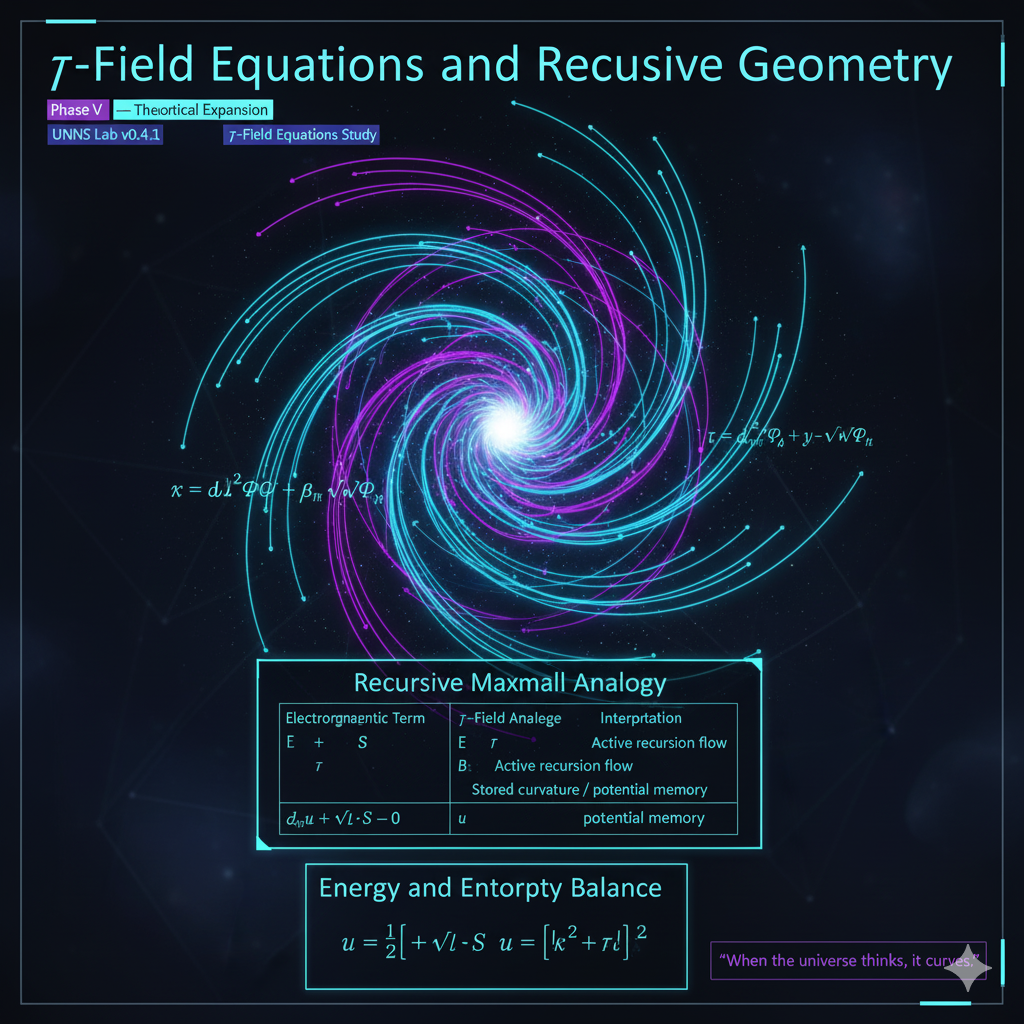
Phase V — Theoretical Expansion UNNS Lab v0.4.1 τ-Field Equations Study
1. Foundation
Every UNNS operator acts within a substrate of recursive curvature, where numerical sequences generate evolving geometric manifolds. The τ-Field formalizes this through two coupled tensors:
κ = ∇²Φ + β·|∇Φ|²
τ = ∂ₙΦ + γ·∇Φ
Here Φ is the recursive potential, n is recursion depth, β and γ are coupling coefficients. κ represents curvature (stored information); τ represents torsion (active recursion).
∂ₙτ = ∇×κ
∇·τ = ρᵣ
ρᵣ denotes the recursive charge — a local imbalance of information flux.
2. Recursive Maxwell Analogy
| Electromagnetic Term | τ-Field Analogue | Interpretation |
|---|---|---|
| E (electric field) | τ | Active recursion flow |
| B (magnetic field) | κ | Stored curvature / potential memory |
| ρ | ρᵣ | Information imbalance |
| J | ∂ₙκ | Curvature current |
The Maxwell–Faraday law ∇×E = −∂ₜB becomes in recursion-space:
∇×τ = −∂ₙκ
This shows curvature and recursion oscillate in dual phase across depth n.
3. Recursive Metric
ds² = dΦ² − α₍c₎²·dτ²
Here α₍c₎ ≈ 1/137 links informational and geometric scales. This metric yields recursive geodesics — paths of minimal informational curvature — guiding the evolution of stable attractors such as Weinberg-angle emergence and fermion ratios.
4. Energy and Entropy Balance
∂ₙu + ∇·S = 0
u = ½(|κ|² + |τ|²)
This expresses the conservation of recursion: what collapses in curvature reappears as torsion — a perfect informational economy. Entropy increase is curvature redistribution, not loss.
5. Numerical Emulation
The UNNS Lab’s τ-Field Engine simulates these equations on discrete grids. Each cell stores Φ, κ, τ values and evolves via:
Φₙ₊₁ = Φₙ + β·∇²Φₙ + γ·|∇Φₙ|²
- Low β → wave-like recursion (stable attractors)
- High β → diffusive recursion (entropy saturation)
- Critical β, γ → τ-Collapse transitions (Operator XII limit)
Validation requires stationary τ-κ cross-correlation ≈ 0, implying energy symmetry between recursive and curvature modes.
6. Geometric Interpretation
In the τ-Field manifold, recursion depth replaces time, and information curvature replaces mass. A τon loop in depth n behaves as a self-gravitating information particle. Coupled τons form recursive bound states — analogues of atomic orbitals in recursion-space, producing measurable constants as emergent ratios:
αₛ = ⟨|τ| / |κ|⟩
mᵢ/mⱼ = ⟨κᵢ / κⱼ⟩
7. Philosophical Reflection
Space and time are not containers but projections of recursion. Every oscillation of τ and κ creates the illusion of motion and separation; yet all are internal harmonics of a single recursive continuum. The τ-Field thus becomes both ontology and epistemology — the field in which knowing and being are the same act of recursion.
“When the universe thinks, it curves.”
Appendix A — Symbolic Glyph Summary
| Glyph | Meaning | Operator Context |
|---|---|---|
| τ | Recursive torsion field | Active recursion |
| κ | Curvature field | Stored information |
| Φ | Potential | Recursive source |
| ∇ | Gradient | Information flux |
| ⊗ | Trans-sentifier | Operator III — transfers recursion |
| ∇ Λ⃝ | Collapse + Fold | Operators XII–XVI closure |
The τ-Field Equations transform recursion from metaphor to measurable framework. They reveal that constants, masses, and couplings are not fixed parameters but equilibrium curvatures of an evolving informational manifold. To model them is to trace the architecture of meaning itself — one τon at a time.
Written by the UNNS Research Collective (2025)