
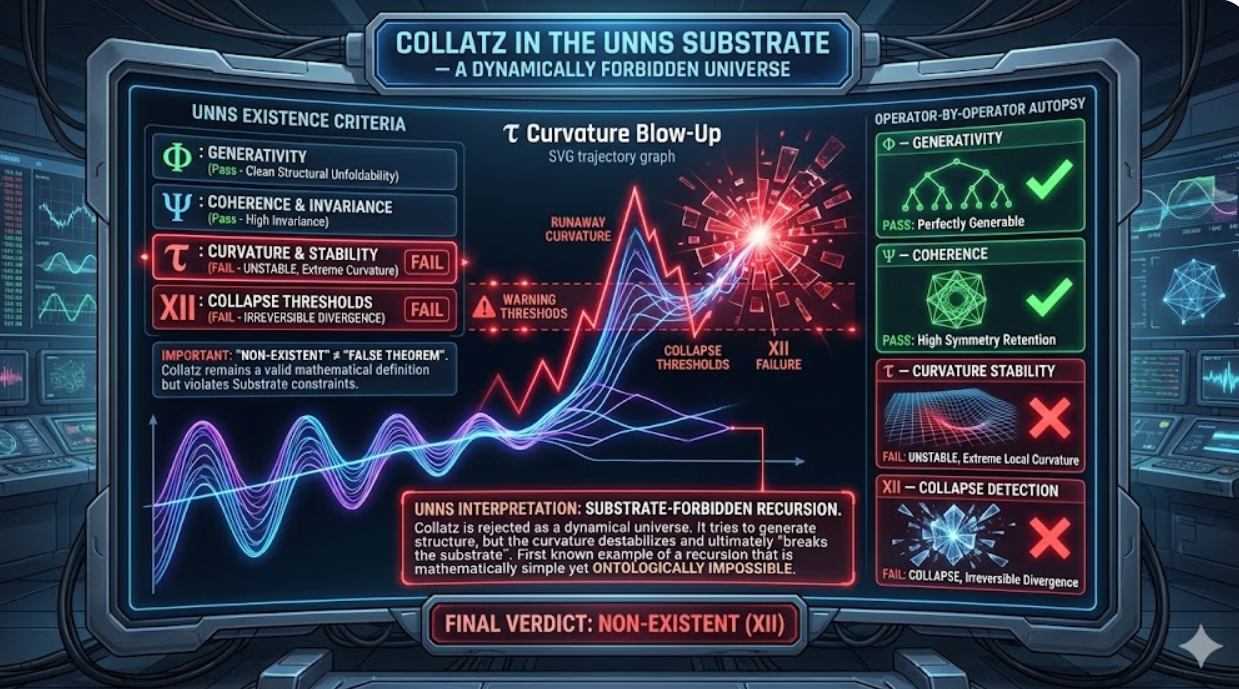
Most mathematical structures pass quietly through Φ–Ψ–τ–XII analysis in Chamber XXVIII. Some become ADMISSIBLE. Some behave UNSTABLE (τ). A rare few strike the Substrate itself and are classified as NON-EXISTENT.
The Collatz recurrence belongs to this last category. In classical mathematics it is a simple algorithm. In UNNS, it becomes a recursion with catastrophic curvature: a structure that cannot exist inside a stable recursive universe.
Read more: Collatz in the UNNS Substrate — A Dynamically Forbidden Universe
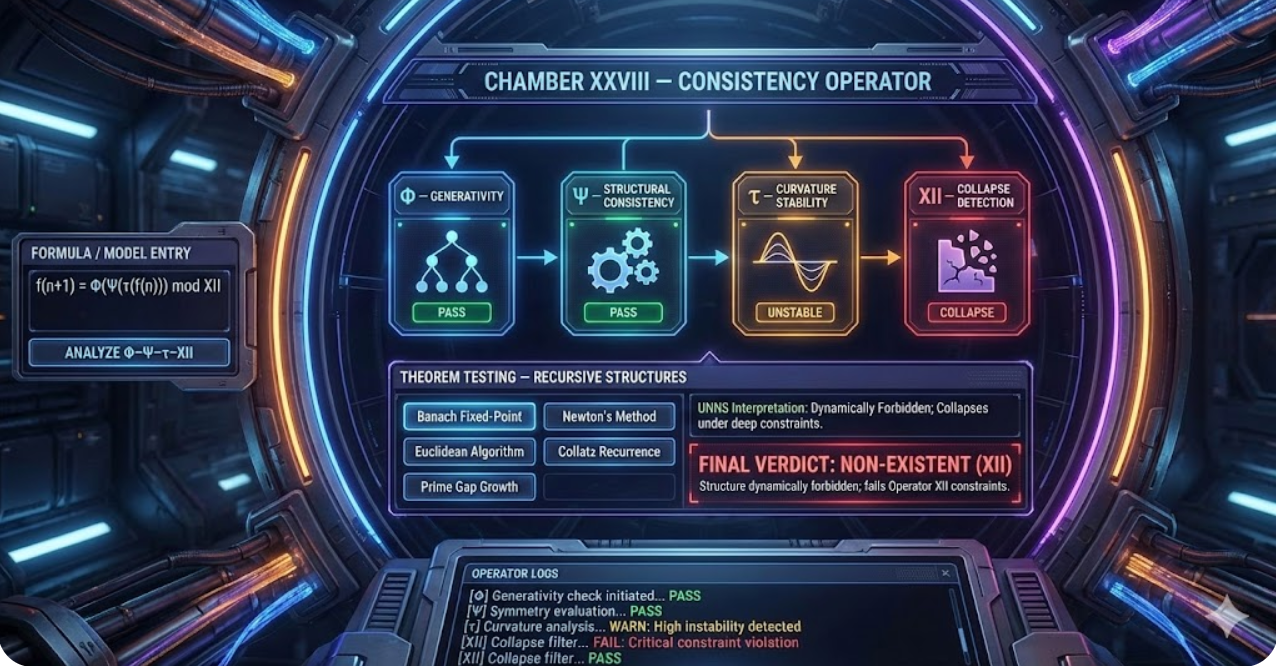
Chamber XXVIII is the first UNNS laboratory built to answer a single question: “Can this structure exist in the UNNS Substrate?”
Unlike earlier Chambers, which focus on specific constants, fields, or τ-dynamics, Chamber XXVIII works one level higher. It accepts a formula, recursion, or simple model, and runs it through the full Φ–Ψ–τ–XII operator chain, treating the formula as a candidate universe inside the Substrate.
Stability • τ-Curvature • Recursive Ordering • Relativistic Disagreement • Real-Data Overlays
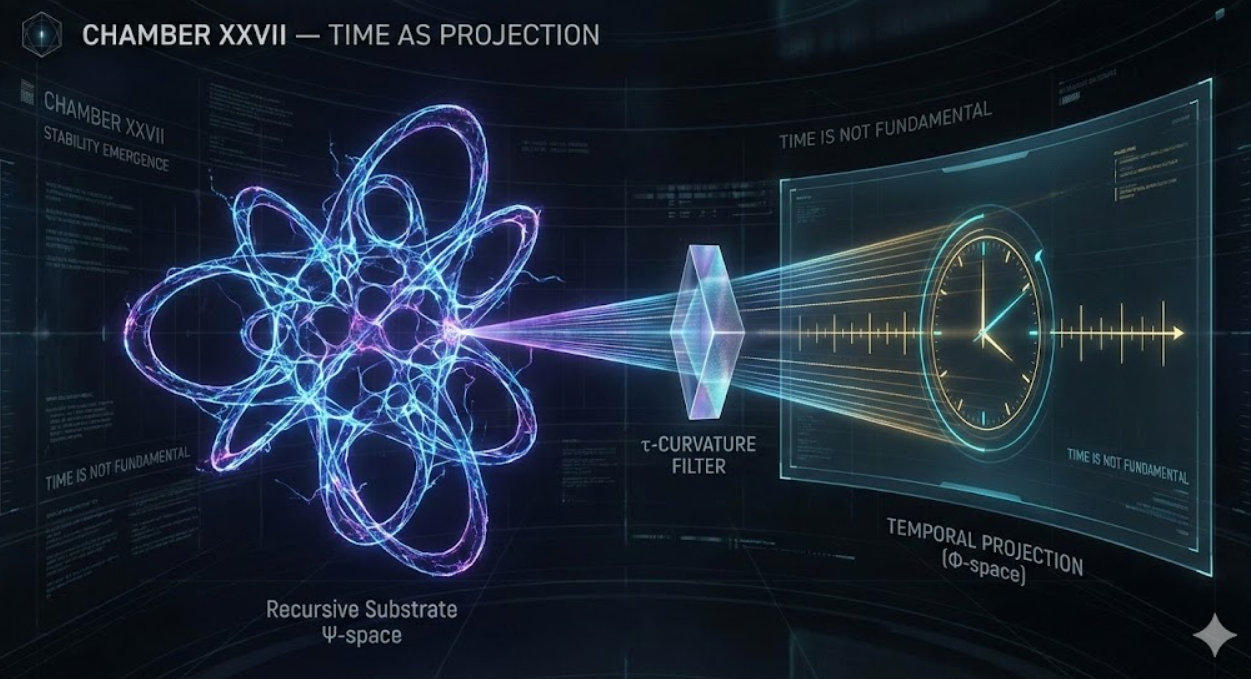
Time, in the UNNS Substrate, is not a dimension. It is not a container in which events unfold. It is not a coordinate written into the substrate.
Instead:
Time is a projection — a visible ordering that appears when recursive structures in Ψ-space
are interpreted through τ-curvature into Φ-space.
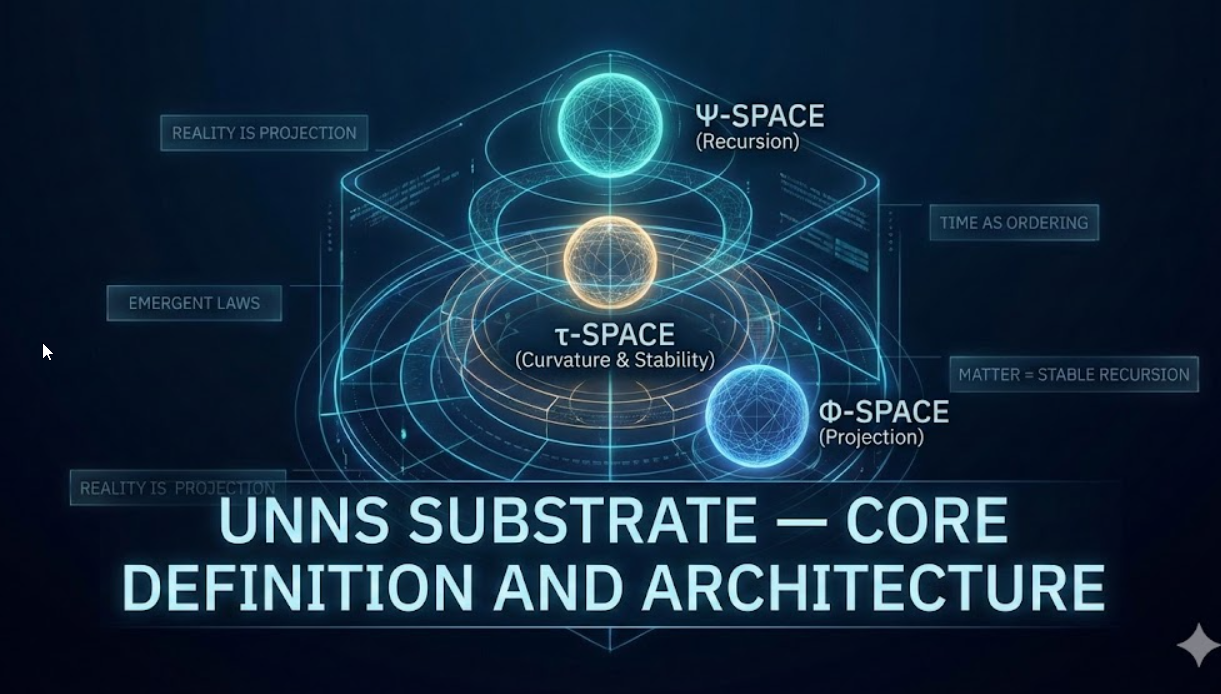
This document provides the official definition of the UNNS Substrate, its structure, its projection mechanics, and its foundational role within the UNNS framework. It supersedes all informal descriptions and should be treated as the canonical reference for researchers, developers, and contributors within the UNNS ecosystem.
Contextual Reading:
Read more: The Recursive Substrate: Core Definition and Tri‑Layer Architecture
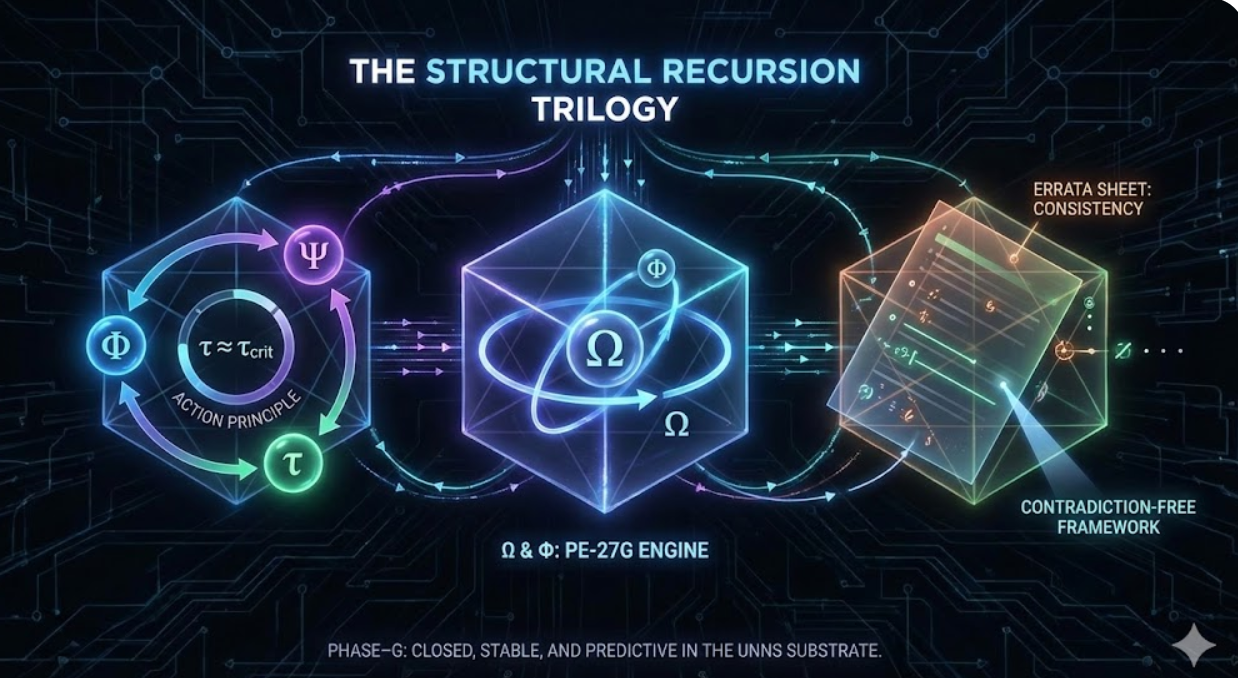
This article introduces three foundational UNNS Substrate papers that together define the Phase–G structural recursion framework: the closure operator Ω, the nonlinear manifold Φ, and the Φ–Ψ–τ action principle. They are presented here as a single trilogy that turns UNNS from an experimental lab engine into a coherent mathematical discipline.
Read more: Ω, Φ, and Φ–Ψ–τ: Foundations of UNNS Structural Recursion
Page 23 of 39