
Irreducible closure mechanisms · τ-closure · Classification, not discovery
The paper Primary τ-Invariants in the UNNS Substrate (Closure, Relaxation, and Projection as Irreducible Structural Principles) proves a classification theorem about τ-closure. It does not enumerate constants, and it does not rely on numerical coincidence.
Instead, it establishes that exactly three irreducible closure mechanisms exist in the UNNS Substrate — mechanisms that remain invariant under arbitrary Φ-refinement and satisfy τ-closure.
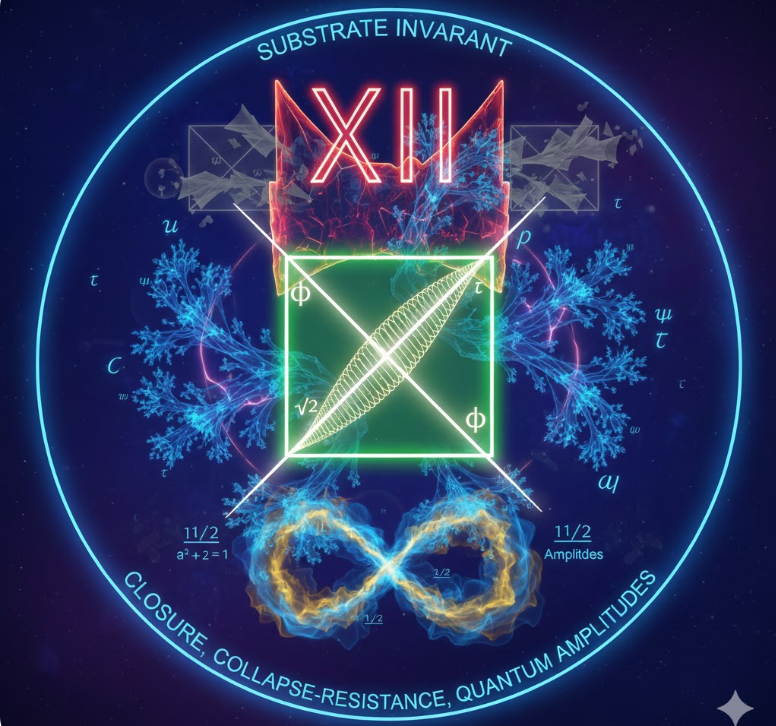
In the UNNS Substrate, √2 is not a “mystical infinity.” It is the first stable signal that geometric closure (τ) cannot be reduced to finite discrete generators (Φ) without recursion. That same signal reappears—almost verbatim—as the normalization backbone of quantum amplitudes.

This page presents the reference paper and the accompanying instrumentation dashboard. Together they formalize a strict UNNS claim: collapse is autonomous and acts as a pre-regularity principle—stability and universality appear prior to geometry, smoothness, or any PDE-based regularity story.
Much of modern mathematics and physics begins after regularity has already been assumed: smooth spaces, well-behaved equations, stable limits. When irregularity appears, it is treated as an exception to be repaired. The UNNS Substrate asks a more primitive question: why does regularity appear at all?
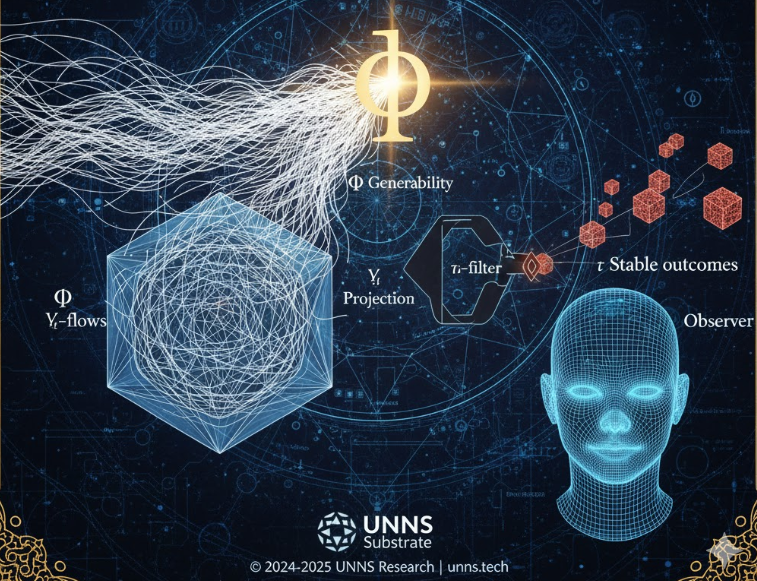
Substrate Ontology · Φ–Ψ–τ Clarification · Structural Testability
The observer debate in quantum foundations often collapses into a false binary: either observers "create" reality, or reality exists in a fully classical sense without any dependence on interaction. The UNNS Substrate offers a third position: reality exists independently of minds, while still being filtered into persistence by stabilization mechanisms that are physical, not psychological.
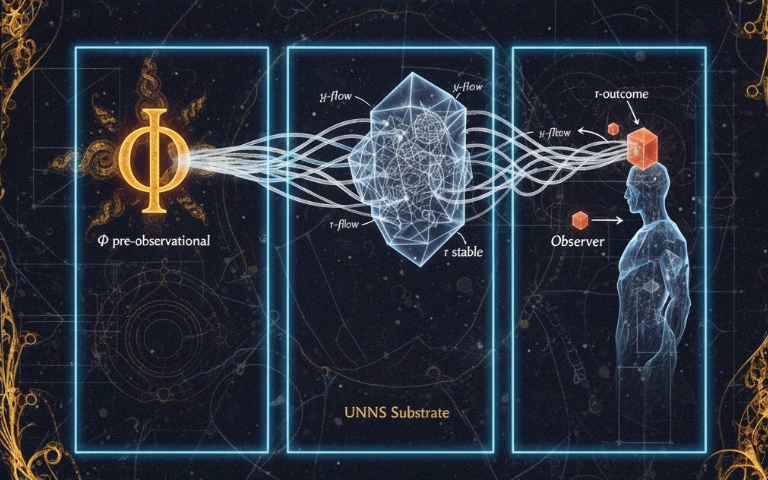
A UNNS Substrate Response to "Reality Exists Without Observers? Boooo!" (Nautilus)
A recent Nautilus article correctly dismantles popular myths about observers, consciousness, and quantum measurement. It rejects the idea that minds create reality, while also showing that attempts to banish observers entirely undermine empirical science.
Page 20 of 39