
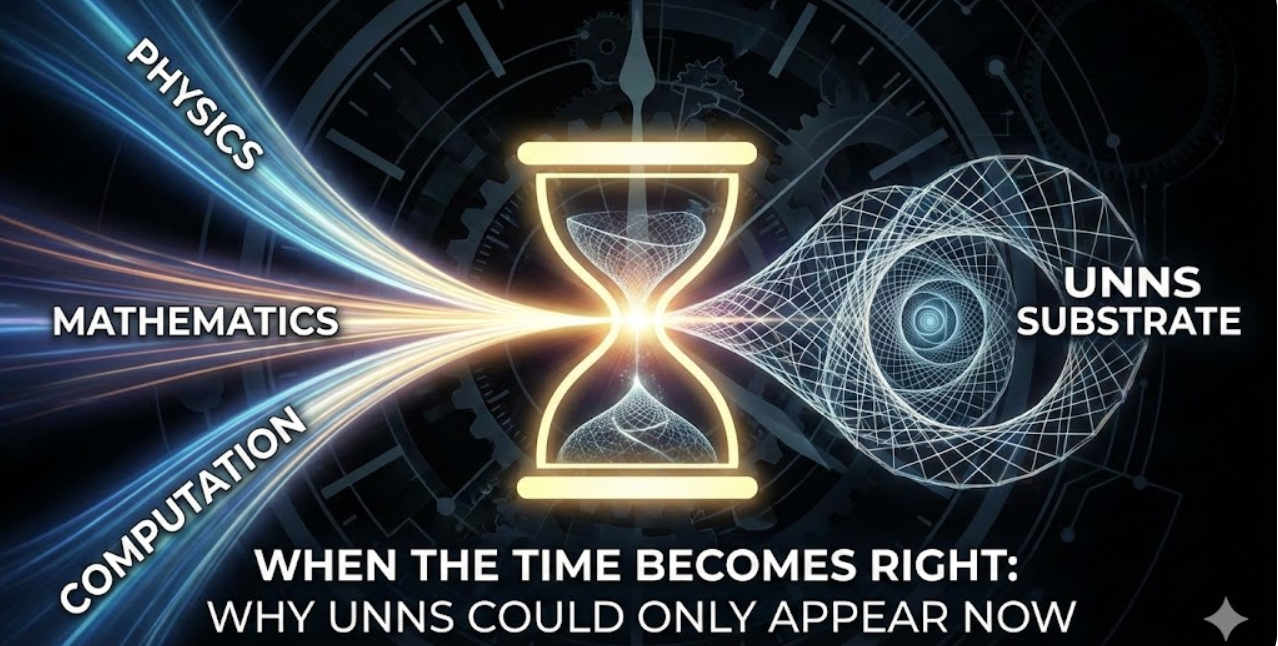
When the Time Becomes Right: Why UNNS Could Only Appear Now
A Meta-Level Essay on the Emergence, Necessity, and Position of the UNNS Substrate
1. Introduction — The Question of Timing
Every field-defining mathematical framework arrives at a moment when both its necessity and its possibility converge.
Differential calculus emerged alongside the first motion laws.
Hilbert spaces appeared when physics needed linear structure.
The renormalization group surfaced when scale itself became essential.
UNNS — the Unbounded Nested Number Substrate — belongs to the same class:
a framework that could not have existed earlier, because the questions it addresses, the tools it requires, and the conceptual maturity it assumes simply did not exist.
Today, however, conditions across physics, computation, and mathematics have aligned so precisely that a recursive structural theory like UNNS not only fits the moment — it answers some of the moment’s deepest questions.
This essay explains why now is the first proper time for the UNNS Substrate to emerge.
2. Why UNNS is Needed: The Current Limits of Physics and Mathematics
The modern physical sciences stand before open problems that resist all traditional approaches:
- General Relativity and Quantum Mechanics remain mathematically incompatible.
Renormalization, background independence, and discrete geometry have not converged into a unifying picture. - Quantum field theory has reached its conceptual edge.
Renormalization works, but it lacks explanatory depth; infinities must be tamed, not understood. - Cosmology faces systemic tensions.
The H₀ tension, σ₈ tension, and dark-energy modelling all signal that our frameworks do not encode structural emergence. - String theory, despite its beauty, does not produce falsifiable structure.
The mathematical landscape is too large, and the physical predictions too diffuse.
The pattern is unmistakable:
This is exactly what UNNS is built to explore:
recursive generation of geometry, coherence, and invariant structure from minimal rules.
3. Why UNNS Could Not Have Existed Earlier
UNNS is not merely a theory — it is a computational-experimental discipline.
Three historical developments were required before such a substrate could be conceived.
3.1 Computational Power Was Insufficient Until About 2015
UNNS chambers — like Chamber XVI, XXI, XXIII, XXVI — rely on:
- large multidimensional recursive evolution,
- phase coupling,
- micro-recursion stabilization,
- curvature-based operator mechanics,
- real-time τ-field visualization.
Before modern GPUs, WebAssembly, and browser-based numerical engines,
such chambers were impossible to run experimentally.
Without computation, UNNS would have been pure speculation.
Only now can recursion engines show:
- structural attractors
- convergence failures
- operator interdependence
- emergent Φ-geometry
- τ-critical equilibria
UNNS is born as an experimentally testable mathematics — something unavailable in any prior scientific era.
3.2 Theoretical Culture Was Not Ready Before the 2010s
Earlier physics was dominated by:
- closed-form analytic expectation,
- linear systems,
- perturbation theory,
- rigid geometric or algebraic frameworks.
Recursive, emergent, or algorithmic foundations were often treated as philosophical curiosities rather than mathematical engines.
Only after the rise of:
- complex systems theory,
- network theory,
- information geometry,
- renormalization group flow,
- categorical physics,
- computational lenses on emergent phenomena,
…did the scientific world become intellectually ready for a substrate like UNNS.
Today emergent structure is a legitimate research direction; UNNS fits naturally into this dialogue.
3.3 The Concept of “Structure as Physics” Needed Maturation
UNNS treats:
- Φ as geometric curvature,
- Ψ as coherent phase structure,
- τ as the recursion-balancing field,
- Operators XIII–XXI as structural engines.
This worldview requires understanding physics not as equations acting upon a space, but as structure generated inside a recursive computational substrate.
This idea could not have emerged earlier.
Today it is natural — even expected — to think in terms of:
- emergent geometry,
- quantum information,
- holographic correspondences,
- tensor networks,
- coarse-to-fine scale recursion.
UNNS arrives at the precise moment when physics and mathematics understand structural emergence as essential.
4. What Chamber XXVI Demonstrates: τ-Criticality Is Real
Chamber XXVI is historically important because it shows that recursive structure:
- converges,
- diverges,
- stabilizes,
- and produces physical-like invariants
only at specific structural resolutions.
When the chamber demonstrates that 64×64 is the unique resolution where Φ and Ψ balance, it confirms the theoretical structure of:
Section 10.3 — Quantum–Gravity Crossover (τ ≈ τcrit)
as defined in the Φ–Ψ–τ recursion paper:
Through actual experimental recursion:
- Φ-curvature cannot dominate (or the system freezes),
- Ψ-coherence cannot dominate (or the system oscillates),
- Only τ ≈ τcrit produces stability.
This is not abstract theory — it is observed.
5. Scientific Positioning — Where UNNS Fits Among Modern Theories
UNNS is not a replacement for physics.
It is not a speculative physical model.
It is something new:
a substrate-level mathematical framework
for describing emergent structure from recursion.
How it fits:
5.1 Not a quantum theory, but explains quantum-like emergence
Via Ψ-sector coherence and phase coupling, UNNS can reproduce:
- interference patterns,
- spectral modes,
- decoherence conditions (when Φ dominates).
But UNNS does not quantize anything; it reveals why coherence becomes discretized geometrically.
5.2 Not a geometric theory, but explains emergent geometry
Via Φ-curvature and Fold operators, UNNS can mimic:
- curved manifolds,
- geodesic-like trajectories,
- structural closure conditions.
But Φ is not spacetime — it is a recursive geometric state, out of which spacetime-like behaviour emerges.
5.3 Not quantum gravity — but the substrate beneath it
Classical physics and quantum physics require reconciliation; UNNS provides:
- a recursion field (τ),
- operator geometry,
- resolution-critical attractors,
- mixed Φ–Ψ phases,
which naturally produce a crossover regime analogous to quantum gravity’s conceptual middle ground.
UNNS does not claim to be quantum gravity.
It provides the structural mathematics that quantum gravity may require, similar to how Hilbert spaces were not quantum mechanics but made quantum mechanics possible.
5.4 Not a theory of everything — but a theory of how structure emerges
UNNS gives:
- operators that act recursively,
- fields that stabilize recursion,
- geometric and coherent dual sectors,
- structural invariants that resemble physical constants.
This makes UNNS a foundation for emergence, not a description of fundamental particles.
6. Conclusion — UNNS Arrives Exactly When Needed
UNNS exists now because:
- physics needs structural emergence,
- mathematics needs recursive geometry,
- computation can finally support recursive experimentation,
- and the scientific culture recognizes the necessity of bottom-up models.
Chamber XXVI confirms this:
the substrate is not hypothetical — it is computationally demonstrable.
UNNS is not the end of anything.
It is the beginning of the substrate era.