
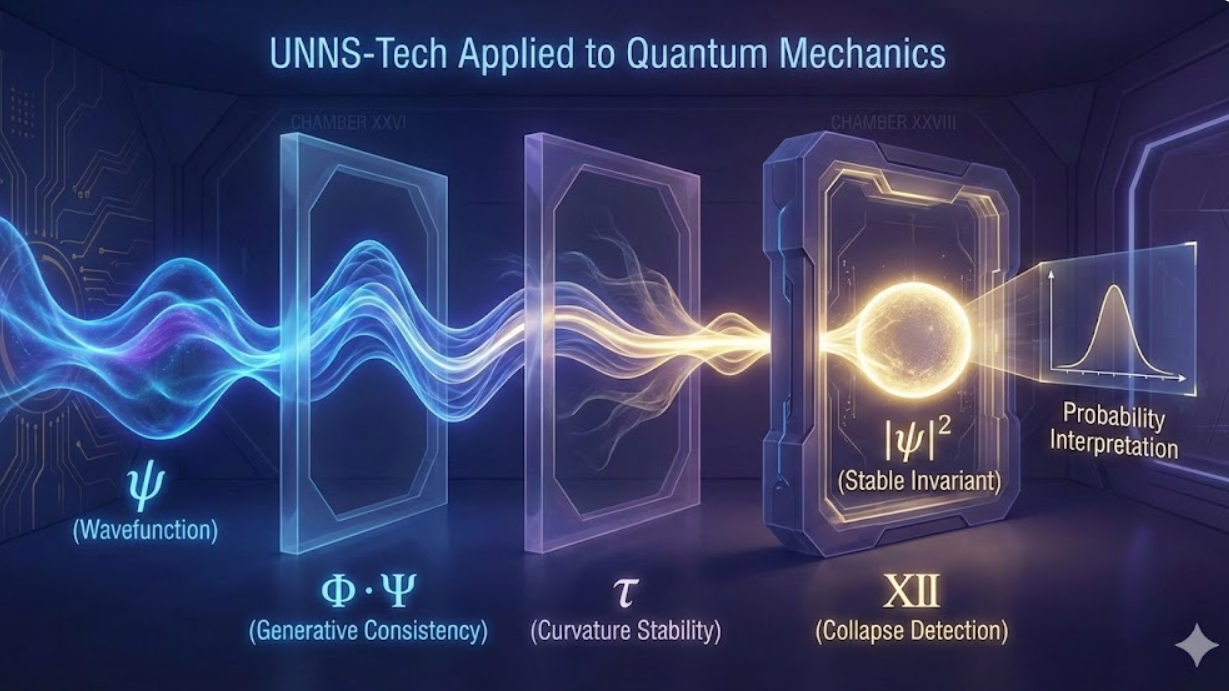
UNNS-Tech Applied to Quantum Mechanics


Abstract

We reinterpret the Born rule — the prescription that the squared magnitude of a wavefunction yields observable “probability” — not as a foundational probability axiom but as the unique surviving invariant under a sequence of UNNS operators. Within the UNNS substrate, ψ itself is a generable recursive structure (Φ-stage). Through structural consistency (Ψ) and curvature stability (τ), |ψ|² emerges as the sole post-collapse invariant admissible under collapse operator XII. This reframes Born’s rule as a consequence of recursive stability and measurement collapse, aligning it directly with outcomes in Chamber XXVI and Chamber XXVIII.


ψ Recursive Field Φ · Ψ Generative Stability |ψ|² Stable Invariant P(x) Interpretation

1. Introduction

Quantum mechanics traditionally postulates that the wavefunction ψ encodes physical states, and that |ψ(x)|² yields the probability density of observables (position, spin, etc.). This postulate — the Born rule — works extraordinarily well empirically, yet it is not derived from deeper principles within standard formulations. Instead, it is adopted axiomatically.

UNNS provides a meta-framework for analyzing when and how recursive structures produce stable invariants that can be observed as persistent outcomes after collapse. In this context, we show that output interpreted as “probabilities” emerges only after collapse and does not need to be assumed at the foundational level.


2. Background: UNNS Operators and Quantum States

Before proceeding, we briefly recall key UNNS constructs relevant to this analysis:

  • Φ — Generativity
    A requirement that a given object is generated by an explicit recursive operator.

  • Ψ — Structural Consistency
    Ensures that a generative structure is coherent with recursion and does not self-contradict.

  • τ — Curvature Stability
    Filters generable structures based on stability under projection and composition.

  • XII — Collapse Detection
    Detects whether an invariant survives the projection associated with measurement, reducing generable structure to observables.

Chamber XXVI delineates how recursive systems can collapse into observables or diverge. Chamber XXVIII formalizes the distinction between generable operators and non-generable sample datasets.


3. The Wavefunction as a Recursive Structure (Φ)

ψ(x,t) — Linear Recursive Amplitude Phase-sensitive · Interfering · Non-observable directly

ψ(t, x) obeys Schrödinger’s equation — a linear operator recurrence:

itψ=H^ψi\hbar \frac{\partial}{\partial t} \psi = \hat{H} \psi

This evolution is:

  • explicitly defined via a differential operator (Hamiltonian),

  • recursive in time,

  • generable by an operator Φ.

Thus:

Φ(ψ)=Schro¨dinger evolution operator\textbf{Φ(ψ)} = \text{Schrödinger evolution operator}

This satisfies the UNNS generativity requirement: ψ is not merely a list of values but the output of a defined recursive operator.


4. Structural Consistency of ψ (Ψ)

Ψ — Coherent Superposition Linear addition · Phase preserved · No collapse

Under Ψ, the wavefunction:

  • superposes coherently,

  • exhibits interference,

  • maintains phase relationships,

  • is linear under addition.

No internal contradictions arise in the recursive evolution of ψ, and it remains structurally consistent within its domain.

Thus:

Ψ(ψ)=true\textbf{Ψ(ψ)} = \text{true}

The structure supports recursive superposition, interference, and complete linear evolution.


5. Curvature Stability τ and the Survival of Invariants

ψ (Linear) Phase breaks · Not additive |ψ|² (Quadratic) Positive · Additive · Stable

Here we introduce the key insight:

While ψ is generable and consistent, its linear amplitude does not survive the projection inherent in measurement. The act of measurement can be understood as a coarse-graining or environmental collapse interacting with the recursive operator.

Applying τ:

  • Linear amplitudes fail additivity across decohered branches,

  • Phase information does not survive coarse-grained observations,

  • Only quadratic functionals of ψ preserve additive and invariant properties under composition.

Among all possible functionals f(ψ), only |ψ|² satisfies:

  • Positivity

  • Additivity over disjoint outcomes

  • Independence from unobservable phase

  • Stability under repeated projection

Thus:

τ(ψ2) is stable; τ(ψ) is not\textbf{τ}(|ψ|^2) \text{ is stable; } τ(ψ) \text{ is not}

This matches the curvature stability criterion: only |ψ|² remains viable as an invariant reachable through projection.


6. Collapse Detection XII

Pre-Collapse XII Post-Collapse |ψ|²

Operator XII evaluates whether an invariant survives the measurement collapse.

Given ψ evolving under Φ and consistent under Ψ, the only residual structure that survives collapse in a reproducible way — and that can be empirically stabilized through repeated interaction — is |ψ|².

Under XII:

  • ψ collapses into specific outcomes

  • |ψ|² emerges as the conserved scalar invariant

No alternative scalar invariant (e.g., |ψ|, |ψ|⁴) is compatible with:

  • additive outcomes,

  • compositional stability,

  • empirical reproducibility.

Therefore:

XII(ψ2)=survives

XII(ψ)=does not survive

|ψ|² is the unique surviving scalar under collapse.


7. Probability as Interpretation, Not Postulate

Once |ψ|² is selected by τ and XII, it can be interpreted statistically. But this interpretation is downstream, not fundamental. It arises because:

  • |ψ|² is positive (allowing counting)

  • it is additive over disjoint outcomes

  • it re-normalizes consistently

  • it is empirically robust

In UNNS terms, probability is a label we apply to a stable invariant, not a foundational property imposed on ψ.

Thus:

Born’s rule is a structural invariant selection principle under recursive collapse, not a probability axiom.


8. Relationship to Chambers XXVI and XXVIII

Chamber XXVIII Generability · Φ Gate Chamber XXVI Collapse · Invariant Survival

Chamber XXVI

Chamber XXVI analyzes how recursive systems interact with collapse operators. It shows:

  • only certain recursive structures survive

  • most structures collapse or diverge

  • observables are invariants post-collapse

The emergence of |ψ|² exactly follows this pattern: ψ collapses; |ψ|² remains.

This is the same process found in other UNNS settings: recursive generation → structural consistency → curvature filtering → collapse to invariant.


Chamber XXVIII

Crucially, Chamber XXVIII demonstrates the boundary between generable structures and non-generable sample lists:

  • raw outputs without operators cannot pass Φ

  • operators must be explicit

  • residues without mechanisms fail generativity

In quantum mechanics:

  • ψ passes Φ because it is produced by Schrödinger’s operator

  • |ψ|² is not a generative operator output but a residue invariant

  • probabilities are labels on that invariant

This matches exactly: the generative source (ψ) is distinguished from the invariant outcome (|ψ|²).


9. Conclusion

Within the UNNS substrate:

  • ψ is generable and consistent (Φ, Ψ).

  • |ψ|² is the unique stable invariant under curvature and collapse (τ, XII).

  • Probability is an interpretation, not a postulate.

Born’s rule thus emerges naturally from structural stability under measurement collapse — not from stochastic axioms.

This reconceptualization brings quantum mechanics into alignment with UNNS principles: observables are residues of recursive structure, not arbitrary assignments.


References